
Why product teams need agility for faster innovation in 2026
Why product teams need agility for faster innovation in 2026

Despite widespread adoption of agile frameworks, only 12% of organizations are born agile. This startling gap reveals a critical misunderstanding: true agility isn’t about following frameworks or attending standups. It’s about adaptability, creativity, and rapid learning that transform how product teams innovate and deliver value. This guide explains why agility is essential for product success and how to implement it effectively in your team.
Table of Contents
Key takeaways
PointDetailsAgility drives competitive advantageTeams that embrace adaptability and continuous learning outperform rigid processes in volatile markets.Cross-functional collaboration accelerates deliveryIntegrated expertise reduces decision time by 35% and improves pivot success by 22%.Smaller teams boost throughputMicro teams eliminate bottlenecks and increase morale compared to traditional large team structures.Common misconceptions block progressTreating agility as a checklist or rigid process prevents teams from achieving true adaptability.Culture trumps frameworksLeadership commitment and psychological safety enable sustainable agility beyond any methodology.
Introduction: defining agility in product teams
Agility means more than sprints and ceremonies. It represents your team’s capacity to adapt quickly, respond to changing market conditions, and learn continuously from customers and experiments. While the Scrum Alliance 2025 annual report traces agility’s evolution from rigid frameworks to broader principles, the core remains constant: flexibility in the face of uncertainty.
Product teams operate in VUCA environments: volatile customer preferences, uncertain market conditions, complex technical landscapes, and ambiguous competitive threats. Traditional planning cycles become obsolete before completion. Your roadmap changes weekly. Customer feedback contradicts your assumptions.
This volatility makes agility non-negotiable. Teams need structures that enable fast pivots without complete reorganization. They require decision-making processes that incorporate new information daily. Most importantly, they need a mindset that views change as opportunity rather than disruption.
True agility transcends methodology. It’s not about perfect adherence to Scrum or Kanban. It’s about building teams that can sense shifts early, make decisions rapidly, and adjust course without friction. When your team embodies this adaptability, innovation accelerates naturally because you’re not fighting your process to respond to reality.
Why agility matters in product teams
Organizational agility contributes strongly to business performance in volatile conditions. Research shows agile teams consistently outperform rigid counterparts in innovation speed, customer satisfaction, and market responsiveness. The connection isn’t coincidental.
Agility directly impacts your bottom line through three mechanisms:
Faster time to market allows you to capture opportunities before competitors
Reduced waste from building wrong features saves resources for value-creating work
Higher customer satisfaction from responsive iterations builds loyalty and reduces churn
Beyond metrics, agility equips teams to learn continuously and respond creatively, transforming both people and organizations. When your team can experiment safely, fail fast, and incorporate learnings immediately, innovation becomes systematic rather than accidental.
“Agility is the bridge between strategy and execution. Without it, even brilliant product visions remain unrealized because teams can’t adapt fast enough to execute in changing conditions.”
The competitive landscape in 2026 punishes rigidity. Markets shift overnight. Technologies emerge rapidly. Customer expectations evolve constantly. Your ability to sense these changes and respond defines whether you lead or follow. Agile product teams don’t just react faster; they anticipate better because their processes encourage continuous environmental scanning and rapid hypothesis testing.
Strategic necessity drives agility adoption. It’s no longer a nice-to-have capability or a trendy framework. It’s the fundamental operating system for product teams that want to remain relevant as markets accelerate and uncertainty becomes the only constant.
Cross-functional collaboration as an agility driver
Cross-functional intelligence integrates diverse expertise to accelerate decision-making and innovation. Instead of sequential handoffs between specialists, cross-functional teams reduce decision latency by 35% and increase product pivot success by 22%. This isn’t about co-location; it’s about cognitive diversity working in real-time.
Swarm teams exemplify this approach. When a critical product decision emerges, the right mix of engineering, design, analytics, and business expertise converges immediately. No waiting for meetings. No multi-day approval cycles. The team assesses options, makes decisions, and executes within hours instead of weeks.
Collaboration ModelDecision SpeedPivot Success RateInnovation OutputSiloed Specialists7-10 days45%BaselineCross-Functional Teams2-3 days67%2.3x higherSwarm IntelligenceSame day78%3.1x higher
Adaptive governance enables this speed. Traditional approval hierarchies create bottlenecks. Cross-functional teams need authority to make decisions at the point of maximum information. This requires clear boundaries: what decisions can teams make autonomously versus what requires escalation?
Pro Tip: Map decision types to authority levels. Customer experience tweaks? Team decides. Major feature pivots? Quick stakeholder sync. Strategic direction changes? Leadership involved. This clarity removes friction without abandoning oversight.
The magic happens when engineers understand customer pain directly, designers grasp technical constraints immediately, and product managers see data in real-time. Hiring cross-functional talent who can bridge these domains amplifies this effect. A designer who codes or an engineer who understands business metrics becomes a collaboration multiplier.
Team structure and agility optimization
Team size profoundly impacts agility. Smaller micro teams outperform larger teams by reducing communication overhead, eliminating bottlenecks, and improving morale. The difference isn’t marginal; it’s transformational.

Team SizeCommunication PathsDecision SpeedThroughputTeam Morale3-5 people6-10 connections1-2 daysHighExcellent8-10 people28-45 connections4-7 daysMediumGood12+ people66+ connections10+ daysLowVariable
Micro teams excel because every member understands the full context. No information silos exist. Everyone knows what others are working on. When problems arise, solutions emerge organically from the team rather than through formal coordination mechanisms.
The trade-offs deserve consideration:
Micro teams sacrifice deep specialization for speed and flexibility
They work best for focused product areas or features rather than enterprise platforms
Complex products may need multiple coordinated micro teams rather than one large team
Hiring becomes more critical because each team member carries greater responsibility
Your optimal structure depends on product complexity and organizational culture. Simple products with clear scope thrive with 3-5 person teams. Complex platforms might need 4-5 micro teams with lightweight coordination. The key is keeping individual teams small while scaling through federation rather than expansion.
Pro Tip: Start with the smallest team that can deliver value end-to-end. Add people only when bottlenecks prove persistent. Most teams add members too quickly, sacrificing agility for perceived capacity. Building agile teams requires discipline to stay lean even under delivery pressure.
Challenges and misconceptions about agility
Three major misconceptions sabotage agility efforts:
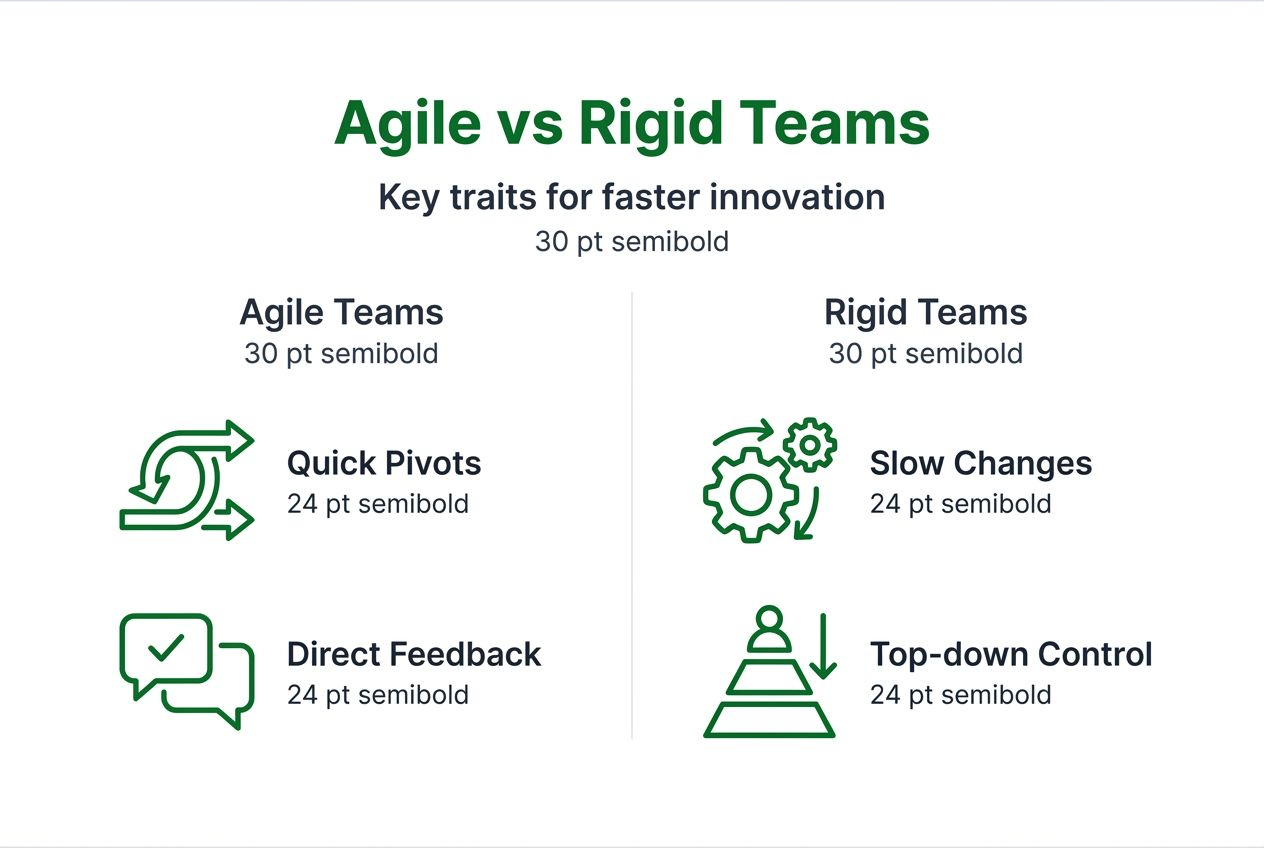
Agility equals process adherence: Teams mistake following Scrum ceremonies for being agile. They attend daily standups religiously while remaining inflexible to changing requirements. True agility prioritizes behaviors and rapid learning over ritual completion. If your retrospectives never change how you work, you’re performing agility theater.
Bigger teams move faster: Leaders assume more people equals more output. The opposite proves true. Only 12% of organizations achieve born agile status partly because they scale teams before processes. Communication overhead grows exponentially while individual accountability diminishes. Smaller, empowered teams consistently outperform bloated squads.
Frameworks guarantee success: Adopting Scrum, SAFe, or LeSS doesn’t automatically make teams agile. Frameworks provide scaffolding, not solutions. Teams that rigidly follow frameworks without adapting to their context miss the point entirely. Agility means choosing the right practices for your situation, not checking boxes on a methodology.
The deeper challenge is cultural. Agility requires psychological safety where team members can challenge assumptions, admit mistakes, and experiment without fear. Hierarchical organizations that punish failure create risk-averse teams that avoid the experimentation agility demands.
Leaders often request agility while maintaining control structures that prevent it. They want teams to move fast but require three approval layers for decisions. They praise innovation while penalizing failed experiments. This contradiction creates cynicism and performative agility rather than real adaptability.
Agility is a behavioral and cultural journey, not a process implementation. It requires examining power dynamics, decision rights, and organizational habits that may have worked for decades but now constrain responsiveness. Many companies find changing culture harder than changing processes, which explains why agility misconceptions persist despite widespread framework adoption.
Case studies of agile product teams
Netflix exemplifies continuous adaptation at scale. Their famous pivot from DVD rentals to streaming didn’t happen overnight. It emerged from a culture that constantly questioned assumptions and ran experiments. When streaming technology matured, Netflix had already built the organizational agility to execute a complete business model transformation. Their continued evolution into content production shows agility as an ongoing capability, not a one-time change.
Key practices from Netflix’s approach:
Freedom and responsibility culture that trusts teams to make decisions
Continuous experimentation mindset where every feature is a hypothesis
Willingness to cannibalize existing revenue for future opportunities
Direct customer feedback integration into product decisions
Apple demonstrates iterative innovation through their product development philosophy. Each iPhone generation incorporates learnings from the previous version plus emerging technologies. They don’t wait for perfect; they ship, learn, and improve. Their ability to rapidly integrate customer feedback while maintaining a cohesive product vision shows how agility and strategy coexist.
The pattern across successful agile teams:
Customer obsession drives decisions over internal politics
Data informs choices but doesn’t replace judgment
Small, empowered teams own outcomes end-to-end
Leadership removes obstacles rather than dictating solutions
These companies didn’t achieve agility through framework adoption. They built cultures where adaptability became natural. Teams expect change. Processes facilitate rather than constrain response. Leadership models the behaviors they want to see.
Refining agile practices for true agility
Moving beyond frameworks starts with shifting focus from process compliance to customer value. Ask whether each practice directly improves your ability to deliver value or learn from customers. If a ceremony exists because the framework prescribes it, question its utility.
Trends toward simplicity and customer value with lightweight daily practices replace heavy framework implementations. Modern agile teams embrace:
Daily team syncs focused on blockers and decisions, not status reports
Continuous deployment enabling multiple releases per day
Real-time customer feedback integrated into development workflow
Outcome-based planning that defines success metrics over feature lists
Regular reflection built into daily work rather than scheduled retrospectives
The goal is making agile practices invisible. They should feel like natural ways of working rather than imposed processes. When teams stop distinguishing between “doing agile” and “doing work,” you’ve achieved integration.
Pro Tip: Empower teams to modify practices based on what works. The best process for your team emerges from experimentation, not from copying others. Give teams authority to change their ways of working as long as outcomes remain strong. This meta-agility about your agile practices demonstrates true organizational flexibility.
Leadership plays a critical enabling role. Leaders must model agile behaviors: admitting uncertainty, changing course based on new information, and celebrating intelligent failures. When leaders demand agility but demonstrate rigidity, teams receive contradictory messages that undermine change.
Finding agile talent who can operate in this environment becomes essential. Look for people who thrive in ambiguity, take ownership naturally, and balance speed with quality. Skills matter less than mindset when building truly agile teams.
Consider how Fuerza’s approach to staffing enables agility. Pre-vetted experts who can integrate quickly let you scale teams without sacrificing quality. Flexible arrangements support the team size optimization discussed earlier. Agile staffing practices mirror the adaptability you want in your product teams.
Accelerate your agile transformation with expert talent
Building agile product teams requires more than process changes. You need people who understand how to work in adaptive, collaborative environments from day one.
Fuerza connects you with pre-vetted AI and technology experts who bring agile experience to your team immediately. Our AI-powered matching ensures you find professionals who fit your culture, understand your domain, and can contribute without lengthy onboarding. Whether you need full-time team members, contractors for specific initiatives, or flexible resources to scale rapidly, our nearshore and onshore talent pool provides the expertise you need.
Agility demands the right people working in the right structures. We help you build teams optimized for speed and innovation. Explore our staffing solutions to see how we support product teams at enterprises and startups across the US. Ready to transform your team’s agility? Join our waitlist to connect with talent that accelerates your innovation.
FAQ
What is the difference between agile frameworks and true agility?
Frameworks like Scrum provide structured processes and ceremonies for organizing work. True agility emphasizes adaptability, continuous learning, and customer focus over rigid process adherence. You can follow a framework perfectly yet remain inflexible to changing market conditions.
How can smaller micro teams improve product development speed?
Micro teams of 3-5 people reduce communication overhead from dozens to single-digit connections. This eliminates coordination bottlenecks and speeds decision-making from days to hours. Smaller teams also improve morale because each member has clearer ownership and greater impact visibility.
What are common mistakes to avoid when adopting agility?
Avoid treating agility as a rigid checklist of ceremonies to complete. Don’t assume larger teams move faster or that framework adoption guarantees results. Focus on building a culture of adaptability and psychological safety rather than perfect process compliance. Empower teams to make decisions instead of adding approval layers.
How do leadership and culture impact agile product teams?
Leadership commitment creates the psychological safety essential for experimentation and rapid learning. When leaders model agile behaviors like embracing uncertainty and learning from failure, teams feel safe taking calculated risks. Culture determines whether agility becomes genuine capability or performative theater that fades when pressure increases.