
What are on-demand teams? Guide for flexible hiring

Nearly every Fortune 500 company has experimented with on-demand talent platforms, yet most treat them as a last resort rather than a strategic asset. That gap between ad hoc use and strategic integration is exactly where competitive advantage gets lost. On-demand teams are not just a fancier term for freelancers or outsourcing. They are a distinct staffing model with specific mechanics, real deployment speed, and measurable impact on project delivery. This guide breaks down what on-demand teams are, how they work, how they compare to other models, and when they are the right call for your organization.
Table of Contents
- What is an on-demand team?
- How on-demand teams work: Steps and structure
- Comparing on-demand teams, freelancers, staff augmentation, and outsourcing
- When (and when not) to use on-demand teams: Benefits, risks, and best practices
- Advanced approaches: Hybrid, AI-powered, and the future of on-demand teams
- How to get started with on-demand teams
- Frequently asked questions
Key Takeaways
| Point | Details |
|---|---|
| Rapid deployment | On-demand teams can start in days, making them ideal for quick project turnarounds when speed matters. |
| Flexible scaling | Organizations can add or reduce team size as project needs change without long-term commitments. |
| Optimal for niche skills | Access to vetted, specialized talent is perfect for short-term initiatives and specialized roles. |
| Best used strategically | On-demand teams deliver best results when aligned with project surges, innovation pilots, and hybrid models. |
What is an on-demand team?
Before diving into the mechanics, it is critical to understand exactly what makes an on-demand team distinct in today’s hiring landscape.
An on-demand team is not a bench of contractors you call when things get busy. According to staffing specialists, on-demand teams are pre-assembled cross-functional groups of vetted specialists accessed rapidly via platforms or providers to address specific projects or capacity needs. They integrate as extensions of your internal team without long-term commitments. That last part matters. You get embedded expertise without the overhead of a permanent hire.
Here is what separates on-demand teams from everything else:
- Pre-vetted talent: Every specialist has been screened for skills, communication, and reliability before you ever meet them.
- Cross-functional by design: A single team can include a product manager, two engineers, a UX designer, and a QA specialist, ready to ship.
- Rapid deployment: Most providers can have a team embedded and productive within 1-2 weeks, compared to months for traditional in-house hiring.
- Embedded workflows: They work inside your tools, your processes, and your sprint cycles, not in a silo.
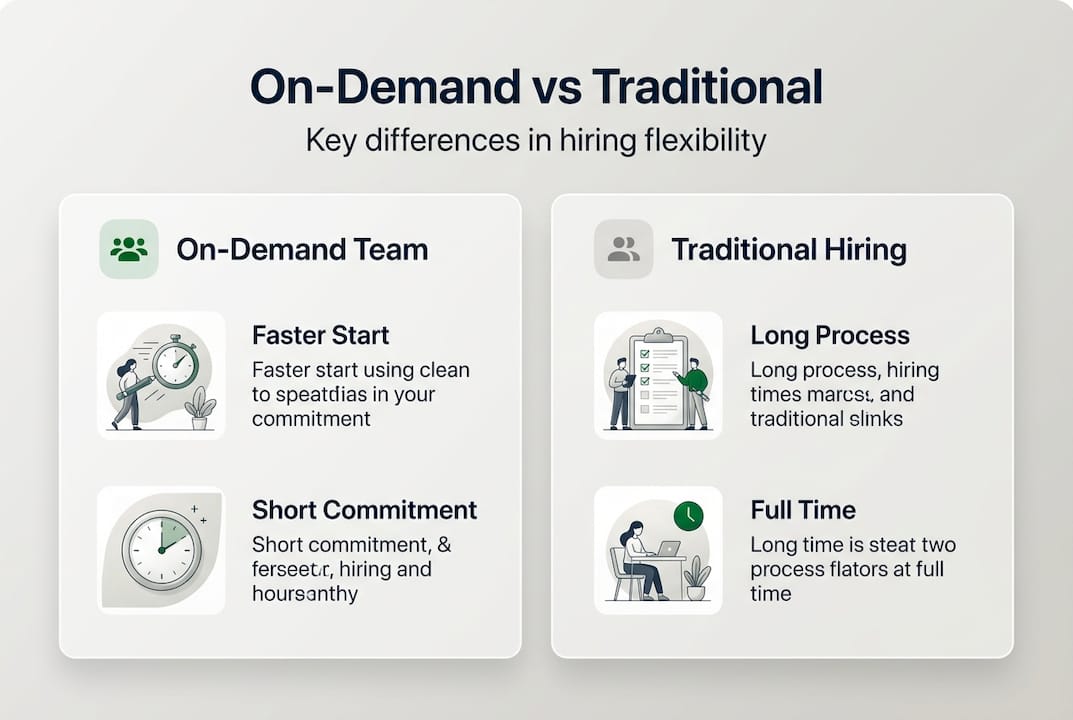
| Criteria | On-demand teams | Traditional hiring |
|---|---|---|
| Time to deploy | 1-2 weeks | 2-4 months |
| Commitment | Project-based | Long-term |
| Availability | Immediate | Delayed |
| Integration | Embedded in client workflows | Onboarded over time |
| Cost structure | Flexible, scalable | Fixed salary + benefits |
Typical use cases where on-demand teams deliver the most value include project surges that exceed internal capacity, technology pivots requiring skills your team does not currently have, and accessing niche expertise for a defined deliverable without building a permanent function around it.
How on-demand teams work: Steps and structure
With the definition in place, let’s explore exactly how on-demand teams are built, deployed, and embedded within organizations.
The engagement process follows a clear four-step structure. Mechanics include analyzing needs, curating and vetting talent, embedding into client processes, and scaling as required. Teams are often structured as managed or self-managing pods ranging from 2 to 12 people.
- Analyze the need: Define the project scope, required skills, timeline, and success metrics before any talent search begins.
- Curate and vet: The provider matches specialists from curated talent pools against your specific requirements, including technical skills, timezone, and cultural fit.
- Embed: The team joins your Slack channels, Jira boards, and sprint planning sessions. They operate as an extension of your internal team from day one.
- Scale: As project demands shift, you add or reduce team members without renegotiating a long-term contract.
| Step | Typical timeframe | Stakeholder involvement |
|---|---|---|
| Analyze need | 1-3 days | Hiring manager, project lead |
| Curate and vet | 3-7 days | Provider, technical lead |
| Embed | 1-3 days | Team lead, IT, operations |
| Scale | Ongoing | Hiring manager, provider |
Team formats vary. Product squads focus on end-to-end feature delivery. Specialist pods concentrate on a single function like data engineering or security. Managed teams come with a dedicated team lead, while self-managing pods require more direct oversight from your side.

Pro Tip: Prioritize providers who guarantee both cultural fit and timezone overlap. A brilliant engineer who is eight time zones away and misaligned with your team’s communication style will cost you more in coordination than they save in hourly rate. For US-based companies, nearshore talent from Latin America often hits the sweet spot on both dimensions. Learn more about embedding on-demand teams effectively before your first engagement.
Comparing on-demand teams, freelancers, staff augmentation, and outsourcing
Understanding how on-demand teams stack up against other popular hiring models will help you make the best staffing decision for your needs.
The staffing market uses these terms interchangeably, but they are not the same. On-demand hiring differs from contract staffing, freelancers, and outsourcing in deployment speed, team size, control, and project scope. Choosing the wrong model for your situation is one of the most common and expensive mistakes hiring managers make.
| Criteria | On-demand teams | Freelancers | Staff augmentation | Outsourcing |
|---|---|---|---|---|
| Cost | Mid-to-high | Low-to-mid | Mid | Variable |
| Coordination | Managed | High effort | Moderate | Low |
| Duration | Weeks to months | Days to weeks | Months to years | Long-term |
| Quality control | Provider-managed | Self-managed | Shared | Vendor-managed |
| Team size | 2-12 people | Individual | Individual or small | Large teams |
Team augmentation boosts velocity by 30-40% over baseline compared to managing individual freelancers, largely because coordination overhead drops when the team is pre-assembled and already working together.
Here is a quick guide on when to use each model:
- On-demand teams: You need a cross-functional group fast, for a defined project with a clear end date.
- Freelancers: You need one specific skill for a very short, well-scoped task.
- Staff augmentation: You need to extend your existing team with individual contributors over a longer period.
- Outsourcing: You want to hand off an entire function and focus on outcomes, not process.
Exploring professional staffing models side by side helps clarify which approach fits your current project stage and internal capacity.
When (and when not) to use on-demand teams: Benefits, risks, and best practices
Having evaluated the alternatives, pinpointing when to use and when to avoid on-demand teams ensures smooth project delivery and avoids costly missteps.
On-demand teams perform best in three scenarios: project surges where your internal team is at capacity, technology pilots where you need specialized skills for a defined sprint, and rapid skills access when building an internal function would take too long. They are not a universal solution.
Best for short-term niche expertise, on-demand teams carry real risks including integration challenges and management overhead that typically runs 15-25% above what you would spend managing a fully internal team. That overhead is manageable, but it must be planned for.
Red flags that suggest on-demand teams are not the right fit:
- The project involves core intellectual property that cannot be shared externally.
- Your internal manager has less than 20% of their time available to oversee the engagement.
- The work requires deep institutional knowledge that takes months to transfer.
- Your organization lacks the tooling or processes to integrate an external team smoothly.
- The project timeline is under two weeks, making onboarding impractical.
“On-demand team engagements fail when manager time drops below 20% availability. Hybrid models pairing external pods with in-house leads consistently outperform fully external arrangements.”
Pro Tip: Assign a dedicated internal point of contact for every on-demand team engagement. This person does not need to be technical, but they need authority to make decisions and enough bandwidth to unblock the team daily. Review integration best practices before kickoff to set the engagement up for success from the start.
Advanced approaches: Hybrid, AI-powered, and the future of on-demand teams
As the landscape evolves, new models and AI-driven platforms are revolutionizing how organizations assemble teams for strategic initiatives.
The most sophisticated organizations are moving beyond simple on-demand engagements toward hybrid and AI-enhanced models. Flash teams, AI-enhanced on-demand groups, are now assembling in minutes for precision projects, using algorithmic matching to identify the exact combination of skills, availability, and working styles needed for a specific deliverable.
Hybrid models pairing core in-house staff with flexible on-demand talent are proving optimal for strategic scaling. The core team holds institutional knowledge and long-term vision. The flex layer brings surge capacity and specialized skills exactly when needed, then scales back without layoffs or restructuring costs.
Key success factors for advanced and hybrid approaches:
- Continuity planning: Ensure knowledge transfer protocols are in place before the on-demand engagement ends.
- Timezone overlap: For US-based companies, nearshore talent in Latin America provides 4-8 hours of daily overlap with Eastern and Pacific time zones.
- Tool integration: Teams that plug directly into your existing stack from day one lose far less time to setup and context switching.
- Clear ownership: Define who owns decisions, who owns delivery, and who owns escalation before the first sprint begins.
The trajectory is clear. Major corporations and growth-stage startups alike are increasing adoption of flexible talent models. AI-enabled rapid team building is making it faster and more precise to match the right specialists to the right projects. Platform innovations in smart matching, compliance management, and performance tracking are removing the friction that once made on-demand teams feel risky.
How to get started with on-demand teams
Ready to leverage the power and flexibility of on-demand teams for your next project? Here is how to take the first step.
Fuerza connects US-based enterprises and startups with pre-vetted, AI-matched on-demand teams across engineering, product, design, and data. Every specialist in our network has been screened for technical skills, communication, and cultural fit before you ever see their profile. Deployment timelines start at 1-2 weeks, and our nearshore and onshore focus means your team works in your timezone, inside your tools, from day one.
Whether you need a two-person pod for a focused sprint or a full cross-functional squad for a multi-month initiative, our specialized on-demand team services are built to match your project scope and internal capacity. If speed is the priority, join the waitlist for immediate deployment and get matched within 72 hours. Or get started with Fuerza today to talk through your specific needs with our staffing team.
Frequently asked questions
How quickly can on-demand teams be deployed?
On-demand teams deploy in 1-2 weeks in most cases, though elite providers can assemble and activate a team within 24-72 hours for urgent, well-scoped projects.
What types of projects are best for on-demand teams?
On-demand teams excel at short-term niche expertise, innovation sprints, technology pilots, and project surges where internal capacity is temporarily insufficient.
Are on-demand teams suitable for managing core intellectual property?
Generally, no. Core IP and deliverables requiring deep institutional knowledge are better handled by internal teams, with on-demand talent supporting adjacent workstreams in a hybrid model.
What are the biggest risks of using on-demand teams?
The primary risks are integration challenges and overhead running 15-25% above internal team management, plus cultural misalignment if the provider does not screen for fit alongside technical skills.
Recommended
- Fuerza — Hire Pre-Vetted AI & Tech Talent | AI-Powered Staffing
- Fuerza — Hire Pre-Vetted AI & Tech Talent | AI-Powered Staffing
- Fuerza — Hire Pre-Vetted AI & Tech Talent | AI-Powered Staffing
- Fuerza — Hire Pre-Vetted AI & Tech Talent | AI-Powered Staffing
- Cost-effective outsourcing methods for scalable support