
What Is Talent Matching AI? Cut Hiring Time 75% in 2026

AI-driven talent matching can cut recruitment time by up to 75%, transforming how enterprises and startups hire skilled professionals. If you’re a hiring manager drowning in candidate applications yet still struggling to find the right fit, talent matching AI offers a powerful solution. This article explores what talent matching AI is, how it works beyond keyword scanning, its proven benefits and limitations, and practical strategies for implementing it effectively in 2026 to gain a competitive edge in hiring.
Table of Contents
- Introduction To Talent Matching AI
- Understanding Talent Matching AI: Beyond Keywords
- Efficiency Gains And Mechanisms Of AI Talent Matching
- Challenges And Limitations In AI Talent Matching
- Evaluating Soft Skills And Cultural Fit With AI
- Technological Evolution And AI Integration In Recruitment
- Strategic Imperative And Industry Trends For AI Talent Matching
- Enhancing Human-AI Collaboration In Talent Matching
- Impact Metrics: Retention And Turnover Improvements
- Conclusion: Balancing Efficiency With Human Judgment
- Discover Fuerza — Your AI-Powered Staffing Partner
- Frequently Asked Questions About Talent Matching AI
Key Takeaways
| Point | Details |
|---|---|
| Speed | AI reduces recruitment time by up to 75% through automated screening and predictive analytics. |
| Accuracy | Combining AI with human judgment improves candidate fit and reduces turnover by 20-30%. |
| Depth | AI analyzes soft skills, cultural fit, and behavioral data beyond simple keyword matching. |
| Oversight | Human review remains essential to avoid bias and ensure fairness in AI-driven hiring. |
| Adoption | 76% of HR leaders view AI talent solutions as critical for maintaining competitive advantage. |
Introduction to Talent Matching AI
Talent matching AI employs sophisticated algorithms to analyze candidate profiles holistically, evaluating skills, experience, and cultural fit simultaneously. Traditional recruitment relies heavily on keyword-based applicant tracking systems that miss qualified candidates who describe their experience differently. AI’s approach enables faster, more precise shortlisting tailored to specific role requirements.
This technology proves especially valuable for enterprises and startups facing large applicant volumes and niche skill demands. The shift from manual screening to intelligent automation transforms how organizations identify top talent in competitive markets.
Key differences between traditional and AI-powered recruiting:
- Traditional methods scan for exact keyword matches, missing relevant experience described differently
- AI evaluates context, understanding how diverse backgrounds apply to role requirements
- AI-powered staffing solutions process hundreds of applications in minutes versus hours of manual review
- Machine learning improves matching accuracy over time as systems learn from hiring outcomes
For hiring managers managing tight deadlines and high volumes, AI talent matching delivers the speed and precision needed to compete for top talent. The technology handles repetitive screening tasks while freeing recruiters to focus on relationship building and strategic decision making.
Understanding Talent Matching AI: Beyond Keywords
AI analyzes candidate competencies through multiple dimensions including technical skills, soft skills, and cultural alignment using psychometric and behavioral data. Keyword-based ATS often overlook candidates with relevant but differently worded experience, creating blind spots in talent pipelines. Keyword matching alone misses qualified candidates 22% of the time, while 42% of companies emphasize talent matching as vital for workforce planning.
This multi-dimensional analysis produces better candidate-job fit and supports strategic workforce planning. Modern AI systems parse resumes for implicit signals about adaptability, learning capacity, and collaboration potential that traditional keyword scanning completely misses.
How AI evaluates candidates beyond surface-level matching:
- Natural language processing understands context and nuance in how candidates describe their experience
- Behavioral analysis examines career progression patterns to predict future performance
- AI talent matching platforms assess cultural fit through values alignment and work style preferences
- Predictive models estimate success probability based on historical data from similar hires
For specialized technical roles, this depth of analysis proves particularly valuable. AI can identify transferable skills from adjacent industries that human reviewers might dismiss, expanding your talent pool while maintaining quality standards.
Pro Tip: Configure your AI tools to prioritize skills and competencies over job titles and years of experience to discover high-potential candidates who might otherwise be filtered out.
Efficiency Gains and Mechanisms of AI Talent Matching
Automated resume parsing and predictive analytics can reduce recruitment time by up to 75%, dramatically accelerating hiring cycles. AI systems quickly filter large applicant pools to identify potential matches based on multiple criteria simultaneously. Predictive analytics rank candidates according to competencies and likelihood to succeed in specific roles.

These efficiency gains free recruiting resources for more strategic activities like candidate engagement and employer branding. Instead of spending hours manually reviewing resumes, recruiters can focus on interviewing pre-qualified candidates and building relationships with top talent.
75% reduction in time-to-hire: AI processes 500+ applications in the time it takes a recruiter to review 20 manually, while maintaining higher accuracy in identifying qualified candidates.
The automation extends beyond initial screening. AI schedules interviews, sends personalized follow-ups, and tracks candidate engagement throughout the hiring process. This end-to-end automation ensures no qualified candidate falls through cracks due to manual process delays.
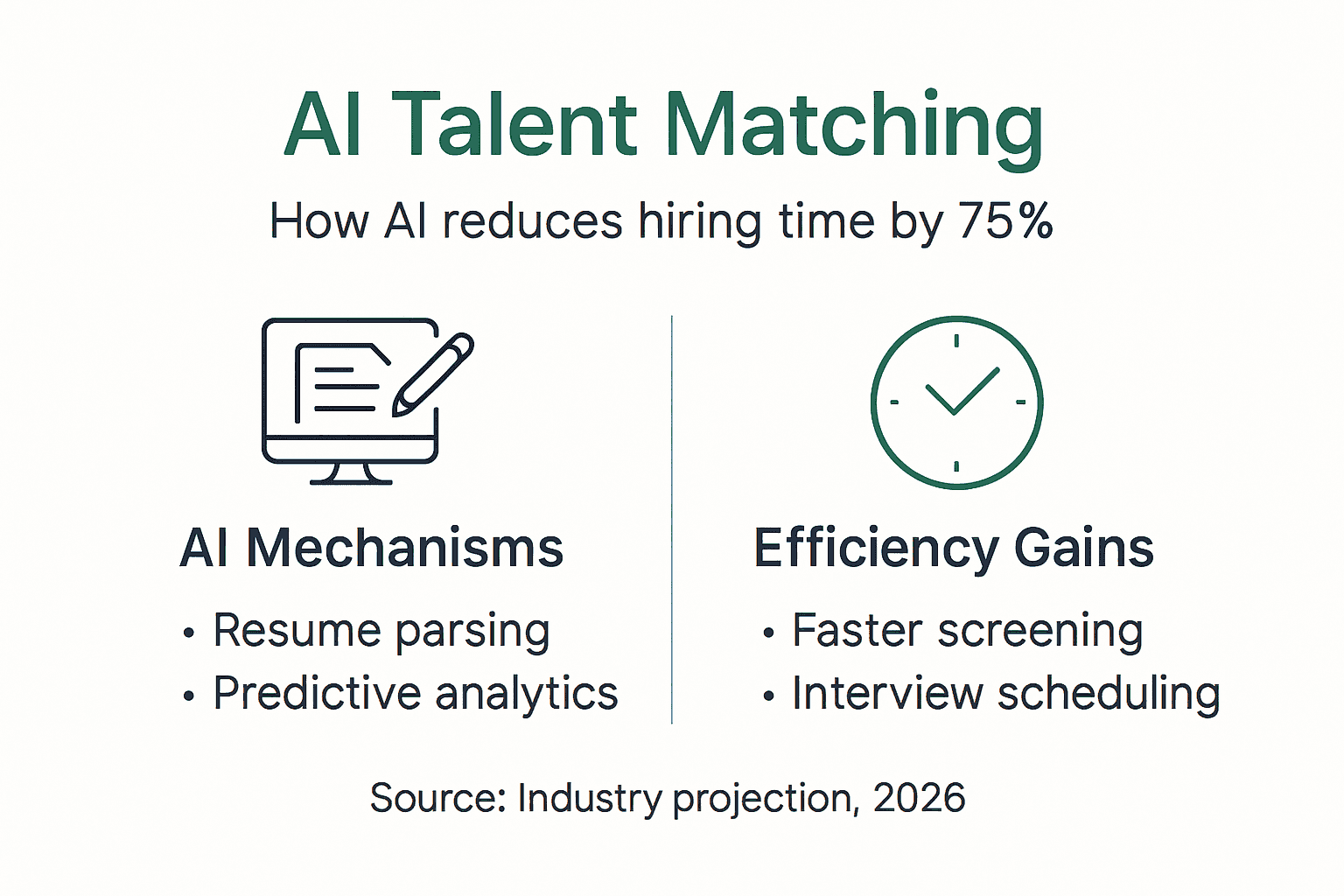
For enterprises hiring at scale, these speed improvements translate directly to competitive advantage. You can secure top candidates before competitors even complete initial screening. Startups benefit equally, as small recruiting teams gain capabilities previously available only to large HR departments.
Reducing time-to-hire with AI becomes critical in competitive talent markets where the best candidates receive multiple offers within days. The faster you identify and engage qualified candidates, the higher your offer acceptance rates.
Challenges and Limitations in AI Talent Matching
AI sometimes misinterprets candidate signals, especially in specialized or emerging roles where training data is limited. AI misinterpretation in niche roles ranges from 30-70%, risking candidate misranking. High volumes of AI-filtered candidates can overwhelm hiring teams in what experts call an ‘AI doom loop’, where more automation produces more candidates requiring human review.
Human recruiters must audit AI recommendations to mitigate biases and errors. Without oversight, AI systems can perpetuate historical hiring biases or make flawed assumptions about candidate potential based on incomplete data.
Common pitfalls requiring human intervention:
- AI may downrank candidates from non-traditional backgrounds despite relevant skills
- Algorithms trained on past hiring data can replicate historical biases around gender, age, or education
- Challenges of AI in niche recruitment include difficulty assessing highly specialized technical expertise
- Overreliance on AI can damage candidate experience when personalization disappears
Establishing review checkpoints for AI shortlists preserves candidate quality and fairness. Recruiters should sample AI recommendations regularly, checking for patterns of bias or systematic errors. This hybrid approach combines AI efficiency with human judgment and contextual understanding.
Balancing AI and human judgment in hiring requires thoughtful workflow design where each plays to its strengths. AI handles data processing and pattern recognition while humans provide strategic thinking and interpersonal assessment.
Pro Tip: Implement monthly audits of AI recommendations, checking for demographic patterns in accepted versus rejected candidates to catch potential bias early.
Evaluating Soft Skills and Cultural Fit with AI
AI uses structured psychometric assessments and behavioral analysis to evaluate adaptability, leadership potential, and teamwork capabilities. Soft skills and cultural fit assessments complement technical screening for holistic candidate evaluation. Better cultural fit achieved through AI correlates with up to 30% reduction in employee turnover, delivering measurable ROI on recruitment technology investments.
These assessments analyze communication patterns, problem-solving approaches, and collaboration preferences to predict how candidates will perform in your specific work environment. AI identifies alignment between candidate values and company culture through carefully designed questions and response pattern analysis.
Three key soft skills AI evaluates effectively:
- Adaptability: How candidates respond to change, ambiguity, and new challenges based on career trajectory and assessment responses
- Communication: Clarity, conciseness, and appropriateness of communication style for role requirements and team dynamics
- Leadership potential: Initiative, decision-making patterns, and ability to influence outcomes even in non-management roles
For hiring managers building cohesive teams, these insights prove invaluable. Technical skills get candidates in the door, but cultural fit and soft skills determine long-term success and retention. AI makes these traditionally subjective assessments more objective and consistent.
The technology analyzes thousands of data points from assessments, work samples, and interaction patterns to build comprehensive candidate profiles. This depth of analysis would take human reviewers days per candidate, making it practically impossible at scale.
Technological Evolution and AI Integration in Recruitment
Modern ATS platforms are evolving into AI-powered ecosystems integrating natural language processing, machine learning, and predictive analytics. The global AI recruitment market valued at USD 720 million in 2025 is projected to reach USD 757 million in 2026, indicating robust growth and increasing adoption.
Emerging tools focus on addressing unique needs of US enterprises and startups, offering specialized features for different hiring contexts. The technology landscape continues advancing rapidly as vendors compete to deliver more accurate matching and better user experiences.
| Feature | Traditional ATS | AI-Powered ATS |
|---|---|---|
| Resume screening | Keyword matching | Contextual analysis with NLP |
| Candidate ranking | Manual prioritization | Predictive scoring algorithms |
| Skills assessment | Self-reported data | Validated testing and behavioral analysis |
| Cultural fit | Subjective interviews | Psychometric assessments and data modeling |
| Time to shortlist | Days to weeks | Hours to days |
| Bias mitigation | Relies on human awareness | Built-in fairness checks and auditing |
This technological shift democratizes access to sophisticated recruiting capabilities. Small startups can now leverage tools previously affordable only to Fortune 500 companies. The playing field levels as AI-powered platforms become more accessible and user-friendly.
AI talent acquisition services combine advanced technology with human expertise, offering the best of both worlds. These hybrid solutions provide automated efficiency while maintaining the personal touch candidates expect.
For enterprises managing multiple simultaneous hiring initiatives, integrated platforms offer centralized data and consistent processes across teams. This standardization improves quality control while maintaining flexibility for different role requirements.
Strategic Imperative and Industry Trends for AI Talent Matching
Over 76% of HR leaders believe organizations not adopting AI-driven talent solutions within 24 months will face competitive disadvantages. AI adoption is increasingly viewed as a strategic necessity rather than an optional enhancement. Global investment in AI talent management is predicted to reach $1.7 billion by 2032, reflecting widespread recognition of its value.
Emphasis on integrating AI insights with human judgment is growing as organizations learn from early implementation challenges. The most successful adopters view AI as augmenting rather than replacing human expertise, creating collaborative workflows that leverage both strengths.
“Organizations that fail to integrate AI into their talent acquisition strategies will find themselves unable to compete for top candidates. Speed and precision in matching have become table stakes in competitive markets. The question isn’t whether to adopt AI, but how quickly you can implement it effectively.”
This strategic shift reflects broader digital transformation trends across HR functions. Companies investing in AI talent matching today position themselves to scale hiring efficiently as they grow. Early adopters gain learning advantages, refining their approaches while competitors struggle with outdated manual processes.
For hiring managers, this trend creates urgency around upskilling and process redesign. Understanding how to work effectively with AI tools becomes a core competency for recruitment professionals. Those who embrace this shift thrive while resisters find themselves increasingly irrelevant.
The competitive landscape is shifting rapidly. Organizations that move quickly to implement AI talent matching gain significant advantages in hiring speed, quality, and cost efficiency.
Enhancing Human-AI Collaboration in Talent Matching
Use AI as an assistant supporting recruiter decision making, not as a replacement for human judgment. Maintain human review to check for AI bias and contextual factors that algorithms miss. Communicate transparently with candidates about AI involvement to enhance experience and build trust.
Balanced workflows allow recruiters to override AI recommendations when contextual knowledge suggests different conclusions. This flexibility preserves recruiter expertise while gaining efficiency from automation.
Five best practices for human-AI collaboration in hiring:
- Define clear decision points where human review is mandatory regardless of AI confidence scores
- Train recruiters on AI capabilities and limitations so they know when to trust or question recommendations
- Collect feedback from recruiters on AI accuracy to continuously improve system performance
- Use AI for initial screening while reserving final decisions for human judgment
- Document reasons when overriding AI recommendations to identify patterns and improve algorithms
This collaborative approach delivers better outcomes than either AI or humans working alone. Recruiters gain efficiency while maintaining control over final hiring decisions. Candidates benefit from faster initial responses combined with personalized human interaction at critical stages.
Best practices for AI and human collaboration evolve as technology improves and organizations learn from experience. Staying current with emerging approaches ensures you maximize value from your AI investments.
Pro Tip: Create feedback loops where recruiters rate AI recommendations after interviews, helping the system learn your specific preferences and requirements over time.
Impact Metrics: Retention and Turnover Improvements
Predictive analytics in AI help identify candidates likely to succeed and stay longer in roles. Better culture and skills alignment achieved through AI contributes to 20-30% improved retention and decreases turnover. Investment in AI hiring technology is validated by positive employee engagement data and reduced replacement costs.
These retention improvements deliver substantial financial returns. The cost of replacing an employee typically ranges from 50-200% of annual salary when factoring in lost productivity, recruiting expenses, and training time. Even modest retention improvements generate significant savings.
| Metric | Pre-AI Implementation | Post-AI Implementation | Improvement |
|---|---|---|---|
| Average time-to-hire | 45 days | 12 days | 73% reduction |
| 90-day turnover rate | 18% | 6% | 67% decrease |
| Cost per hire | $4,200 | $1,800 | 57% savings |
| Hiring manager satisfaction | 62% | 89% | 27 percentage points |
| Candidate quality rating | 3.2/5 | 4.3/5 | 34% increase |
For hiring managers measured on retention and quality of hire, AI talent matching directly impacts performance metrics. Better initial matching means fewer bad hires and more successful long-term placements. This accuracy improvement compounds over time as you build stronger teams.
AI impact on retention and turnover extends beyond individual hires to team dynamics. When new hires fit well culturally and possess appropriate skills, existing team members experience less disruption and higher satisfaction.
These measurable benefits make the business case for AI talent matching compelling. Organizations see ROI within months through faster hiring, better retention, and improved candidate quality.
Conclusion: Balancing Efficiency with Human Judgment
Talent matching AI dramatically improves hiring speed and quality when paired with thoughtful human judgment. Balanced AI-human approaches avoid pitfalls of bias and misranking while delivering efficiency gains traditional methods cannot match. Hiring managers should strategically implement AI tools in 2026 to maintain trust and competitive advantage.
The future of recruitment depends on augmenting rather than replacing human expertise. Organizations that master this balance will dominate talent acquisition in their markets. Those that resist AI adoption or eliminate human oversight will struggle with quality issues and candidate experience problems.
As you consider AI talent matching for your organization, focus on integration rather than wholesale replacement of existing processes. Start with high-volume screening where AI delivers immediate value, then expand to more nuanced applications as you build confidence and expertise. The technology will continue evolving, but the principle of human-AI collaboration remains constant.
Discover Fuerza — Your AI-Powered Staffing Partner
Ready to experience the efficiency gains of AI talent matching firsthand? Fuerza’s AI-powered staffing platform connects enterprises and startups with pre-vetted tech and AI experts using advanced matching algorithms.
Our custom AI talent acquisition services reduce your time-to-hire while improving candidate fit through data-driven matching. Whether you need full-time hires, contractors, or freelancers, our nearshore and onshore talent pools offer the specialized skills your projects demand. Join Fuerza’s waitlist today to transform your recruitment process and secure top talent faster than ever.
Frequently Asked Questions About Talent Matching AI
What differentiates talent matching AI from traditional ATS?
Talent matching AI analyzes candidates holistically using natural language processing and predictive analytics, evaluating context and fit beyond simple keyword matching. Traditional ATS rely on exact keyword matches and manual filtering, missing qualified candidates who describe experience differently. AI processes applications 75% faster while identifying better matches through multi-dimensional analysis.
How does AI evaluate cultural fit and soft skills?
AI uses structured psychometric assessments and behavioral analysis to measure adaptability, communication style, and leadership potential. The systems analyze response patterns, career progression data, and interaction styles to predict alignment with company culture. This approach provides more objective and consistent evaluation compared to subjective interview impressions alone.
Can AI fully replace human recruiters in hiring?
No, AI should augment rather than replace human recruiters. While AI excels at processing large volumes and identifying patterns, humans provide essential contextual judgment, relationship building, and bias oversight. The most effective approach combines AI efficiency with human strategic thinking and interpersonal assessment for optimal hiring outcomes.
What are the risks if relying solely on AI for candidate screening?
Sole reliance on AI risks perpetuating historical biases, misinterpreting niche role requirements, and creating impersonal candidate experiences. AI misinterpretation rates in specialized roles can reach 30-70%, potentially eliminating qualified candidates. Without human oversight, you may also face legal compliance issues and damage your employer brand through poor candidate communication.
How quickly can enterprises expect to see hiring improvements using AI?
Most organizations see immediate time-to-hire reductions of 50-75% within the first month of implementation. Quality improvements and retention benefits typically become measurable within 90-180 days as you accumulate hiring outcome data. The speed of impact depends on implementation quality, team training, and integration with existing workflows.
Recommended
- Fuerza — Hire Pre-Vetted AI & Tech Talent | AI-Powered Staffing
- Fuerza — Hire Pre-Vetted AI & Tech Talent | AI-Powered Staffing
- Fuerza — Hire Pre-Vetted AI & Tech Talent | AI-Powered Staffing
- Fuerza — Hire Pre-Vetted AI & Tech Talent | AI-Powered Staffing
- Match a CV with a Job Offer – AI-Powered CV Analysis
- How to Engage and Hire Top Talent With Video - Kicker Video