
What is talent agility? A guide for hiring managers

Many hiring managers believe talent agility simply means filling open positions faster. This misconception overlooks a powerful strategic capability that transforms how organizations respond to market shifts and technological disruption. Talent agility encompasses workforce adaptability through continuous learning, internal mobility, and flexible staffing models. For US enterprises and startups navigating rapid change, understanding and implementing true talent agility determines competitive advantage. This guide clarifies what talent agility really means and provides practical frameworks for HR professionals managing talent acquisition to build this essential organizational capability.
Table of Contents
- Key takeaways
- Understanding talent agility: Definition and components
- Why talent agility matters for hiring managers and HR teams
- How to build and implement talent agility in your organization
- Measuring and sustaining talent agility over time
- How Fuerza supports building talent agility
- What is talent agility? FAQ
Key Takeaways
| Point | Details |
|---|---|
| Definition and components | Talent agility is the organization’s ability to adapt its workforce and skills to rapidly changing business needs through continuous learning, internal mobility, and flexible talent models. |
| Core components | The three pillars are continuous learning, internal mobility, and flexible talent models that allow rapid scaling and redeployment. |
| Faster market response | Organizations with high talent agility respond to market disruptions forty percent faster by redeploying skills and acquiring new capabilities. |
| Practical HR framework | HR teams should identify skill gaps, enable learning pathways, track mobility, and integrate external talent to build an agile workforce. |
Understanding talent agility: Definition and components
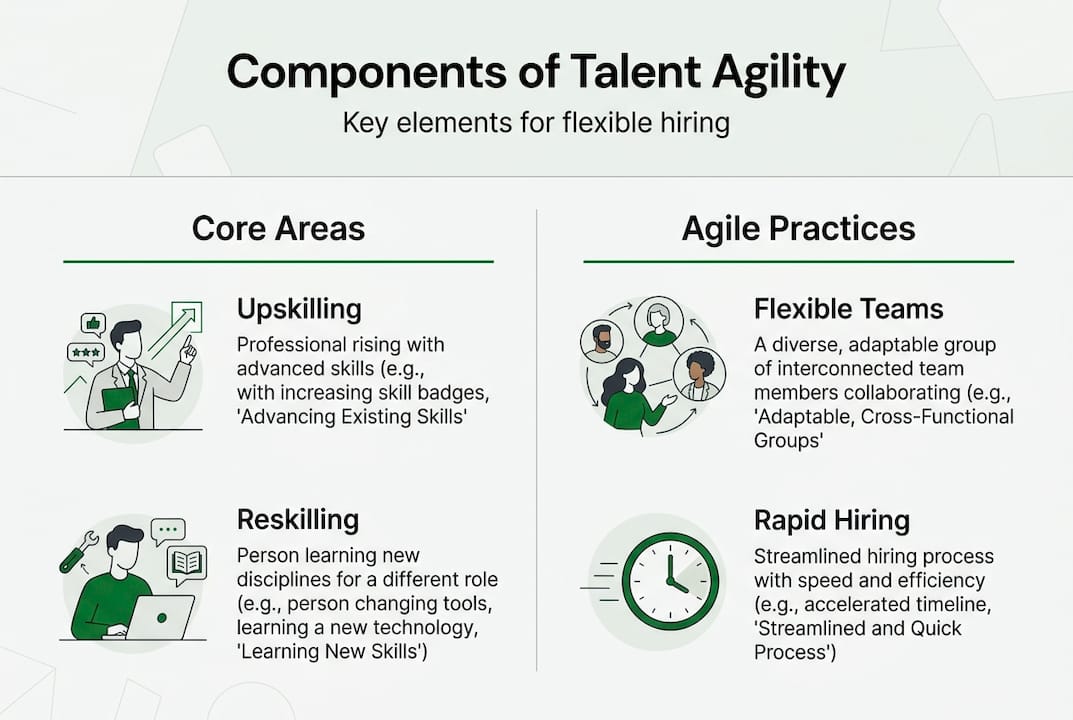
Talent agility is the organization’s ability to adapt its workforce and skills to rapidly changing business needs through continuous learning, internal mobility, and flexible talent models. Unlike traditional talent management focused on filling current roles, talent agility emphasizes building workforce capacity to pivot as business requirements evolve. This strategic capability enables organizations to redeploy skills internally, rapidly acquire new capabilities externally, and maintain competitive responsiveness.
Three core components define organizational talent agility. First, continuous learning creates a culture where employees regularly acquire new skills aligned with emerging business priorities. This includes formal training programs, micro-learning opportunities, and cross-functional skill development. Second, internal mobility enables organizations to redeploy existing talent to high-priority areas without external hiring delays. When market conditions shift or new initiatives launch, agile organizations move people with transferable skills into critical roles. Third, flexible talent models incorporate contractors, freelancers, and project-based specialists alongside full-time employees, allowing rapid scaling up or down based on demand.
These components work together synergistically. A software company might upskill existing developers in machine learning while simultaneously engaging specialized AI contractors through flexible staffing services for immediate project needs. This dual approach maintains momentum on strategic initiatives while building long-term internal capabilities.
“Organizations with high talent agility respond to market disruptions 40% faster than competitors by rapidly redeploying skills and acquiring new capabilities through flexible workforce models.”
Implementing these components requires shifting from rigid organizational structures to fluid talent ecosystems. HR teams must develop systems that identify internal skill gaps, facilitate learning pathways, track mobility opportunities, and integrate external talent sources seamlessly. The payoff comes when unexpected challenges arise and your organization can adapt its workforce composition within weeks rather than quarters.
Why talent agility matters for hiring managers and HR teams
Market volatility has made workforce planning increasingly complex for US hiring managers. Technology disruptions, economic uncertainty, and evolving customer expectations create constant pressure to adjust team capabilities. Talent agility enables organizations to rapidly adjust their talent pools, critical in dynamic business environments where yesterday’s skills become obsolete and tomorrow’s requirements remain unclear. Organizations lacking agility face prolonged hiring cycles, skill mismatches, and competitive disadvantages when opportunities emerge.

Retention improves significantly when organizations match employee skills to evolving business needs. Rather than laying off workers whose roles become redundant, agile companies redeploy them into growth areas through reskilling programs. This approach preserves institutional knowledge while demonstrating commitment to employee development. A marketing professional whose traditional advertising skills face declining demand might transition into digital analytics or content strategy roles, maintaining employment while gaining marketable capabilities. This internal mobility reduces turnover costs and builds employee loyalty.
Competitive advantage flows directly from workforce flexibility. When a startup competitor launches an innovative product or a new technology disrupts your industry, agile organizations respond by quickly assembling teams with relevant expertise. Companies relying solely on traditional hiring processes spend months recruiting specialized talent while agile competitors leverage existing employees with adjacent skills plus targeted contractor engagements to capture market share. Speed matters in technology-driven markets where first-mover advantages compound rapidly.
Pro Tip: Calculate your organization’s agility score by measuring average time to fill critical roles, percentage of positions filled internally, and employee skill acquisition rate. Baseline these metrics quarterly to track improvement as you implement agility initiatives.
For enterprises managing large talent acquisition operations, agility reduces hiring bottlenecks that stall strategic initiatives. Rather than waiting for perfect candidates, agile hiring managers assess which skills exist internally, which can be developed quickly, and which require external specialists. This triage approach accelerates project launches while building sustainable talent pipelines. Startups benefit even more dramatically since limited resources make every hiring decision critical and mistakes costly.
How to build and implement talent agility in your organization
Building talent agility requires systematic implementation across multiple organizational dimensions. Organizations build talent agility through continuous learning, internal mobility, and flexible talent models that work together as an integrated system. Follow this roadmap to develop these capabilities progressively.
- Conduct a comprehensive skills inventory across your current workforce to identify existing capabilities, skill gaps, and transferable competencies that could serve emerging business needs.
- Establish learning pathways that connect current employee skills to future organizational requirements through structured upskilling and reskilling programs with clear progression milestones.
- Create internal mobility mechanisms including job rotation programs, temporary assignments, and cross-functional project opportunities that expose employees to diverse experiences.
- Develop flexible staffing partnerships with platforms providing pre-vetted contractors and freelancers who can augment full-time teams during demand spikes or specialized projects.
- Implement talent analytics systems that track skill development, predict future capability needs, and identify internal candidates for emerging roles before posting external job listings.
- Build manager capability in agile workforce planning through training on skill-based hiring, internal talent development, and effective integration of flexible workers.
Upskilling and reskilling initiatives form the foundation of talent agility. Rather than generic training catalogs, effective programs align learning investments with strategic business priorities. If your organization plans expansion into artificial intelligence applications, create learning pathways that move software engineers from traditional development into machine learning roles. Partner with educational platforms offering certification programs, provide dedicated learning time, and recognize skill acquisition through internal credentialing systems.
Pro Tip: Start small with a pilot program in one department before rolling out organization-wide. Measure results, refine processes, and build internal champions who can advocate for broader adoption based on demonstrated success.
Flexible staffing models provide immediate agility while internal capabilities develop. Rather than viewing contractors as temporary gap-fillers, integrate them strategically into your talent ecosystem. A product launch might combine full-time product managers with specialized UX contractors and freelance content creators, allowing you to scale the team precisely to project phases. After launch, the flexible talent scales down while core team members transition to the next initiative. This approach optimizes costs while maintaining momentum. Explore timing strategies for when to engage different talent types and review comprehensive service options that support agile workforce models.
| Approach | Traditional talent model | Agile talent model |
|---|---|---|
| Hiring focus | Filling current vacancies with perfect-fit candidates | Building adaptable workforce with transferable skills |
| Staffing mix | Primarily full-time employees | Blend of full-time, contractors, freelancers matched to needs |
| Skill development | Occasional training for current role requirements | Continuous learning aligned with future business priorities |
| Internal movement | Limited, role-specific career paths | Frequent mobility across functions and projects |
| Response time | Months to adjust workforce composition | Weeks to redeploy or acquire new capabilities |
Join the waitlist to access pre-vetted talent pools that accelerate your agility implementation.
Measuring and sustaining talent agility over time
Effective measurement ensures your talent agility investments deliver tangible business results. Regular measurement of talent agility helps organizations stay responsive to changing workforce demands by tracking leading indicators that predict future capability gaps before they impact operations. Focus on metrics that reveal both current agility levels and trajectory of improvement.
Key performance indicators for talent agility include time-to-fill for critical roles, internal mobility rate, learning program uptake, skill gap closure speed, and flexible workforce utilization. Time-to-fill measures how quickly you assemble teams with required capabilities through any combination of internal redeployment, upskilling, or external hiring. Agile organizations fill urgent needs in weeks rather than months. Internal mobility rate tracks the percentage of open positions filled by existing employees, revealing whether your workforce can adapt to changing priorities. Target 30% or higher for mature agility programs.
Learning program uptake indicates employee engagement with skill development opportunities. Track both participation rates and completion rates across different programs to identify which learning pathways deliver value. Skill gap closure speed measures how quickly your organization builds capabilities in emerging areas after identifying strategic needs. If leadership prioritizes cloud architecture skills, how long until you have sufficient internal expertise or reliable external talent partnerships to support initiatives?
- Workforce composition flexibility: Percentage of work performed by full-time employees versus contractors and freelancers, with targets varying by business model and industry
- Skill diversity index: Average number of distinct skill areas per employee, indicating workforce versatility and redeployment potential
- Capability response time: Days required to assemble a team with specific skills for new strategic initiatives
- Retention of high-potential talent: Turnover rates among employees identified as having strong adaptability and learning agility
| Measurement dimension | Non-agile approach | Agile approach |
|---|---|---|
| Hiring metrics | Cost per hire, time to fill individual roles | Speed of capability acquisition across all talent sources |
| Development tracking | Training hours completed, compliance certifications | Skills gained mapped to business priorities, application in new roles |
| Success criteria | Headcount targets, budget adherence | Workforce adaptability, strategic initiative velocity |
| Planning horizon | Annual workforce plans with quarterly updates | Continuous talent forecasting with monthly adjustments |
Sustaining talent agility requires treating it as an ongoing capability rather than a one-time initiative. Establish quarterly reviews where HR and business leaders assess emerging skill requirements, evaluate current talent pool readiness, and adjust learning and hiring strategies accordingly. Create feedback loops where hiring managers share insights about skill gaps encountered during projects, informing future upskilling priorities. Refresh your flexible talent partnerships regularly to ensure access to current specialized capabilities as technology and market demands evolve.
How Fuerza supports building talent agility
Building talent agility requires both internal capability development and external partnerships that provide rapid access to specialized skills. Fuerza connects US enterprises and startups with pre-vetted AI and tech talent through flexible engagement models that support agile workforce strategies. Our platform addresses the immediate talent needs that arise when market conditions shift or new initiatives launch, while your internal teams develop long-term capabilities.
Pre-vetted nearshore and onshore experts integrate seamlessly with your existing teams, providing specialized capabilities without lengthy hiring processes. Whether you need machine learning engineers for a product enhancement, data scientists for an analytics initiative, or cloud architects for infrastructure modernization, Fuerza’s talent network delivers professionals ready to contribute immediately. This flexibility lets you scale teams up during critical project phases and adjust composition as priorities evolve.
Our Miami-based team understands the talent challenges facing US hiring managers and HR professionals. We support your agility goals by providing contractor, freelance, and full-time placement options matched to your specific engagement needs. Explore our comprehensive services or join our waitlist to access talent that accelerates your organization’s responsiveness to change.
What is talent agility? FAQ
What does talent agility mean in simple terms?
Talent agility is your organization’s ability to quickly adjust workforce skills and composition when business needs change. It combines continuous employee learning, internal job mobility, and flexible staffing models to maintain the right capabilities at the right time.
How is talent agility different from traditional talent management?
Traditional talent management focuses on filling current job openings with candidates who match existing role requirements. Talent agility emphasizes building adaptable workforces that can pivot to new priorities through skill development, internal redeployment, and flexible talent engagement rather than only external hiring.
What are the first steps to start building talent agility today?
Begin with a skills inventory identifying what capabilities your current employees possess and which future business priorities require new skills. Then establish one learning pathway connecting existing employee skills to an emerging business need, and pilot a flexible staffing partnership for specialized capabilities you need immediately.
Can small startups benefit from talent agility or is it only for large enterprises?
Startups often benefit more from talent agility since limited resources make every hiring decision critical. Agile approaches let startups engage specialized contractors for specific projects while building core team versatility through cross-functional experiences, optimizing both costs and capabilities during rapid growth phases.
How long does it take to see results from talent agility initiatives?
Initial results appear within weeks when you implement flexible staffing models that provide immediate access to specialized skills. Broader organizational agility from learning programs and internal mobility develops over 6-12 months as employees acquire new capabilities and systems for skill-based deployment mature across the organization.
Recommended
- Fuerza — Hire Pre-Vetted AI & Tech Talent | AI-Powered Staffing
- Fuerza — Hire Pre-Vetted AI & Tech Talent | AI-Powered Staffing
- Fuerza — Hire Pre-Vetted AI & Tech Talent | AI-Powered Staffing
- Fuerza — Hire Pre-Vetted AI & Tech Talent | AI-Powered Staffing
- Agile HR The Future Of Talent Acquisition - Stratgetic IT Consultants For Accountants