
What is agile team building: a manager's guide

Agile team building is often misunderstood as simply adopting standups and sprints. But true agile team building goes far beyond ceremonies. It centers on forming cross-functional, self-organizing teams that collaborate iteratively to deliver real value. Many managers struggle to move past superficial adoption, missing the transformative potential of genuine agile practices. This guide clarifies what agile team building really means, explores proven methodologies, addresses common pitfalls, and shows how to build high-performing teams that drive collaboration and efficiency in US enterprises and startups.
Table of Contents
- Key takeaways
- Understanding agile team building: core concepts and principles
- Key methodologies and practices in agile team building
- Addressing challenges and nuances in agile team formation
- Practical application: implementing agile team building in US enterprises and startups
- Discover Fuerza’s AI-powered staffing solutions for agile teams
- Frequently asked questions
Key Takeaways
| Point | Details |
|---|---|
| Cross functional teams | Form small cross functional teams of 5 to 10 people that own features end to end from concept to deployment. |
| Core principles | Collaboration, adaptability, and delivering value guide daily work and outcomes. |
| Self selection empowerment | Team members choose where they contribute in formation workshops, creating stronger commitment and better skill distribution. |
| Value stream mapping | Map the full workflow from customer request to delivered value to reveal bottlenecks and guide natural team boundaries. |
Understanding agile team building: core concepts and principles
Agile team building refers to forming cross-functional, self-organizing teams of 5 to 10 members aligned with agile principles. These teams organize around delivering value iteratively rather than following rigid hierarchies or sequential processes. Each member brings diverse skills, enabling the team to own entire features or products from concept to deployment.
The foundation rests on three core principles: collaboration, adaptability, and delivering value. Collaboration means team members work together daily, sharing knowledge and solving problems collectively. Adaptability allows teams to pivot based on feedback, market changes, or new insights. Delivering value focuses effort on outcomes that matter to customers and stakeholders, not just completing tasks.
Typical agile teams include three key roles:
- Product Owner prioritizes work and represents customer needs
- Scrum Master facilitates ceremonies and removes impediments
- Development Team executes work and self-organizes around delivery
This structure differs sharply from traditional hierarchies. Instead of managers directing work, agile team building services help create environments where teams pull work based on capacity and expertise. Decision-making shifts closer to the work itself, reducing delays and increasing responsiveness.
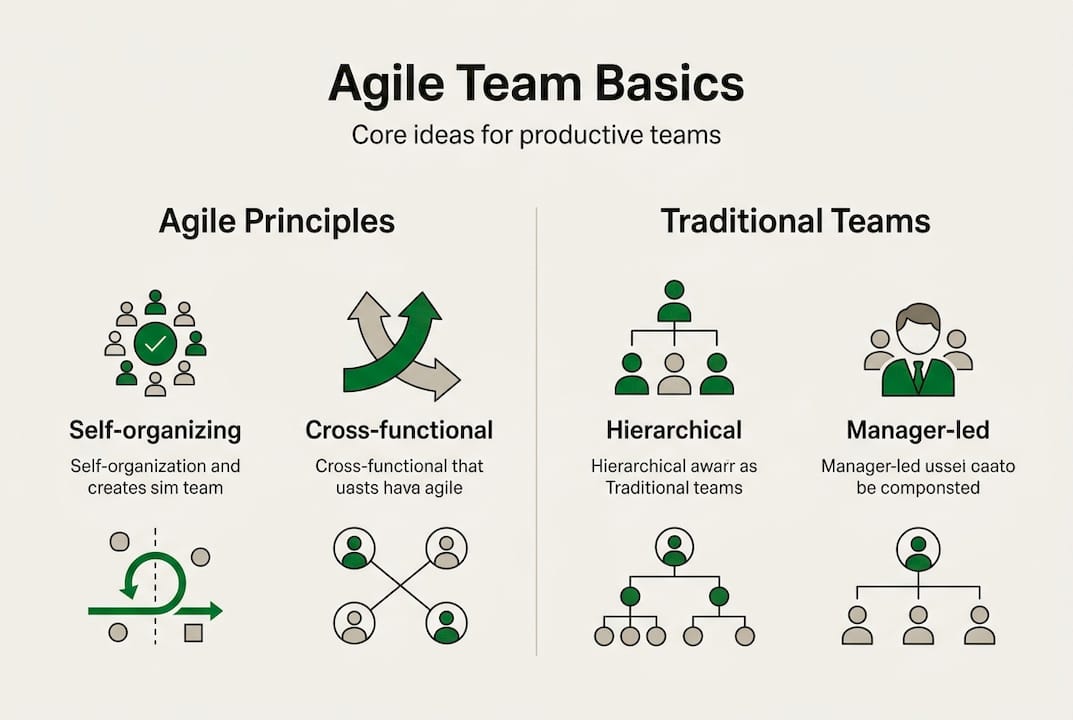
Why does this matter for your organization? Agile teams consistently outperform traditional structures in productivity and adaptability. They respond faster to changing requirements, deliver working software more frequently, and maintain higher morale through autonomy and purpose. For US enterprises and startups competing in fast-moving markets, these advantages translate directly to competitive edge.
The shift requires more than adopting new terminology. It demands rethinking how work flows, how teams form, and how success gets measured. Understanding these core concepts sets the foundation for implementing methodologies that actually work.
Key methodologies and practices in agile team building
An 8-step process includes value stream mapping, team type determination, and team formation workshops. This structured approach ensures teams align with organizational goals while maintaining autonomy and cross-functional capability.
Value stream mapping identifies how work flows through your organization. You visualize every step from customer request to delivered value, spotting bottlenecks and waste. This clarity guides team formation by revealing natural boundaries where teams can own complete value streams.
Next, determine team types based on your organizational needs:
- Stream-aligned teams own specific product or service flows
- Enabling teams build capabilities in other teams
- Platform teams provide shared services and infrastructure
- Complicated subsystem teams handle specialized technical domains
Conducting team formation workshops with self-selection empowers members to choose where they contribute best. This approach, while initially uncomfortable for traditional managers, produces stronger commitment and better skill distribution than top-down assignments. Agile team talent acquisition becomes easier when team members participate in defining their own composition.
Iterative sprints, daily standups, retrospectives, and backlog refinement form the heartbeat of agile work. Sprints create time-boxed periods, typically two weeks, for delivering working increments. Daily standups synchronize work and surface blockers quickly. Retrospectives enable continuous improvement by examining what worked and what needs adjustment. Backlog refinement keeps upcoming work clear and ready.

Each ceremony serves a specific purpose beyond ritual. Standups prevent coordination delays. Retrospectives drive learning. Sprint reviews gather feedback early. When teams understand these purposes, ceremonies become valuable rather than bureaucratic.
Defining roles clearly prevents confusion and overlap. The Product Owner maintains a prioritized backlog and makes trade-off decisions. The Scrum Master coaches the team on agile practices and shields them from distractions. The Development Team commits to sprint goals and self-organizes to meet them. Agile timing and planning depends on these roles functioning smoothly together.
Pro Tip: Ensure psychological safety to encourage ownership and open communication. Teams perform best when members feel safe admitting mistakes, asking questions, and challenging ideas without fear of punishment or ridicule.
Addressing challenges and nuances in agile team formation
Large teams increase coordination overhead, especially beyond 10 to 12 members. Communication paths multiply exponentially with each added person. A team of 5 has 10 possible communication pairs. A team of 12 has 66. This explosion creates meeting fatigue, information silos, and slower decision-making.
Remote and hybrid teams face additional complexity. Asynchronous ceremonies and communication become necessary when team members span time zones. Daily standups might become written updates. Sprint planning requires more structured documentation. The spontaneous collaboration that happens naturally in co-located teams needs deliberate design in distributed settings.
A critical misconception plagues many organizations: agile becomes corporate theater when teams mimic waterfall processes while using agile terminology. Teams hold standups but make no decisions. They run sprints but deliver nothing until the final iteration. They conduct retrospectives but implement no changes. This superficial adoption wastes time without capturing agile benefits.
True cross-functionality prevents waterfall in disguise. Feature teams that lack diverse skills create hidden handoffs and dependencies. A team that must wait for database experts, UI designers, or security reviews cannot deliver complete increments. They batch work, delay feedback, and lose the iterative advantage that makes agile powerful.
Shared leadership boosts productivity but requires genuine empowerment:
- Team members must have authority to make technical decisions
- Product Owners need autonomy to prioritize without constant approval
- Scrum Masters should coach rather than manage or direct
- Leadership must trust teams to self-organize and learn from mistakes
Psychological safety underpins this empowerment. Without it, team members defer to authority, hide problems, and avoid experimentation. With it, they surface issues early, propose solutions, and iterate rapidly.
“The best agile teams treat ceremonies as tools, not rules. They adapt practices to their context rather than following playbooks rigidly.”
Pro Tip: Limit dependencies per team to reduce cognitive load. Each external dependency adds coordination overhead, delays, and risk. Scaling agile practices becomes exponentially harder as dependency networks grow. Aim for teams that can deliver value independently at least 80% of the time.
Practical application: implementing agile team building in US enterprises and startups
Startups and enterprises face different scaling challenges when building agile teams:
| Context | Optimal approach | Key considerations |
|---|---|---|
| Startups | Small, autonomous teams of 5-7 | Move fast, pivot easily, minimize process overhead |
| Mid-size companies | Multiple stream-aligned teams with light coordination | Balance autonomy with alignment, avoid premature scaling frameworks |
| Large enterprises | SAFe or similar frameworks with clear value streams | Manage coordination costs, prevent bureaucracy, maintain team autonomy |
In startups, small teams excel because they minimize communication overhead and maximize speed. Everyone knows what everyone else is doing. Decisions happen in minutes, not meetings. But as organizations grow, informal coordination breaks down. Enterprises often need frameworks like SAFe to maintain alignment across dozens of teams, though they must watch coordination costs carefully.
Use the ATPI-SD scale for assessing team agility and aim for over 60% retrospective action implementation. The Agile Team Performance Indicator scale measures dimensions like collaboration, adaptability, and delivery capability. Teams scoring high on ATPI-SD consistently outperform those with lower scores. Tracking retrospective action implementation reveals whether teams actually improve or just talk about improvement.
Monitoring and improving retrospective actions requires discipline. Many teams generate great insights during retrospectives but implement few changes. Set a simple rule: commit to no more than three improvements per sprint, assign clear owners, and review progress in the next retrospective. This focus beats long lists of vague intentions.
Best practices for value stream mapping and self-selection include:
- Start with customer outcomes, work backward to identify necessary capabilities
- Map current state honestly, including delays and handoffs
- Design teams around value streams, not technical layers
- Let team members choose their teams during formation workshops
- Adjust team composition after initial sprints based on actual workflow
Industry benchmarks and DORA metrics provide objective measures of team productivity and efficiency. DORA metrics include deployment frequency, lead time for changes, time to restore service, and change failure rate. Elite teams deploy multiple times per day with lead times under one hour. Most teams have significant room to improve these metrics through better agile practices.
First steps for managers implementing agile team building:
- Map your current value streams to understand work flow
- Identify natural team boundaries around customer value
- Conduct workshops where team members self-select into teams
- Define clear roles for Product Owner, Scrum Master, and Development Team
- Start with basic ceremonies and adapt based on retrospective feedback
- Measure both quantitative metrics and qualitative team health
- Invest in agile team building services to accelerate capability development
Success requires patience and commitment. Teams need several sprints to find their rhythm. Early stumbles are normal and valuable for learning. Resist the urge to revert to command and control when teams struggle. Instead, coach them through challenges and trust the process.
Scaling agile teams across an organization demands careful attention to dependencies and coordination mechanisms. Each team should own a clear value stream with minimal handoffs. When dependencies exist, make them explicit and manage them actively through coordination ceremonies or shared backlogs.
Discover Fuerza’s AI-powered staffing solutions for agile teams
Building high-performing agile teams starts with finding the right talent. Fuerza’s AI-powered staffing connects US enterprises and startups with pre-vetted experts who understand agile methodologies and can contribute immediately. Whether you need full-time team members, contractors, or freelancers, Fuerza specializes in nearshore and onshore resources that align with your team’s culture and goals.
Our Miami-based team uses intelligent matching to identify candidates with the specific skills and agile experience your teams need. From software developers to product managers, Fuerza staffing services deliver quality faster than traditional recruiting. You get pre-vetted AI and tech talent ready to join sprint planning on day one, not months into onboarding.
Pro Tip: Align hiring strategy with agile team goals for best results. Define the cross-functional capabilities your teams need before sourcing candidates, ensuring new hires fill genuine gaps rather than creating redundancy.
Frequently asked questions
What size should an agile team be?
The recommended team size is 5 to 10 members for optimal collaboration and coordination. Smaller teams communicate more efficiently and make decisions faster. Larger teams face exponentially more communication overhead, requiring additional coordination mechanisms that slow delivery. Adjust size based on work complexity and organizational context, but err toward smaller when possible.
How do I measure if my agile team is effective?
Use metrics like sprint velocity, DORA metrics, and the ATPI-SD scale for comprehensive agility assessment. Track retrospective action implementation rates, aiming for over 60% to ensure continuous improvement. Combine quantitative metrics with qualitative feedback from team members and stakeholders. Effective teams show consistent delivery, improving cycle times, and high morale alongside strong business outcomes.
What are common pitfalls to avoid in agile team building?
Avoid treating agile as just a set of ceremonies without fostering real collaboration and adaptability. Don’t create teams that lack true cross-functionality, which leads to waterfall in disguise with hidden handoffs. Be mindful of coordination overhead with large teams or excessive dependencies between teams. Empower shared leadership and foster psychological safety so team members take ownership and speak up about problems early.
How do agile teams differ from traditional project teams?
Agile teams are stable, cross-functional groups that persist across multiple projects or products. Traditional project teams assemble for a single initiative and disband afterward. Agile teams self-organize around work rather than waiting for management assignments. They deliver working increments every sprint instead of waiting until project completion. This continuity builds expertise, improves estimation accuracy, and creates stronger team cohesion over time.
Recommended
- Fuerza — Hire Pre-Vetted AI & Tech Talent | AI-Powered Staffing
- Fuerza — Hire Pre-Vetted AI & Tech Talent | AI-Powered Staffing
- Fuerza — Hire Pre-Vetted AI & Tech Talent | AI-Powered Staffing
- Fuerza — Hire Pre-Vetted AI & Tech Talent | AI-Powered Staffing
- 5 Essential Traits for Building a High-Performing Team - xpath.global
- Build a business team for growth in 2026: proven steps