
Role of AI in Recruitment: Transforming Talent Acquisition

Recruiting new talent often means juggling endless resumes, candidate questions, and time-consuming interviews—leaving little space for deeper relationship-building or quality assessments. As American companies compete for top candidates across onshore and nearshore talent pools, the need for faster, fairer hiring has never been greater. Artificial intelligence delivers a true shift by automating sourcing and screening, offering consistency and efficiency while helping recruiters focus on the human side of hiring. AI’s role in transforming recruitment brings tangible improvements to both speed and candidate quality for forward-thinking organizations.
Table of Contents
- Defining AI’s Role In Modern Recruitment
- Types Of AI Technologies In Hiring Processes
- AI-Driven Candidate Sourcing And Screening
- Addressing Bias, Ethics, And Compliance In Recruitment
- Challenges, Limitations, And Future Outlook
Key Takeaways
| Point | Details |
|---|---|
| Role of AI in Recruitment | AI acts as a powerful assistant, automating repetitive tasks and improving decision-making efficiency in hiring. |
| Bias and Ethics Awareness | Organizations must address potential biases in AI systems to ensure fair hiring practices and transparency. |
| Diverse AI Technologies | Utilizing a variety of AI tools tailored for different recruitment phases enhances effectiveness and mitigates risks. |
| Continuous Monitoring | Implementing regular audits and reviews is crucial to maintain ethical standards and improve hiring outcomes. |
Defining AI’s Role in Modern Recruitment
Artificial intelligence has become a powerful force reshaping how organizations find and hire talent. Rather than replacing human judgment, AI serves as a smart assistant that handles repetitive tasks, spots patterns in candidate data, and helps teams make faster, more informed decisions about who to hire.
Think of AI in recruitment as a filter and analyzer combined. It processes thousands of applications in minutes, identifies promising candidates based on job requirements, and surfaces insights that might take human recruiters weeks to uncover manually. This shift fundamentally changes how talent acquisition teams allocate their time and energy.
What AI Actually Does in Recruitment
AI automates several critical hiring functions that traditionally consume hours of recruiter effort:
-
Resume screening and parsing: AI reads applications, extracts key qualifications, and flags candidates who match job criteria without human reviewers sorting through stacks of documents
-
Candidate sourcing: AI identifies potential hires from multiple channels, networks, and databases, expanding the talent pool beyond traditional job board postings
-
Interview scheduling: Automated systems coordinate calendars, send invitations, and reduce back-and-forth communication that delays hiring timelines
-
Skill and experience matching: AI analyzes candidate profiles against role requirements, creating ranked lists of best matches for your team to review
-
Interview analysis: Some systems evaluate video interviews for communication skills, engagement, and relevant keywords, providing objective data alongside subjective impressions
Research on AI-based recruitment strategies shows these automations increase hiring efficiency while improving overall candidate quality through more consistent evaluation standards.
Speed Meets Better Decision-Making
Speed is obvious. What’s less obvious is that AI actually helps you hire better candidates by removing some inconsistencies from human evaluation. Every candidate experiences the same screening criteria, the same interview questions, and the same evaluation rubric.
This standardization matters because humans bring unconscious bias to hiring decisions. One recruiter might favor a candidate because they went to the same university; another might overweight recent job-hopping. AI doesn’t have these preferences.
AI accelerates hiring timelines while applying consistent evaluation standards, helping you compete for top talent in fast-moving markets where candidates accept offers within days, not weeks.
For companies hiring nearshore and onshore talent pools simultaneously, consistency across geographies is especially valuable. You need confidence that candidates in Miami and candidates in other locations are evaluated using identical criteria.
The Reality of Bias and Ethics
Before AI sounds like a perfect solution, understand its limitations. Algorithms trained on historical hiring data can amplify past biases if not carefully designed. If your company historically hired less diverse teams, the AI learns those patterns and repeats them.
This isn’t a reason to avoid AI. It’s a reason to use it thoughtfully. Most modern recruitment AI includes fairness controls, but they require intentional setup and monitoring. You must actively check whether your AI is actually reducing bias or just hiding it better.
Transparency matters too. Candidates deserve to understand how automated systems evaluate them, especially when those decisions significantly impact their careers.
Why This Matters for Your Organization
Whether you’re scaling fast or optimizing hiring quality, AI handles the volume so your team focuses on relationship-building and critical judgment calls. Recruiters stop doing data entry and start doing what humans do best: assessing cultural fit, probing background stories, and building relationships with candidates.
This reallocation of effort directly impacts time-to-hire and candidate experience. When your team isn’t buried in administrative tasks, they can move faster and treat candidates with more respect.
Pro tip: Start with AI automation for your highest-volume hiring role first, measure the impact on time-to-hire and quality metrics, then expand. Success with one role builds team confidence and clarity about where AI adds value in your specific hiring context.
Types of AI Technologies in Hiring Processes
AI doesn’t work as one monolithic system in recruitment. Instead, different AI technologies handle different stages of hiring, each with its own strengths and limitations. Understanding which tools do what helps you build a recruitment stack that actually works for your team.
Think of it like assembling a toolkit. You wouldn’t use a hammer for every job, and you shouldn’t use the same AI technology for every hiring phase. Some tools excel at volume work, while others shine at nuanced candidate evaluation.
Core AI Technologies Transforming Recruitment
Several distinct AI approaches power modern hiring systems:
-
Machine learning for resume screening: Algorithms trained on your company’s historical hiring data learn patterns that predict successful hires. These systems rank candidates by how closely they match those patterns, handling thousands of applications automatically
-
Natural language processing (NLP): This technology powers chatbots that engage candidates, answer FAQs, and conduct preliminary screening conversations. NLP understands context and nuance in human language, not just keywords
-
Predictive analytics: Statistical models forecast which candidates will succeed in specific roles, calculating job-fit scores based on skills, experience, and behavioral factors
-
Video interview analysis: AI systems evaluate recorded interviews, analyzing word choice, tone, engagement level, and communication patterns to provide objective scoring alongside human review
-
Candidate matching engines: These combine multiple data points—skills, location, salary expectations, career progression—to surface the strongest possible matches for open roles
AI-assisted technologies across recruitment phases show strongest adoption in sourcing and pre-screening, where volume work justifies automation investments. Later-stage decisions still rely heavily on human judgment, reflecting organizational trust concerns.
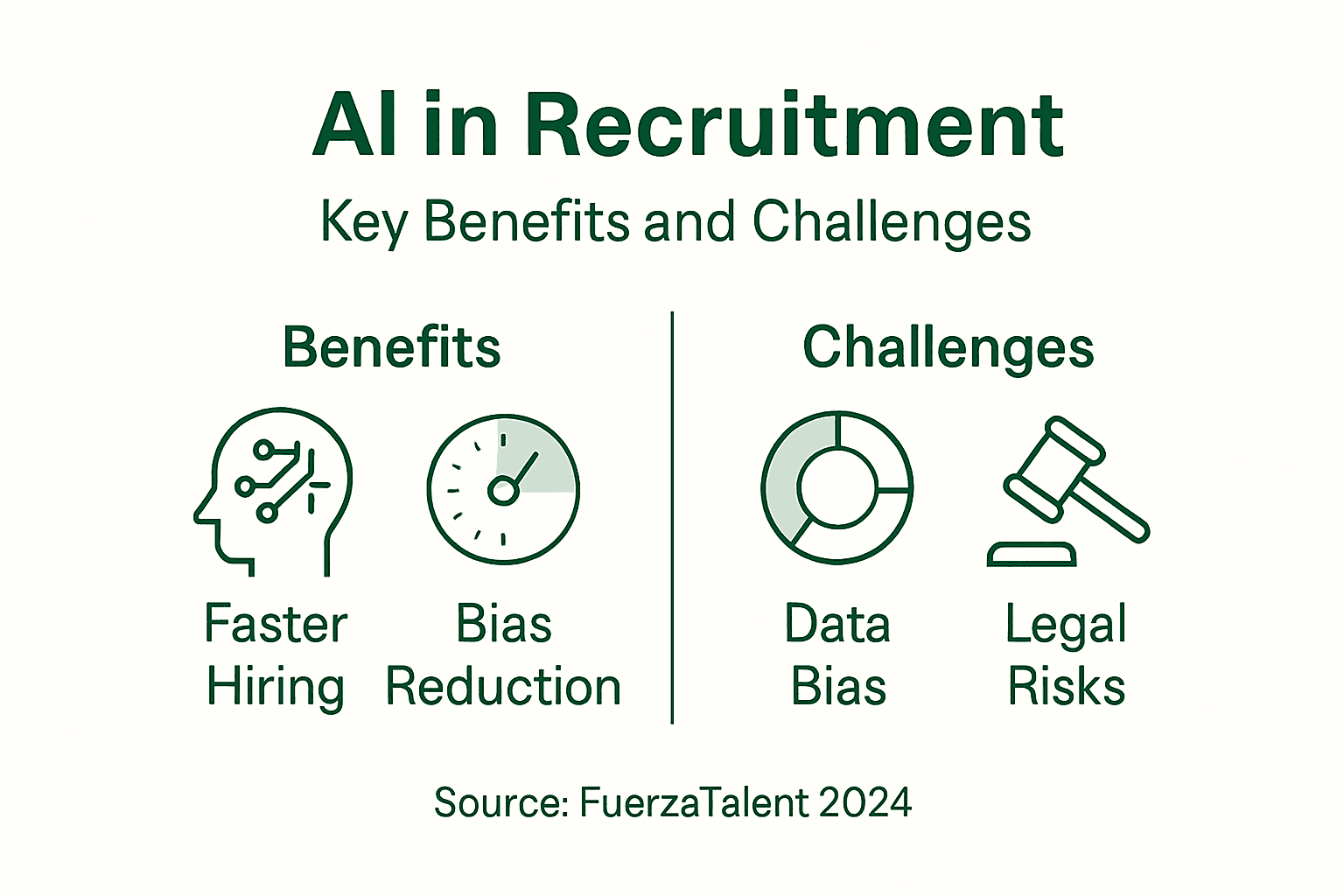
Here’s a summary of core AI technologies and their primary contributions to recruitment:
| AI Technology | Main Application | Benefit for Hiring Teams |
|---|---|---|
| Machine Learning | Resume screening | Faster identification of strong fits |
| Natural Language Processing | Chatbot communications | Improved candidate engagement |
| Predictive Analytics | Job-fit scoring | More accurate candidate ranking |
| Video Interview Analysis | Communication assessment | Objective soft skill measurement |
| Matching Engines | Multi-variable comparisons | Broader, data-driven candidate pool |
Where AI Excels (And Where It Struggles)
AI performs exceptionally well at repetitive, data-heavy tasks. Resume screening, initial candidate sourcing, and scheduling coordination are perfect AI applications because they involve clear criteria and high volume.
AI struggles more with subjective judgment calls. Assessing cultural fit, evaluating leadership potential, or understanding career motivation requires human insight that algorithms can’t fully replicate.
The most successful teams use AI to handle volume and consistency, then deploy human recruiters for relationship-building and nuanced assessment where judgment matters most.
For nearshore and onshore hiring, this division of labor becomes even more valuable. AI maintains consistent evaluation standards across geographies, while your team focuses on the human elements of recruitment that actually convince top candidates to accept offers.
Why Technology Diversity Matters
Relying on a single AI platform limits your capabilities. Different tools excel at different problems. One system might score video interviews brilliantly but miss important resume details. Another could source candidates effectively but misunderstand cultural nuances.
Building a diverse AI toolkit means you’re not locked into one vendor’s assumptions or limitations. You can optimize each hiring stage independently.
Pro tip: Start by automating your highest-friction hiring stage first—usually resume screening or interview scheduling—then evaluate results before expanding to other phases. This creates quick wins and helps your team build confidence in AI before scaling more broadly.
AI-Driven Candidate Sourcing and Screening
Candidate sourcing and screening represent the highest-volume work in recruitment. This is where AI delivers its biggest impact. Instead of recruiters spending weeks filtering applications, AI systems process thousands of profiles in hours, surfacing the strongest matches automatically.

This shift transforms what your team does. Recruiters move from being data processors to being relationship builders. They focus on the candidates AI identifies as promising, not on sorting through hundreds of obviously unqualified applications.
How AI Sources Candidates
AI sourcing doesn’t just post job descriptions and wait. Active sourcing means AI actively hunts for candidates across multiple channels:
-
Database mining: AI searches your existing applicant tracking system and external databases, identifying passive candidates who match your criteria
-
Social media and professional networks: AI extracts profiles from LinkedIn, GitHub, and industry-specific platforms, pulling in candidates who aren’t actively job hunting
-
Skills-based matching: Rather than keyword matching, AI understands skills clusters, identifying candidates with adjacent expertise that could transfer to your role
-
Behavioral and background filtering: AI analyzes career patterns, tenure, company types, and growth trajectory to predict culture and role fit
-
Geographic flexibility: AI accounts for relocation willingness, visa sponsorship needs, and timezone considerations for nearshore and onshore hiring
This active approach expands your talent pool dramatically. You’re no longer limited to people who happen to be actively job searching right now.
The Screening Efficiency Advantage
Once sourced, candidates enter screening. This is where machine learning frameworks optimize matching accuracy by extracting and comparing profile attributes automatically. AI systems apply consistent criteria to every candidate, eliminating the screening bias that occurs when humans manually review applications.
Here’s what happens in an AI screening workflow:
- Candidate profiles are parsed, extracting skills, experience, education, and work history
- AI compares extracted data against job requirements using trained algorithms
- Candidates receive match scores based on how closely their profile aligns with role criteria
- Top-ranked candidates automatically move to the next hiring stage or human review
AI screening maintains consistency across thousands of candidates while reducing manual review time by 60-70%, letting your team focus on relationship-building with promising prospects.
The consistency matters as much as the speed. Every candidate experiences identical evaluation criteria. No recruiter is having an off day and overlooking someone qualified.
Why This Matters for Your Hiring Timeline
Time-to-hire directly impacts your ability to land top talent. When candidates are actively interviewing with three companies simultaneously, a fast process wins. AI-driven sourcing and screening compresses weeks into days.
For nearshore and onshore talent pools, this speed advantage is critical. You’re competing against other enterprises and startups for the same candidates. Faster feedback loops, quicker interview invitations, and speedier decision-making differentiate winning offers from rejections.
Pro tip: Audit your top 50 recent hires and identify common profile attributes they shared before implementation. Use these patterns to train your AI sourcing system, ensuring it learns from your actual hiring successes rather than generic job description requirements.
Addressing Bias, Ethics, and Compliance in Recruitment
AI hiring systems amplify problems they weren’t designed to solve. If your historical hiring data reflects bias, the algorithm learns that bias and repeats it at scale. What might have affected 10 candidates monthly now affects hundreds. This is the central ethical challenge of AI in recruitment.
Understanding and addressing bias isn’t optional. It’s essential for legal compliance, fairness, and building a genuinely diverse workforce that reflects the talent market.
The Bias Problem in AI Recruitment
Algorithmic bias emerges when training data reflects historical discrimination. Consider a real example: if your company hired significantly more men than women in engineering roles historically, an AI system trained on that data learns to prioritize male candidates. The algorithm doesn’t understand gender discrimination. It just learned patterns from your past hiring.
Bias doesn’t always come from intentional discrimination. It comes from incomplete data, skewed sample sizes, or proxy variables that correlate with protected characteristics. A recruiter hiring in one geographic region might inadvertently train an algorithm to prefer candidates from that region, potentially excluding qualified candidates from other areas.
Mitigating bias requires transparency audits and collaborative governance between AI developers and HR teams. You can’t outsource this responsibility to vendors alone.
Required Actions for Ethical Implementation
Addressing bias requires concrete steps, not just good intentions:
-
Conduct bias audits: Regularly test your AI system with diverse candidate profiles to identify patterns where it unfairly advantages or disadvantages certain groups
-
Diversify training data: Ensure historical hiring data reflects the candidate population you want to hire, not just who you hired in the past
-
Monitor outcomes: Track hiring metrics by demographic group. If your AI system consistently rejects women or minorities at higher rates, that’s evidence of bias regardless of intent
-
Document and disclose: Maintain records of how your AI system was built, what data trained it, and any known limitations or biases
-
Create human oversight: Never allow AI to make final hiring decisions alone. Always include human review, especially for borderline candidates
-
Enable candidate appeal: Let candidates understand and challenge AI screening decisions. Transparency builds trust.
Ethical AI hiring means accepting slower implementation timelines to get bias mitigation right, rather than racing to deploy systems that create legal and reputational risk.
Compliance and Legal Considerations
Regulatory pressure is increasing globally. The Equal Employment Opportunity Commission has begun scrutinizing AI hiring tools for discrimination. European regulations impose strict requirements on automated hiring decisions. Compliance isn’t a technical problem alone—it’s a governance problem.
Your organization bears legal responsibility for AI hiring outcomes, even when using vendor tools. Due diligence means understanding exactly what your AI system does and why it makes the decisions it makes.
Pro tip: Before deploying any AI hiring system at scale, run a 30-day pilot with a single hiring role, comparing AI-selected candidates against human selections for quality and diversity metrics. This low-risk approach reveals bias issues before they affect your entire recruitment pipeline.
Challenges, Limitations, and Future Outlook
AI recruitment isn’t a finished product. It’s a rapidly evolving toolkit with real limitations that organizations need to understand before betting their hiring strategy on it. The gap between AI’s promise and its current reality matters more than the marketing suggests.
Success requires honest acknowledgment of what AI can and cannot do right now, plus clarity on where the field is heading.
Current Challenges Holding Back Adoption
Several practical barriers prevent widespread AI recruitment implementation:
-
Data quality issues: Most companies have messy historical hiring data. Incomplete records, inconsistent job titles, and missing information make training algorithms difficult
-
Integration complexity: Your new AI tool needs to connect with your applicant tracking system, email systems, interview scheduling tools, and background check services. These integrations often fail or break after updates
-
Change management resistance: Recruiters trained for decades to make judgment calls resist automated screening. Organizations underestimate the time needed for team adoption
-
Vendor lock-in: Switching AI recruitment vendors means retraining algorithms, losing historical data, and starting relationship-building over
-
Transparency challenges: Candidates want to understand why they were rejected. Most AI systems can’t explain their decisions in human terms
These aren’t technical problems that engineers can solve with better code. They’re organizational and human problems.
The following table compares key challenges of AI recruitment with strategies to address them:
| Challenge | Impact on Hiring | Strategy for Mitigation |
|---|---|---|
| Bias in Data | Unfair candidate rejection | Regular bias audits |
| Data Quality Issues | Reduced AI accuracy | Clean and enrich training data |
| Integration Complexity | Slower team adoption | Prioritize compatible vendors |
| Lack of Explainability | Lower candidate trust | Use transparent algorithms |
The Limits of AI in Recruitment
Ongoing research highlights algorithmic bias, privacy concerns, and accountability gaps that require more than technical solutions. AI can optimize sourcing and screening, but it struggles with evaluation of soft skills, leadership potential, and cultural alignment.
AI also reflects historical patterns. If your industry hired primarily from certain universities or backgrounds, your AI system will perpetuate that. Fixing this requires actively teaching the algorithm to value diversity—which means actively changing your hiring patterns.
Privacy is another real limitation. Sourcing candidates across social media and professional networks raises data privacy questions that vary by jurisdiction. Europe’s regulations differ sharply from the United States. Operating globally means navigating conflicting legal requirements.
Current AI recruitment tools excel at volume processing but struggle with nuanced judgment, making them best suited for initial screening rather than final decision-making.
Where AI Recruitment Is Heading
The next evolution will likely focus on two areas: explainability and multi-dimensional fairness.
Explainability means AI systems that can tell candidates why they were rejected and what they could improve. This transparency builds trust and reduces legal risk. Research in this space is advancing, but production systems lag behind.
Multi-dimensional fairness goes beyond preventing discrimination against protected classes. It means ensuring AI evaluates candidates fairly across different educational backgrounds, geographic regions, career trajectories, and industry transitions. This is harder than it sounds but increasingly necessary.
What This Means for Your Implementation
Don’t wait for perfection. But don’t deploy blindly either. Start with limited scope—one hiring role, one sourcing channel—and measure outcomes rigorously. Build internal expertise rather than trusting vendors entirely. Plan for ongoing adjustments, not one-time implementation.
The organizations winning with AI recruitment aren’t the earliest adopters. They’re the ones who moved thoughtfully, measured impact honestly, and adjusted based on what they learned.
Pro tip: Set a quarterly bias audit cadence where you review hiring outcomes by demographic group, candidate source, and AI system version. Track whether rejection rates have shifted for different populations. This data-driven approach catches bias drift before it becomes systemic.
Transform Your Hiring with AI-Powered Nearshore and Onshore Staffing
The article highlights the real challenges of implementing AI in recruitment such as bias mitigation, consistent candidate evaluation, and speeding up time-to-hire without sacrificing quality. If your hiring team struggles with high-volume resume screening, candidate sourcing, or maintaining fairness across geographies, leveraging AI-powered staffing solutions is the answer. At Fuerza, we connect you with pre-vetted experts focused on nearshore and onshore talent pools in the US, ensuring automated efficiency combined with human judgment where it matters most.
Start accelerating your recruitment process while reducing bias and improving candidate quality by partnering with Fuerza. Discover how our AI-enabled solutions streamline your hiring for freelancers, contractors, and full-time roles. Don’t let manual screening slow you down. Visit Fuerza Staffing now to transform your talent acquisition strategy with trusted, fast, and fair AI staffing support.
Frequently Asked Questions
What role does AI play in the recruitment process?
AI functions as a smart assistant in recruitment by automating repetitive tasks, analyzing candidate data, and providing insights to help teams make informed hiring decisions.
How does AI improve the efficiency of candidate sourcing and screening?
AI automates the sourcing and screening of candidates, processing thousands of applications in a fraction of the time it would take human recruiters, thus speeding up hiring timelines significantly.
Can AI eliminate biases in the recruitment process?
AI can standardize evaluations to reduce inconsistencies and unconscious biases in hiring. However, if trained on historical biased data, it may inadvertently perpetuate those biases, making careful implementation essential.
What are the limitations of using AI in recruitment?
AI struggles with subjective assessments such as cultural fit and leadership potential. While it excels in processing large volumes of data, human insight is still crucial for nuanced evaluation.