
Role of AI in Interviews: Boosting Hiring Results

Selecting top talent across the United States often means juggling tight deadlines and skyrocketing candidate volumes. As the pressure mounts, many hiring managers turn to artificial intelligence interview tools for relief, only to face confusion about what these systems actually do. By clearing up common myths and showing how AI-driven interview technologies objectively assess candidates and reduce bias without replacing human oversight, this article offers practical guidance to help you make smarter, faster and better hiring decisions.
Table of Contents
Key Takeaways
| Point | Details |
| AI is a Tool, Not a Replacement | AI enhances the recruitment process by assisting human recruiters rather than replacing them entirely. It is essential to maintain human oversight in decision-making. |
| Understanding AI Limitations | AI cannot fully assess soft skills or completely eliminate biases, necessitating a balanced approach to hiring. |
| Choose the Right Technology | Selecting AI tools that complement your recruitment process can enhance efficiency and candidate evaluation. |
| Ethical Management of AI | Organizations must conduct regular audits of AI systems to ensure fairness and compliance with legal standards. |
Defining AI in Interviews and Common Myths
Artificial Intelligence (AI) has emerged as a transformative technology in the hiring landscape, yet significant misunderstandings persist about its actual capabilities and limitations. Complex algorithmic systems are often misinterpreted, leading to unrealistic expectations about AI’s role in interview processes.
At its core, AI represents technological systems designed to mimic human cognitive functions, but not replace human judgment entirely. These systems leverage machine learning algorithms capable of analyzing patterns, processing data, and making recommendations. However, contrary to popular belief, AI cannot completely automate human decision-making, especially in nuanced contexts like interviewing.
Key misconceptions about AI in interviews include:
-
AI can fully replace human recruiters
-
AI is completely objective and unbiased
-
Machine learning algorithms understand complex soft skills
-
AI interview tools work identically across all contexts
Objective Assessment requires understanding that AI is a sophisticated tool, not a magical solution. Adaptive behavioral technologies can enhance recruitment processes, but they work best when complementing human expertise, not replacing it.
Professional hiring teams recognize that AI serves as an intelligent assistant, helping to streamline initial screening, reduce unconscious bias, and provide data-driven insights. The technology works most effectively when integrated thoughtfully, with human oversight and contextual understanding.
Pro tip: Always maintain a balanced perspective by viewing AI as a powerful tool that augments human decision-making, not a complete replacement for professional judgment.
Main Types of AI Interview Technologies
The landscape of AI interviewing technologies has dramatically evolved, offering sophisticated tools that transform traditional recruitment processes. Advanced interviewing systems now encompass multiple technological approaches designed to enhance candidate evaluation and streamline hiring workflows.
These AI interview technologies can be categorized into several distinct types:
-
Rule-Based Chatbots: Simple conversational interfaces using predefined decision trees
-
Natural Language Processing (NLP) Platforms: Advanced systems analyzing speech patterns and linguistic nuances
-
Virtual Reality Interview Simulators: Immersive environments for realistic candidate interactions
-
Emotion Recognition Technologies: AI tools assessing nonverbal communication and emotional intelligence
Screening Technologies represent the most common application, leveraging automated candidate assessment techniques. These systems typically integrate resume parsing, standardized question generation, and objective evaluation algorithms to provide comprehensive candidate insights.
Each technology offers unique capabilities. Rule-based chatbots provide basic screening, while NLP platforms can conduct more complex linguistic analyses. Virtual reality simulations create immersive interview experiences, allowing deeper skill assessments beyond traditional text-based interactions.
Here’s a quick overview of core AI interview technology types and their typical use cases:
| Technology Type | Primary Function | Business Impact |
| Rule-Based Chatbots | Basic question screening | Increases early-stage efficiency |
| NLP Platforms | In-depth language analysis | Improves candidate assessment |
| VR Interview Simulators | Realistic scenario evaluation | Enhances skill demonstration |
| Emotion Recognition Tools | Nonverbal and emotional analysis | Adds insight on soft skills |
Pro tip: Select AI interview technologies that complement your existing recruitment workflow and align closely with your specific hiring requirements.
How AI Improves Interview Efficiency
Artificial Intelligence has revolutionized recruitment by dramatically streamlining interview processes and enhancing overall hiring effectiveness. Automated recruitment systems dramatically reduce the time and resources traditionally consumed by manual screening and evaluation methods.
The efficiency gains from AI-powered interviewing technologies are substantial and multifaceted:
-
Rapid Candidate Screening: Automatically filters and ranks candidates in minutes
-
Bias Reduction: Provides objective, data-driven candidate assessments
-
Standardized Evaluation: Ensures consistent interview criteria across all candidates
-
Real-Time Performance Analysis: Generates immediate insights into candidate potential
Workflow Optimization represents a critical advantage of AI interviewing technologies. Generative AI recruitment tools enable organizations to process larger candidate pools more quickly, reducing time-to-hire and minimizing administrative overhead.
By automating repetitive tasks like initial resume screening and preliminary interviews, AI allows recruitment professionals to focus on high-value interactions. The technology generates comprehensive candidate profiles, highlights potential matches, and provides nuanced insights that traditional methods might overlook.
Pro tip: Implement AI interviewing tools incrementally, starting with specific stages of your recruitment process to maximize adaptation and minimize disruption.
Bias, Legal Compliance, and Candidate Risks
Artificial Intelligence in recruitment introduces complex ethical and legal challenges that demand careful navigation. Algorithmic bias detection reveals significant risks of perpetuating systemic discrimination through seemingly objective technological systems.
Key risks in AI-driven recruitment include:
-
Demographic Bias: Unintentional discrimination based on race, gender, age
-
Data Privacy Violations: Potential unauthorized collection and processing of personal information
-
Transparency Limitations: Difficulty explaining AI decision-making processes
-
Potential Legal Non-Compliance: Risk of violating anti-discrimination regulations
Ethical Considerations require proactive management of potential prejudices embedded within AI systems. HR Technology Compliance demands continuous auditing and implementation of fairness metrics to prevent systematic exclusion of qualified candidates.
Organizations must develop robust governance frameworks that prioritize algorithmic fairness, regular bias assessments, and transparent decision-making processes. This involves implementing multi-layered validation techniques, diverse training datasets, and periodic external audits to ensure AI recruitment tools remain equitable and legally compliant.
Pro tip: Conduct quarterly comprehensive bias audits of your AI recruitment algorithms to proactively identify and mitigate potential discriminatory patterns.
Human vs. AI Interviewing: Pros and Cons
The recruitment landscape is undergoing a transformative shift with the integration of artificial intelligence into interview processes. Hiring technology comparisons reveal a nuanced picture of strengths and limitations across human and AI-driven approaches.
Comparative advantages of each interviewing method include:
-
Human Interviewing Strengths:
-
Deeper emotional intelligence
-
Contextual understanding
-
Ability to read subtle nonverbal cues
-
Flexibility in conversation
-
-
AI Interviewing Strengths:
-
Consistent evaluation criteria
-
Rapid candidate processing
-
Reduced unconscious human bias
-
Scalable screening capabilities
-
Interview Effectiveness demands a balanced approach. Hybrid interview methodologies suggest combining AI’s objective screening with human intuition to maximize recruitment outcomes. AI excels at initial candidate filtering, while human recruiters provide critical insights into cultural fit and complex interpersonal dynamics.
The table below contrasts strengths and limitations of human and AI interviewing methods:
| Aspect | Human Interviewers | AI Interviewing Tools |
| Consistency | May vary by interviewer | Uniform evaluations |
| Processing Speed | Time-consuming | Processes large volumes |
| Emotional Detection | Nuanced understanding | Limited emotional context |
| Bias Risk | Prone to human bias | Risks algorithmic bias |
The most sophisticated organizations are moving toward integrated models that leverage technological efficiency without sacrificing the nuanced judgment of experienced human professionals. This approach allows for comprehensive candidate assessment that balances technological precision with human emotional intelligence.
Pro tip: Develop a hybrid interviewing strategy that uses AI for initial screening and human experts for final candidate evaluation to optimize hiring quality and efficiency.
Elevate Your Hiring with AI-Powered Staffing Solutions
The article highlights the challenge of integrating AI technologies effectively into the interview process while maintaining fairness, reducing bias, and enhancing efficiency. If you are aiming to boost your recruitment results by combining AI’s rapid candidate screening with human expertise, you need a trusted partner who understands these complexities. At Fuerza, we provide AI-powered staffing that connects you with pre-vetted experts, ensuring you leverage cutting-edge technologies that complement human judgment and reduce legal and ethical risks.
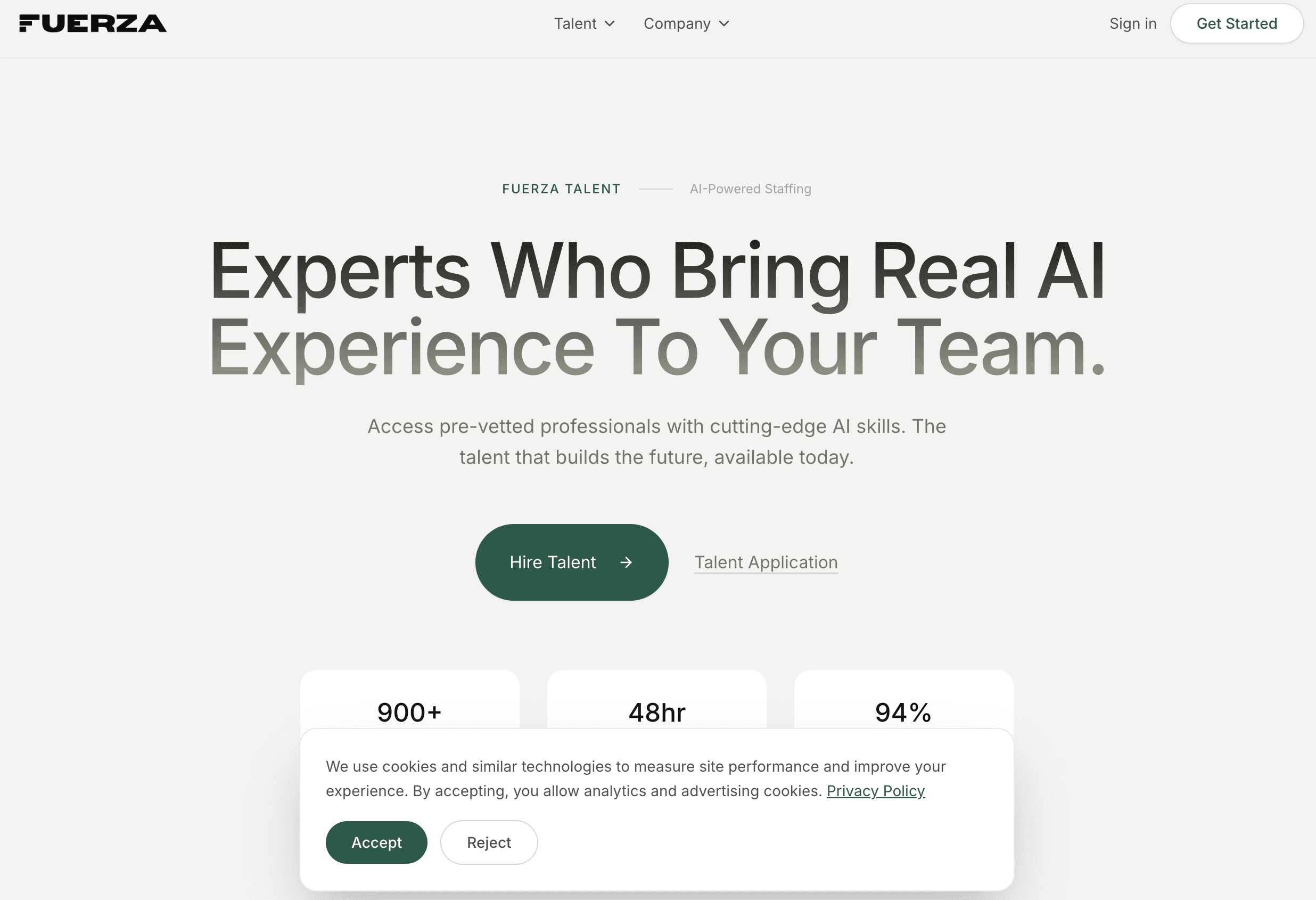
Discover how precise AI-assisted hiring supported by real human insight can transform your talent acquisition strategy. Visit Fuerza to explore how we focus on nearshore and onshore staffing tailored for US companies. Get started today and experience the difference intelligent automation and expert curation make in hiring top professionals quickly and fairly. Learn more about our unique approach at https://fuerza.work.
Frequently Asked Questions
What are the main types of AI interview technologies?
AI interview technologies can be categorized into rule-based chatbots, natural language processing (NLP) platforms, virtual reality interview simulators, and emotion recognition technologies. Each type offers unique capabilities for enhancing candidate evaluation.
How does AI improve the efficiency of the interview process?
AI improves interview efficiency by rapidly screening candidates, reducing bias through objective assessments, standardizing evaluation criteria, and providing real-time performance analysis, which saves time and resources.
What are the risks associated with using AI in recruitment?
Key risks of using AI in recruitment include demographic bias, data privacy violations, transparency limitations in decision-making processes, and potential legal non-compliance with anti-discrimination regulations.
How can organizations balance human and AI interviewing methods?
Organizations can balance human and AI interviewing by developing hybrid strategies that leverage AI for initial candidate screening while utilizing human expertise for final evaluations, ensuring a comprehensive assessment of candidates.