
Role of AI in HR: Transforming Talent Strategies

Every HR professional knows the challenge of keeping up with talent needs while juggling manual screening and data overload. In today’s high-speed hiring climate, artificial intelligence in human resources is more than a buzzword—it transforms how American organizations find, evaluate, and retain top talent. By taking routine tasks off your plate and delivering new workforce insights, AI helps your team compete for the best people and build a stronger, more adaptable workplace.
Table of Contents
- Defining The Role Of AI In HR Today
- Key Types Of AI-Driven HR Solutions
- How AI Enhances Hiring And Staffing
- Legal And Ethical Considerations For AI Use
- Risks, Best Practices, And Adoption Challenges
Key Takeaways
| Point | Details |
|---|---|
| AI Enhances HR Efficiency | AI automates repetitive tasks like resume screening and scheduling, freeing HR teams to focus on strategic initiatives. |
| Stages of AI Integration | Organizations typically progress from isolated AI tasks to fully integrated systems, balancing technology with human judgment. |
| Importance of Data Privacy | Legal and ethical considerations are vital, requiring transparency and candidate consent to safeguard sensitive information. |
| Adoption Challenges | Successful AI implementation requires addressing employee resistance, data quality, and maintaining human oversight throughout the process. |
Defining the Role of AI in HR Today
Artificial intelligence is no longer a futuristic concept in human resources. It’s actively reshaping how talent teams operate right now, from candidate screening to employee development and retention strategies.
AI in HR today serves three core functions that directly impact your hiring and talent management outcomes.
What AI Actually Does in HR Operations
AI handles the data-heavy lifting that consumes hours of manual work. Think resume scanning, skills matching, scheduling interviews, and analyzing employee performance patterns. Your team gains back time to focus on relationship-building and strategic decisions rather than administrative tasks.
The technology also powers predictive analytics, helping you identify high-potential candidates before competitors do. AI is reshaping HRD practices by automating routine processes while creating new possibilities for talent insights.
But here’s what matters most: AI doesn’t replace judgment. It augments it.
The Three Phases of AI Integration
AI adoption in HR follows a progression, and understanding where your organization stands matters:
-
Technocratic phase: AI handles isolated tasks like job posting distribution or first-pass resume reviews. Limited integration, clear boundaries.
-
Integrated phase: AI works alongside HR teams on more complex decisions, like identifying skills gaps or predicting turnover risks. Requires human review and judgment.
-
Fully embedded phase: AI influences strategic HR planning, workforce planning, and organizational development. Requires strong governance and human oversight.
Most US startups and enterprises operate between phases one and two right now, testing capabilities while building internal expertise.
Here’s a quick comparison of AI integration phases in HR:
| Integration Phase | Core Tasks Handled | HR Involvement | Typical Organization Type |
|---|---|---|---|
| Technocratic | Job posting, resume scans | Minimal, isolates AI functions | Early-stage startups |
| Integrated | Skills gap analysis, turnover prediction | Active human review and judgment | Growth-stage companies |
| Fully Embedded | Strategic HR and workforce planning | Strong oversight, human governance | Large enterprises |
The key is balancing technological efficiency with human judgment. AI excels at pattern recognition; humans excel at nuance and context.
Why This Matters for Your Hiring Team
For HR professionals and hiring managers, AI changes your competitive advantage in talent acquisition. Nearshore and onshore talent pools expand when you can quickly identify skills matches across larger candidate pools. Speed matters in startup environments where first-mover advantage matters.
You also reduce bias in early-stage screening when AI systems are properly configured and monitored. The technology flags inconsistencies in hiring patterns that humans might miss.
The Human-Centric Requirement
Advancing HR through enhanced system efficiencies requires centering human considerations alongside technology. This means your role evolves from executing processes to stewarding how AI gets applied in hiring and talent development.
Your decisions about which AI tools to implement, how to interpret their recommendations, and when to override them define whether AI becomes a genuine competitive advantage or just another expense.
Pro tip: Start by identifying your most time-consuming, repetitive HR tasks. Those are your quick wins for AI implementation, and they’ll free your team to focus on strategic talent initiatives that actually move the needle for your organization.
Key Types of AI-Driven HR Solutions
AI in HR isn’t monolithic. Different tools solve different problems, and understanding what each category does helps you choose the right solution for your talent strategy.
The main AI technologies reshaping HR fall into four distinct categories, each with specific applications that matter to your hiring and people operations.
Machine Learning and Predictive Analytics
Machine learning algorithms analyze historical hiring and performance data to predict future outcomes. These systems identify which candidates will succeed in specific roles, which employees are flight risks, and where skills gaps will emerge.
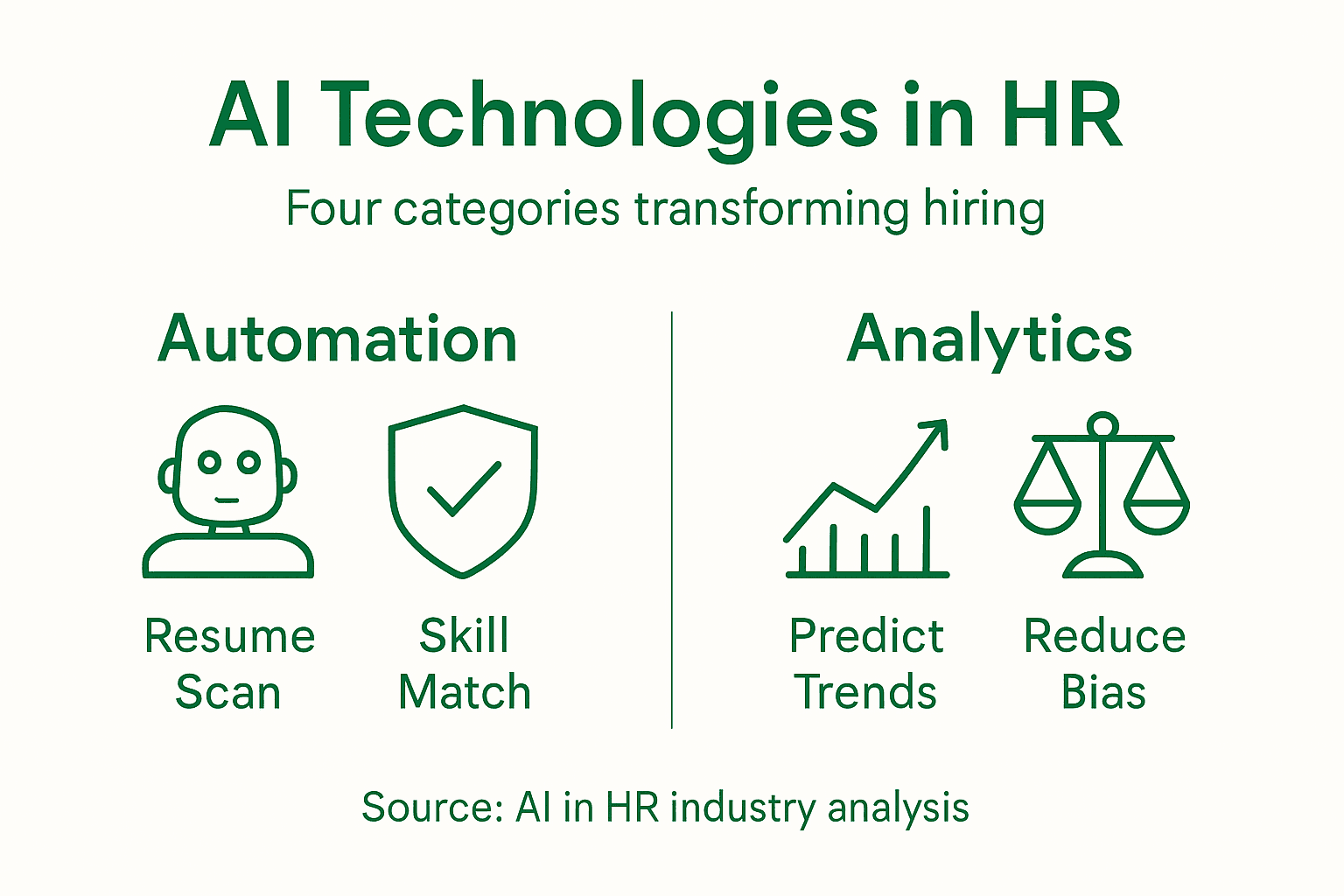
Predictive analytics powers your ability to act before problems occur. Instead of reacting to turnover, you’re identifying at-risk employees and intervening early.
The approach works because patterns in your data reveal what success actually looks like in your organization, not industry assumptions.
Natural Language Processing for Talent Operations
Natural language processing (NLP) understands and extracts meaning from text. Resume screening, job description optimization, and employee feedback analysis all rely on this technology.
When you process 500 resumes manually, you miss nuance. NLP catches skill mentions buried in unconventional formats and matches them against your actual job requirements.
This matters especially for sourcing nearshore and onshore talent where resumes might highlight experience differently than traditional formats.
Deep Learning and Pattern Recognition
AI technologies like deep learning and machine learning excel at recognizing complex patterns across large datasets. Your recruiting team might see surface-level candidate profiles; deep learning systems see underlying capability indicators that predict performance.
Video interview analysis, for example, uses deep learning to assess communication style, engagement level, and cultural fit indicators that human reviewers might rate inconsistently.
Big Data Analytics for Workforce Strategy
Big data analytics synthesizes information from recruiting platforms, performance systems, employee surveys, and organizational data to reveal workforce trends. These insights drive strategic decisions about hiring needs, skill development priorities, and retention investments.
This is where AI moves beyond operational efficiency into strategic talent planning.
Explore how key AI-driven HR solutions differ in application:
| Technology Category | Primary Application | Typical Benefit | Example Use Case |
|---|---|---|---|
| Machine Learning | Predicting employee success | Early intervention | Spotting flight risks |
| Natural Language Processing | Analyzing resumes/text | Improved candidate matching | Screening unconventional resumes |
| Deep Learning | Video interview insights | Enhanced profile accuracy | Detecting cultural fit |
| Big Data Analytics | Synthesizing workforce info | Strategic decision-making | Identifying skill gaps |
The AI Solutions Your Team Actually Uses
Most hiring managers interact with AI through these practical applications:
- Resume screening and candidate ranking
- Skills-to-job matching across your talent pool
- Interview scheduling and coordination
- Predictive performance assessment
- Turnover risk identification
- Bias detection in hiring decisions
- Employee engagement and development recommendations
The best AI solution for your organization isn’t the most sophisticated—it’s the one your team actually adopts and trusts to improve their decisions.
Matching Solutions to Your Hiring Challenges
Startups often need speed in candidate evaluation. Enterprises typically need predictive accuracy for workforce planning. Your specific challenge determines which AI solution provides the most immediate value.
When evaluating AI tools, ask which technology category they use and whether that addresses your actual bottleneck.
Pro tip: Start with one AI solution that solves your most expensive problem—whether that’s reviewing hundreds of resumes, predicting turnover, or matching candidates to roles. Once your team trusts that system, expand to other AI applications.
How AI Enhances Hiring and Staffing
AI transforms hiring from a time-intensive manual process into a data-driven system that moves faster and makes better decisions. For HR teams managing high candidate volumes or rapid scaling, this shift changes everything.
The impact spans three critical areas: speed, accuracy, and strategic insight.
Automating Resume Screening and Candidate Ranking
Your team spends hours reviewing resumes that don’t match your requirements. AI eliminates this waste by screening candidates against your job criteria in minutes, not days.
AI automates candidate screening by parsing resumes, extracting key skills and experience, and ranking applicants by fit. Instead of reading 200 resumes manually, your team reviews 20 pre-ranked candidates.

This matters most when sourcing nearshore or onshore talent where resume formats vary widely. AI handles unconventional formatting and catches relevant experience standard keyword searches would miss.
Expanding Candidate Search with Big Data
Traditional recruiting limits your pool to active job seekers or candidates matching narrow search criteria. AI-powered systems access broader talent networks and identify passive candidates with relevant skills.
Big data algorithms surface qualified people you didn’t know existed. This expands your options significantly, especially for specialized AI and tech roles where competition for talent is fierce.
Predicting Job Performance and Retention
Hiring the best resume isn’t the same as hiring someone who’ll stay and perform. AI analytics predict which candidates will succeed in specific roles and which employees might leave within 12 months.
Predictive analytics identify turnover risk before it becomes expensive. You can invest in retention strategies for high-value employees before they start looking elsewhere.
Performance prediction helps you match candidates to roles where they’ll thrive, reducing bad hires and onboarding time.
How This Translates to Real Hiring Wins
The practical benefits your team experiences:
- Time savings: Screen 500 candidates in hours instead of weeks
- Better matches: Rank candidates by actual job fit, not resume keywords
- Faster decisions: Move qualified candidates through your pipeline quickly
- Reduced bias: Consistent evaluation criteria applied uniformly
- Lower turnover: Identify retention risks and high-performing hires
- Expanded reach: Access talent pools beyond traditional job boards
Speed matters in competitive hiring markets, but accuracy matters more. AI gives you both by handling volume while improving decision quality.
The Strategic Advantage for Startups and Enterprises
Startups benefit from AI’s speed. Enterprises benefit from its accuracy across large workforces. Both gain competitive advantage in talent acquisition.
When you can evaluate candidates faster and more accurately than competitors, you land better people. When you predict who’ll succeed and who’ll leave, you build stronger teams.
Pro tip: Measure your current hiring metrics before implementing AI—time-to-hire, quality-of-hire, and first-year retention. After AI adoption, track improvement in these specific areas. This proves ROI to leadership and guides where to expand AI usage next.
Legal and Ethical Considerations for AI Use
AI hiring tools are powerful, but they come with legal and ethical risks that can expose your organization to liability, regulatory penalties, and reputational damage. Understanding these risks isn’t optional—it’s a business requirement.
The stakes are real. Biased AI systems, data privacy violations, and opaque decision-making create legal exposure that grows as AI adoption increases.
Algorithmic Bias and Fair Hiring Practices
AI systems trained on historical hiring data can perpetuate past discrimination. If your organization historically hired more men for technical roles, the AI learns that pattern and replicates it, creating legal exposure under equal employment opportunity laws.
Bias appears in subtle ways. Resume screening AI might penalize candidates with employment gaps. Video interview analysis might rate candidates differently based on accent or speaking style. These patterns create disparate impact claims even when bias isn’t intentional.
Data Privacy and Candidate Protection
Ethical AI deployment requires data privacy frameworks that protect candidate information. You’re collecting sensitive data—education history, work experience, sometimes video and voice recordings—and you have legal obligations to secure it.
Regulations vary by jurisdiction. California’s data privacy laws differ from European GDPR requirements. If you source nearshore talent from other countries, you navigate multiple legal regimes simultaneously.
Transparency and Candidate Understanding
Candidates have the right to understand how AI evaluates them. Using black-box AI systems without explaining decision criteria creates legal and ethical problems. If a candidate is rejected based on an AI system’s assessment, they should know why.
Transparency builds trust. When candidates understand your hiring process, they’re more likely to accept decisions and less likely to pursue legal action.
Key Legal and Ethical Risks to Address
Your organization should implement safeguards for these specific areas:
- Algorithmic auditing for bias across demographic groups
- Data retention policies that limit how long you store candidate information
- Explainability documentation showing how AI makes hiring decisions
- Candidate consent for data collection and AI processing
- Regular compliance reviews with legal counsel
- Vendor accountability when using third-party AI tools
- Human review of AI recommendations before final hiring decisions
Legal compliance and ethical practice aren’t in tension—they reinforce each other. Fair AI systems reduce legal risk while building candidate trust.
Building Responsible AI Practices
Responsible AI in hiring means three things: it must be fair, transparent, and accountable. You can’t achieve one without the others.
Fairness requires testing AI systems against potential bias. Transparency requires documenting how systems work. Accountability requires clear ownership when problems occur.
Pro tip: Before deploying any AI hiring tool, conduct a bias audit by testing its outputs across demographic groups. Document the results and keep records showing you investigated fairness. This demonstrates due diligence if legal questions arise later and protects your organization.
Risks, Best Practices, and Adoption Challenges
AI adoption in HR looks simple on paper. In reality, your organization faces technical hurdles, employee resistance, and implementation complexity that can derail projects if you’re unprepared.
Knowing these challenges upfront helps you build strategies that actually work instead of learning painful lessons after deployment.
Common Adoption Challenges You’ll Face
Your team resists change. That’s human nature, not a character flaw. HR professionals trained to make judgment calls sometimes view AI as a threat to their expertise rather than a tool that amplifies it.
Technical complexity creates another barrier. Integrating AI systems with your existing HRIS, recruiting platform, and performance management tools requires expertise many organizations don’t have in-house.
Data quality issues create silent failures. If your historical hiring data contains gaps, inconsistencies, or reflects past biases, AI systems will amplify those problems rather than solve them.
Key Risks to Prevent
AI adoption challenges include employee resistance and technological complexity that require careful change management. Beyond that, specific risks demand attention:
- Black-box decision-making that you can’t explain to candidates
- Over-reliance on AI recommendations without human review
- Implementation that scales too fast and outpaces training
- Vendor lock-in with proprietary systems difficult to replace
- Gaps between promised capabilities and actual performance
Best Practices That Drive Success
Organizations that successfully implement AI share common approaches:
- Start small with one specific problem rather than company-wide rollout
- Maintain human oversight—AI recommends, humans decide
- Train your team on both the technology and its limitations
- Audit AI outputs regularly for bias and accuracy
- Build transparency into how systems work and why they make recommendations
- Create feedback loops that let humans flag AI errors
- Document everything for compliance and improvement
Human-AI Collaboration as Your Foundation
Human-AI collaboration overcomes adoption barriers by positioning technology as a partner to your team rather than a replacement. Your recruiters still make final hiring decisions. AI handles volume and pattern recognition.
This approach builds adoption because teams see AI as making their jobs better, not threatening their jobs.
Successful AI adoption isn’t about moving fast. It’s about moving sustainably, with your team aligned and equipped to handle change.
Building Organizational Buy-In
Leadership support matters. If executives push AI without giving HR teams time to learn and adjust, resistance increases.
Involve stakeholders early. Let your hiring managers test the system. Address their concerns before rollout. This builds advocates who champion adoption internally.
Pro tip: Implement AI in one job category or department first, document results carefully, and celebrate wins publicly. Success breeds adoption. Once your team sees reduced time-to-hire or better retention in one area, they’ll support expanding AI to other functions.
Unlock the Power of AI to Revolutionize Your Hiring Strategy
The article highlights the critical challenge of managing time-consuming and bias-prone HR tasks while scaling talent acquisition effectively. You want to harness AI technologies such as predictive analytics and natural language processing to streamline candidate screening and identify the best talent faster without sacrificing fairness or accuracy. This goal of balancing technological efficiency with human judgment echoes the exact hurdles faced by HR teams today.
At Fuerza, we understand the urgency to accelerate hiring through AI-powered staffing solutions tailored for startups and enterprises focused on nearshore and onshore US talent. Our platform connects you with pre-vetted experts—whether freelance, fulltime, or contractors—allowing you to overcome operational bottlenecks highlighted in the article and focus on strategic, value-driven work.
Explore how our AI-Enhanced Talent Pool can expand your reach to diverse, qualified candidates quickly and reduce the bias inherent in manual screening.
Take the next step today to transform your HR operations with trusted AI tools and expert talent at Fuerza. Visit https://fuerza.work now to discover how you can drive faster hiring, better matches, and stronger teams while maintaining human oversight.
Frequently Asked Questions
What are the core functions of AI in HR operations?
AI in HR mainly handles tasks like resume scanning, skills matching, interview scheduling, and analyzing performance patterns. This allows HR teams to focus more on strategic decisions and relationship-building rather than administrative tasks.
How does AI improve the hiring process?
AI automates resume screening and candidate ranking, significantly speeding up the review process. It helps identify qualified candidates in large talent pools and enhances the accuracy of matching candidates to job requirements.
What are the different phases of AI integration in HR?
AI integration in HR occurs in three phases: the Technocratic phase (handling isolated tasks), the Integrated phase (working alongside HR teams), and the Fully Embedded phase (influencing strategic HR planning). Most organizations currently operate between the first two phases.
What are the legal and ethical considerations when implementing AI in hiring?
Employers must address algorithmic bias, ensure data privacy, and maintain transparency in AI decision-making. It’s crucial to conduct bias audits, protect candidate information, and explain hiring decisions to candidates to mitigate legal risks.