
Leverage AI for better employee retention in 2026

Organizations implementing AI-powered retention strategies have reduced turnover by up to 20% through early intervention and personalized engagement. By 2026, AI has evolved from experimental HR tools into mission-critical systems that predict flight risks, automate routine tasks, and deliver personalized employee experiences. This guide shows you how to harness AI to transform your retention strategy with proven frameworks, ethical safeguards, and measurable results.
Table of Contents
- Introduction To AI In Employee Retention
- How AI Predicts And Prevents Turnover
- AI-Enhanced Employee Engagement And Retention
- Common Misconceptions About AI In Retention
- Risks And Ethical Considerations For AI In Retention
- Case Studies And Quantified Impact Of AI On Retention
- Practical Frameworks And Implementation Strategies
- Discover AI-Powered Staffing Solutions With Fuerza
- Frequently Asked Questions
Key takeaways
| Point | Details |
|---|---|
| Predictive analytics identify at-risk employees | AI analyzes engagement, performance, and behavior data to flag turnover risks months before resignation, enabling proactive interventions. |
| Personalized engagement boosts retention 2.5x | Employees receiving AI-driven recognition and career pathing are 2.5 times more likely to stay with their organization. |
| AI augments managers without replacing judgment | Tools provide data-driven alerts and automate routine queries, increasing manager follow-up rates by 30% while preserving human decision-making. |
| Ethical governance prevents privacy and bias risks | Regular audits, transparent policies, and human oversight on high-impact decisions maintain employee trust in AI systems. |
| Pilot programs demonstrate 10-20% retention gains | Organizations report measurable improvements in 90-day retention rates and faster HR case resolution through targeted AI adoption. |
Introduction to AI in employee retention
By 2026, AI has shifted from experimental to strategic in HR, with organizations recognizing its ability to deliver actionable insights before turnover risks materialize. Traditional retention approaches rely on exit interviews and annual surveys, which capture problems only after employees have mentally checked out. AI transforms this reactive model into a proactive system that continuously monitors engagement signals across multiple data streams.
The financial stakes are enormous. Replacing an employee costs between 50% to 200% of their annual salary when accounting for recruitment, onboarding, lost productivity, and knowledge drain. AI-driven retention strategies can save organizations up to twice the annual salary of replaced employees by preventing departures before they happen. This shift from damage control to prevention represents a fundamental change in how HR teams approach workforce stability.
Traditional methods lack the real-time, personalized insights that AI provides. Consider these key differences:
- Manual surveys capture static snapshots while AI analyzes continuous behavioral patterns
- Generic retention programs treat all employees identically while AI tailors interventions to individual risk factors
- Lagging indicators like exit interviews arrive too late while AI flags risks months in advance
- Siloed HR data limits visibility while AI integrates performance, engagement, and communication signals
AI-powered staffing solutions enable organizations to build teams equipped with the technical expertise to implement these transformative retention systems. The integration of multiple data sources creates a comprehensive view of employee sentiment and engagement that was impossible to achieve manually.
How AI predicts and prevents turnover
AI-powered predictive analytics can identify employees at risk of leaving weeks or months before they resign by analyzing engagement, performance, and behavior data. This early warning system transforms retention from reactive firefighting into strategic workforce planning. The technology examines patterns invisible to human observers, detecting subtle shifts in communication frequency, collaboration patterns, and work quality that signal disengagement.
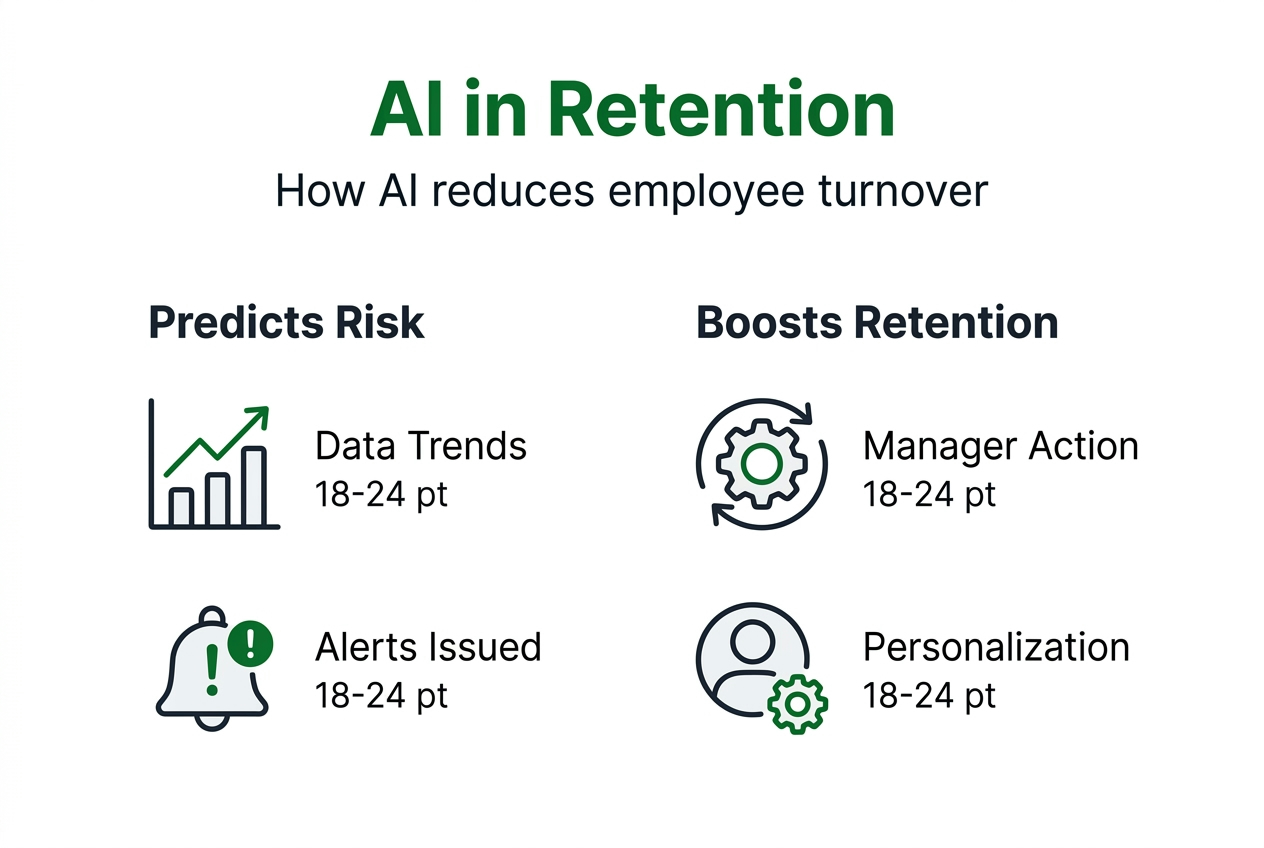
Predictive models analyze multiple data streams simultaneously. Performance metrics reveal declining output or missed deadlines. Engagement survey responses show drops in satisfaction or alignment with company values. Attendance patterns flag increased sick days or late arrivals. Sentiment analysis uses natural language processing to detect disengagement themes anonymously from employee communications, identifying frustration, burnout, or disconnection without invading individual privacy.
When AI flags a high-risk employee, it generates alerts that enable managers to conduct timely, personalized retention conversations. These interventions address specific concerns rather than generic stay interviews. A manager might learn that an employee feels unchallenged in their current role and can immediately discuss growth opportunities. Another might discover workload imbalance and can redistribute tasks before burnout sets in.
| Risk Factor | AI Detection Method | Retention Intervention |
|---|---|---|
| Declining engagement | Survey response trends, collaboration frequency | One-on-one coaching, role adjustment |
| Performance slippage | Quality metrics, deadline adherence | Skills training, workload rebalancing |
| Communication withdrawal | Message frequency, meeting participation | Check-in conversations, team inclusion |
| Career stagnation signals | Learning activity drops, internal mobility searches | Development planning, promotion discussion |
Combining AI insight with human intervention can reduce turnover by approximately 20%. The technology handles the impossible task of continuously monitoring hundreds or thousands of employees, while managers apply emotional intelligence and contextual understanding to retention conversations. This partnership leverages the strengths of both machine learning and human empathy.
Pro Tip: Configure AI systems to provide managers with specific conversation starters based on detected risk factors, making retention discussions feel natural rather than surveillance-driven. This approach increases intervention success rates while maintaining trust.
Understanding predictive analytics in HR requires recognizing that these systems identify correlations, not certainties. Human judgment remains essential to interpret alerts within broader organizational context and employee circumstances.
AI-enhanced employee engagement and retention
Personalized recognition powered by AI dramatically increases the likelihood employees will stay with their organization. Employees who feel their work is valued through AI-personalized recognition are 2.5 times more likely to stay compared to those receiving generic acknowledgment. AI systems analyze individual preferences to deliver recognition in formats that resonate, whether public praise, private thank-you messages, or tangible rewards aligned with personal interests.

Internal mobility platforms powered by AI enable data-driven career pathing that reduces turnover by 10-15%. These systems match employee skills, aspirations, and performance data with internal opportunities before workers start looking externally. When employees see clear advancement paths within their current organization, they invest in development rather than job hunting. AI recommendations surface opportunities employees might not discover through traditional job boards, expanding their sense of possibility.
Personalized interventions extend beyond recognition and mobility:
- Learning recommendations tailored to career goals keep employees engaged in skill development
- Mentorship matching connects employees with advisors who share relevant experience
- Project assignments align with interests revealed through engagement data and past work preferences
- Workload balancing algorithms identify overburdened team members before burnout occurs
AI chatbots automate routine HR queries, freeing HR professionals to focus on human-centric retention efforts. Employees get instant answers about benefits, time off policies, or payroll questions without waiting for HR availability. This immediate service improves satisfaction while allowing HR teams to dedicate time to complex issues requiring empathy and judgment, such as conflict resolution, career counseling, or accommodation requests.
The personalization at scale that AI enables would be impossible manually. A 500-person organization would require dozens of HR staff to deliver the individualized attention that AI provides automatically. This efficiency doesn’t replace human connection, it creates space for more meaningful interactions by handling transactional tasks.
Pro Tip: Combine AI-generated personalization with manager involvement to ensure employees feel recognized by humans, not just algorithms. AI should inform manager actions rather than replace them entirely.
AI staffing services connect organizations with specialists who can implement and optimize these engagement systems, ensuring technical excellence and strategic alignment with retention goals.
Common misconceptions about AI in retention
Myth: AI replaces HR managers and eliminates the need for human judgment in retention decisions. Fact: AI augments rather than replaces managers; human oversight remains essential to prevent bias and ensure ethical decision-making. AI provides data-driven nudges and insights, but retention decisions require empathy, contextual understanding, and relationship-building that machines cannot replicate. A manager who receives an AI alert about an at-risk employee must still have a genuine conversation, interpret concerns within organizational dynamics, and craft personalized solutions.
Myth: AI leads to invasive employee surveillance that erodes trust and creates a Big Brother workplace culture. Fact: Ethical AI use includes transparency, governance, and limits on data scope to maintain trust while delivering insights. Organizations that communicate clearly about what data AI analyzes, how it protects privacy, and why it benefits employees see higher acceptance rates. Sentiment analysis, for example, examines aggregated patterns rather than individual messages, protecting privacy while detecting team-wide engagement issues.
The reality is that AI tools increase manager follow-up rates on retention risks by approximately 30%, supporting rather than substituting human roles. Managers gain confidence in addressing potential problems because they have data backing their instincts. This empowerment leads to more proactive leadership rather than reactive crisis management.
Key distinctions that matter:
- AI surfaces patterns; managers interpret meaning and context
- AI flags risks; humans decide interventions and maintain relationships
- AI automates analysis; managers deliver empathy and judgment
- AI provides recommendations; leaders make final decisions with ethical considerations
“AI is not here to replace the human touch in HR. It’s here to give HR professionals superpowers, freeing them from administrative burden so they can focus on what they do best: connecting with people, understanding their needs, and creating cultures where everyone can thrive.”
Concerns about job displacement in HR stem from misunderstanding AI’s role. The technology shifts HR work from data compilation to strategic action, from answering repetitive questions to solving complex human challenges. Organizations that frame AI as a tool that elevates HR work rather than threatens it see smoother adoption and better results.
AI adoption pilot programs help organizations test these systems in controlled environments, building confidence through measurable results before full deployment.
Risks and ethical considerations for AI in retention
Privacy intrusion represents a major risk when analyzing personal employee data without clear boundaries and consent. Privacy intrusion and algorithmic bias are top risks; governance with human signoff and regular bias audits mitigate downsides. Organizations must establish explicit policies defining what data AI systems can access, how long it’s retained, and who can view insights. Transparent communication about these boundaries builds trust, while secret monitoring destroys it irreparably.
Algorithmic bias risks can unfairly target or overlook employees based on historical patterns that reflect existing inequities rather than genuine performance indicators. If an AI system learns from past promotion decisions that favored certain demographics, it may perpetuate those biases when flagging flight risks or recommending interventions. Regular bias audits examining outcomes across demographic groups are necessary to identify and correct these patterns before they harm individuals or expose organizations to legal liability.
Human review and signoff on high-impact AI decisions ensure ethical standards and compliance with employment regulations. Automated systems should never terminate, demote, or discipline employees without human evaluation of context and fairness. This oversight prevents algorithmic errors from causing real harm and maintains accountability for decisions affecting people’s livelihoods and careers.
Transparency about AI processes and involving employees in governance foster trust that makes retention programs effective:
- Explain what data feeds AI systems and why each type matters for insights
- Share how AI protects individual privacy while analyzing collective patterns
- Invite employee representatives to participate in AI ethics committees
- Provide clear channels for workers to question or appeal AI-influenced decisions
- Publish regular reports on AI system performance and bias audit results
Failing to govern AI properly can erode employee confidence and reduce retention gains, turning a powerful tool into a source of anxiety and resentment. Workers who feel monitored without consent or concerned about biased treatment will disengage regardless of AI’s technical capabilities. The perception of fairness matters as much as actual fairness in maintaining organizational trust.
Ethical AI adoption requires ongoing vigilance rather than one-time setup. As systems learn from new data and organizational contexts evolve, regular review ensures alignment with values and regulations. Establishing clear escalation paths for ethical concerns gives employees confidence that problems will be addressed rather than ignored.
Organizations should document ethical AI governance steps in formal policies accessible to all employees, demonstrating commitment to responsible technology use in retention strategies.
Case studies and quantified impact of AI on retention
Pilot programs show 15% improvement in 90-day retention and 20% faster HR case resolution due to AI-driven risk alerts and automated query handling. Several organizations across industries have documented measurable retention improvements after implementing AI systems. A technology company running a six-month pilot in their sales organization reduced new hire turnover from 28% to 13% by using AI alerts to trigger personalized onboarding adjustments and early manager check-ins.
Integrating AI risk alerts allows managers to intervene early, reducing both turnover and support cases that escalate to HR. When managers address concerns proactively, employees feel heard before frustration builds to resignation levels. This early intervention reduces the volume of formal grievances, accommodation requests, and exit processes that consume HR resources. One manufacturing firm reported a 35% decrease in HR case volume after deploying AI that flagged workload imbalance and enabled immediate reallocation.
| Organization Type | AI Application | Retention Impact | Additional Benefit |
|---|---|---|---|
| Tech company | Predictive turnover alerts | 15% reduction in 90-day departures | 30% increase in manager proactive conversations |
| Healthcare system | Sentiment analysis | 18% decrease in nurse turnover | 25% improvement in engagement scores |
| Financial services | Internal mobility matching | 12% retention gain | 40% increase in internal promotions |
| Retail chain | Chatbot for HR queries | 10% retention improvement | 50% faster response times |
HR query resolution times improved by up to 20-50%, improving overall employee experience and reducing frustration with administrative processes. Employees no longer wait days for answers about benefits enrollment or time off policies. Instant, accurate responses from AI chatbots eliminate friction points that erode satisfaction and create negative perceptions of organizational support.
Data shows internal mobility platforms powered by AI increase retention by 10-15% by surfacing opportunities employees might otherwise miss. Workers who find growth paths internally stay longer and perform better than those who feel stuck in their current roles. AI democratizes access to opportunity by matching skills to openings regardless of personal networks or manager advocacy.
“We implemented AI retention analytics expecting modest improvements. Within six months, our voluntary turnover dropped 22%, and manager confidence in addressing retention risks increased dramatically. The technology paid for itself in saved recruitment costs within the first quarter.”
Case studies exemplify how combining AI insights with manager actions yields measurable retention gains that exceed technology-only or human-only approaches. The synergy between data-driven identification and empathetic intervention creates a retention system greater than the sum of its parts.
AI staffing success stories demonstrate how organizations access specialized talent to build and optimize these transformative retention systems without expanding internal headcount.
Practical frameworks and implementation strategies
Starting with low-risk pilots measuring engagement, retention, and query resolution KPIs combined with governance frameworks is critical for success. Organizations that attempt full-scale AI deployment without testing often face technical issues, user resistance, and unclear ROI. A phased approach builds confidence, demonstrates value, and allows refinement before broader rollout.
Follow this step-by-step framework for AI retention implementation:
- Begin with focused low-risk pilots targeting specific departments with high turnover, measurable baselines, and willing managers who will champion adoption.
- Deploy AI tools for predictive analytics and employee engagement personalization, starting with one or two use cases rather than comprehensive systems.
- Train managers and HR staff on interpreting AI outputs and ethical governance, ensuring they understand both technical capabilities and human oversight responsibilities.
- Regularly measure KPIs including engagement scores, retention rates of flagged employees, HR resolution times, and manager follow-up rates to quantify impact.
- Establish governance protocols including bias audits, transparent communication, human signoff requirements, and employee feedback channels before expanding deployment.
| AI Retention Tool Type | Primary Function | Implementation Complexity | Typical ROI Timeline |
|---|---|---|---|
| HR chatbots | Automate routine queries | Low | 3-6 months |
| Sentiment analysis | Monitor engagement patterns | Medium | 6-9 months |
| Predictive analytics platforms | Flag flight risks | Medium-High | 9-12 months |
| Full retention management systems | Integrate multiple functions | High | 12-18 months |
Pro Tip: Ensure human signoff on all AI-generated decisions impacting employee status to prevent over-reliance on algorithms and maintain ethical standards.
Key performance indicators to track throughout implementation:
- Voluntary turnover rate compared to pre-AI baseline
- Time between flight risk alert and manager intervention
- Employee engagement scores from surveys
- HR case resolution time and volume
- Manager confidence in addressing retention proactively
- Employee trust scores related to AI use
Successful implementation requires executive sponsorship to secure resources and signal organizational commitment. HR leaders should present AI retention investments as strategic initiatives with measurable business impact rather than experimental technology projects. Quantifying the cost of turnover and projecting savings from even modest retention improvements builds compelling business cases.
Integrate AI retention tools with existing HR systems rather than creating isolated platforms. Seamless data flow between performance management, learning systems, and AI analytics maximizes insight quality while minimizing manual data entry. Technical integration challenges often determine success or failure, making expert implementation support valuable.
AI retention pilot programs provide access to specialists who guide implementation, avoiding common pitfalls and accelerating time to value. Organizations should also consider timing AI adoption to align with strategic planning cycles and budget availability.
Continuous improvement cycles refine AI models based on outcomes. If predicted flight risks don’t materialize into actual departures, models need recalibration. If certain demographics show different alert rates, bias audits should investigate potential unfairness. AI retention systems require ongoing attention rather than set-and-forget deployment.
Discover AI-powered staffing solutions with Fuerza
Implementing the AI retention strategies outlined in this guide requires specialized technical talent with expertise in machine learning, HR analytics, and ethical AI governance. AI-powered staffing solutions from Fuerza connect you with pre-vetted experts who can accelerate your retention initiatives while ensuring best practices and measurable results.
Fuerza’s nearshore and onshore talent pool includes data scientists, AI engineers, and HR technology specialists experienced in building and optimizing retention systems. Their scalable staffing approach lets you access expertise precisely when needed, whether for pilot program implementation, full system deployment, or ongoing optimization.
Expert support ensures ethical and effective AI adoption tailored to your organization’s culture, technical infrastructure, and retention challenges. Rather than navigating complex implementation alone, you gain partners who have successfully deployed similar systems and can help you avoid costly mistakes.
AI staffing services from Fuerza integrate seamlessly with your HR and workforce planning initiatives, providing flexible engagement models from project-based support to long-term embedded team members. Their Miami headquarters and focus on US clients means time zone alignment and cultural fit for American enterprises and startups.
Join the AI talent waitlist to gain early access to specialists who can transform your retention strategy with cutting-edge AI capabilities while maintaining the human touch that keeps employees engaged and loyal.
Frequently asked questions
What are the key benefits of using AI in employee retention?
AI provides early identification of turnover risks months before resignation by analyzing engagement, performance, and behavioral patterns invisible to manual observation. This early warning enables proactive interventions that address specific concerns rather than generic retention efforts. Personalized engagement powered by AI increases the likelihood employees stay by 2.5 times through tailored recognition, career pathing, and development recommendations. Automation of routine HR queries frees professionals to focus on complex human challenges requiring empathy and judgment. When integrated with human decision-making, AI improves both retention rates and employee satisfaction while reducing the cost burden of constant recruitment and onboarding. Organizations report 10-20% retention improvements within pilot programs, with benefits scaling as systems mature and learn from outcomes. Access AI talent solutions to build teams capable of implementing these transformative systems effectively.
How does AI avoid bias and privacy issues in retention management?
Mitigation involves regular bias audits examining AI outcomes across demographic groups to identify and correct patterns reflecting historical inequities rather than genuine performance. Human oversight for high-impact decisions prevents automated systems from terminating, demoting, or disciplining employees without contextual evaluation and fairness review. Transparency about data use, including explicit policies on what information AI analyzes and how long it’s retained, builds trust essential for effective retention programs. Employee involvement in governance through ethics committees and clear appeal channels ensures concerns are heard and addressed promptly. Clear policies and technological safeguards like aggregated sentiment analysis rather than individual message monitoring protect privacy while delivering valuable insights.
What steps should organizations follow to implement AI retention tools effectively?
Start with focused pilots in departments with high turnover and willing managers who will champion adoption, establishing measurable baselines before deployment. Deploy one or two AI use cases initially rather than comprehensive systems, allowing teams to learn and refine approaches before broader rollout. Train managers on interpreting AI insights and ethical governance responsibilities, ensuring they understand both technical capabilities and human oversight requirements. Measure key performance indicators including engagement scores, retention rates of flagged employees, and HR resolution times to quantify impact and justify expansion. Establish ethical governance including bias audits, transparent communication, and human signoff on high-impact decisions before scaling deployment. Gradually expand based on pilot results while maintaining human oversight and continuous improvement cycles that refine models based on outcomes. Expert guidance from AI retention pilot specialists accelerates implementation and helps avoid common pitfalls that delay value realization.
Can small organizations benefit from AI retention tools or are they only for large enterprises?
Small organizations can benefit significantly from AI retention tools, especially cloud-based platforms that require minimal technical infrastructure and offer usage-based pricing. Losing even one key employee has proportionally greater impact in small teams, making early intervention particularly valuable. Many AI retention vendors now offer solutions scaled for organizations with 50-500 employees, focusing on high-impact use cases like HR chatbots and basic predictive analytics. Small companies should prioritize tools with quick implementation, intuitive interfaces requiring minimal training, and clear ROI within 6-12 months. The key is selecting solutions matching organizational maturity and technical capacity rather than attempting enterprise-grade systems requiring dedicated data science teams.
Recommended
- Fuerza — Hire Pre-Vetted AI & Tech Talent | AI-Powered Staffing
- Fuerza — Hire Pre-Vetted AI & Tech Talent | AI-Powered Staffing
- Fuerza — Hire Pre-Vetted AI & Tech Talent | AI-Powered Staffing
- Fuerza — Hire Pre-Vetted AI & Tech Talent | AI-Powered Staffing
- 7 Key AI Trends in 2025 Every UK Professional Should Know - Kefihub
- Employee Retention Solutions, Lower Turnover | OpenElevator