
How to build remote teams that scale in 2026
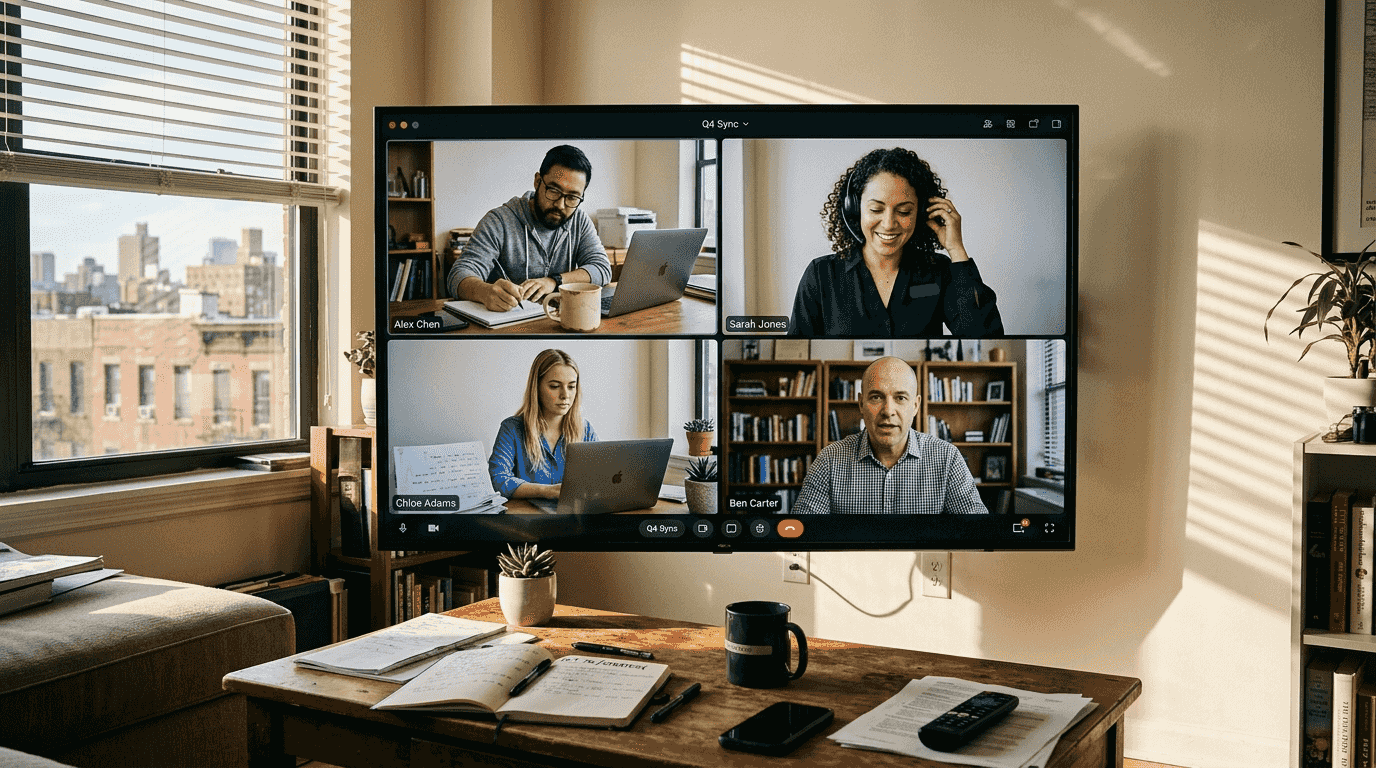
Hiring managers face a deceptive challenge when building remote teams: what looks like a simple shift from office to distributed work actually demands rethinking every step of your hiring and management process. Remote and hybrid work remain durable parts of the U.S. labor market, yet most organizations still approach remote hiring with office-based assumptions. This guide walks you through practical frameworks to build, onboard, and scale high-performing remote teams using pre-vetted professionals, avoiding the costly mistakes that undermine distributed team success.
Table of Contents
- Understand The Remote Work Landscape And Common Hiring Challenges
- Prepare Your Hiring Process: Define Outcomes And Select Candidates Effectively
- Execute Remote Onboarding And Management With Effective Processes And Tools
- Verify And Scale: Measure Remote Team Success And Leverage Diversity Benefits
- Scale Your Remote Teams Faster With Fuerza’s AI-Powered Staffing
Key takeaways
| Point | Details |
|---|---|
| Define clear outcomes | Focusing on measurable role outcomes rather than task lists improves remote hiring success and team alignment. |
| Plan longer onboarding | Remote onboarding requires 30-50% more time than traditional processes to ensure effective communication and cultural integration. |
| Adopt different management | Remote teams need asynchronous tools, clear communication norms, and timezone-aware collaboration frameworks. |
| Leverage diversity gains | Remote work increases access to underrepresented talent pools and boosts overall workforce productivity by 10%. |
| Consider initial in-person | Starting with in-person training can significantly improve long-term remote performance and reduce attrition rates. |
Understand the remote work landscape and common hiring challenges
Remote work has stabilized as a permanent fixture in the American labor market rather than fading as a pandemic-era experiment. Yet hiring managers continue to stumble over predictable obstacles when building distributed teams. The most damaging mistake is treating remote roles like office positions with a location change. This superficial approach leads to misaligned expectations, poor candidate fit, and expensive turnover.
Three critical errors plague remote hiring efforts. First, managers focus on tasks instead of outcomes, creating job descriptions that list activities rather than defining what success looks like. Second, unstructured interviews allow bias and gut feelings to override objective assessment, resulting in inconsistent hiring decisions. Third, inadequate onboarding leaves new remote employees struggling to navigate company culture and communication norms without the ambient learning that happens naturally in physical offices.
Understanding these pitfalls is the foundation for building effective remote teams. You need a systematic approach that acknowledges the unique demands of distributed work. The good news is that remote hiring services can help you avoid these traps by providing structured frameworks and pre-vetted candidates who already understand remote work dynamics.
Common challenges hiring managers face include:
- Difficulty assessing soft skills and cultural fit through video interviews alone
- Uncertainty about productivity measurement without physical oversight
- Struggles coordinating across multiple time zones and asynchronous workflows
- Inadequate tools and processes for remote collaboration and knowledge sharing
- Higher initial costs for comprehensive onboarding and technology infrastructure
Recognizing these challenges early allows you to design hiring processes that address them proactively rather than discovering problems after making expensive hiring mistakes.
Prepare your hiring process: define outcomes and select candidates effectively
Successful remote hiring starts with clarity about what you actually need someone to accomplish. Instead of listing responsibilities like “manage social media accounts” or “write code,” define measurable outcomes such as “increase engagement rate by 15%” or “reduce page load time to under 2 seconds.” This outcome-focused approach helps candidates understand expectations and gives you objective criteria for evaluation.
Implementing skills testing transforms your selection process from subjective to evidence-based. Strong remote hires come from defining role outcomes, using skills tests, running structured interviews, and following a 30-60-90 day onboarding plan with clear communication norms. Skills tests reveal actual capabilities rather than resume claims, reducing the risk of bad hires who interview well but underperform.

Structured interviews ensure consistency across candidates and minimize bias. Create a standardized question set that probes for remote work competencies like self-direction, communication clarity, and problem-solving without immediate supervision. Research shows that video interview practice boosts hiring chances by 25% in 2026, so consider offering candidates preparation resources to level the playing field.
Your selection framework should include:
- Clear outcome definitions with measurable success criteria for the first 90 days
- Skills assessments that simulate actual work tasks rather than theoretical knowledge
- Structured interview questions that evaluate remote work competencies consistently
- Reference checks focused on remote work performance and communication effectiveness
- Trial projects or paid test assignments to observe real working behavior
Pro Tip: Create a scoring rubric that assigns numerical values to each evaluation criterion, then require multiple interviewers to score independently before discussing. This prevents the first person’s opinion from anchoring the entire team’s assessment.
Understanding hiring process timing helps you balance speed with thoroughness. While you want to move quickly to secure top talent, rushing through skills testing and structured interviews increases the risk of expensive mistakes. Working with pre-vetted talent selection services can accelerate your timeline without sacrificing quality, since candidates have already cleared initial screening hurdles.
The 30-60-90 day onboarding framework gives new hires clear milestones. In the first 30 days, they should master tools and processes while building relationships. By day 60, they should contribute independently on smaller projects. At 90 days, they should deliver measurable outcomes aligned with the role definition you created during hiring.
Execute remote onboarding and management with effective processes and tools
Remote onboarding demands significantly more time and intentionality than traditional office orientation. Remote onboarding takes 30-50% longer than in-office onboarding because you must explicitly teach the cultural norms and communication patterns that office workers absorb through observation. This extended timeline is an investment, not a waste, since thorough onboarding dramatically improves retention and performance.
Remote teams require fundamentally different processes, tools, and management approaches compared to traditional office-based teams. You cannot simply replicate office management through video calls. Instead, embrace asynchronous communication as the default, using synchronous meetings only for discussions that genuinely require real-time interaction.
Essential technology infrastructure includes project management platforms like Asana or Monday for transparent task tracking, video conferencing tools like Zoom for face-to-face connection, and documentation hubs like Notion or Confluence for centralized knowledge. Equally important are communication norms that specify response time expectations, preferred channels for different message types, and guidelines for when to use synchronous versus asynchronous methods.
Key onboarding and management practices:
- Assign a dedicated onboarding buddy who checks in daily during the first two weeks
- Create comprehensive documentation for every process, tool, and workflow
- Schedule regular one-on-one video calls to build relationships and address concerns
- Establish core collaboration hours when the entire team is available simultaneously
- Use recorded video messages for training and updates that don’t require live interaction
Pro Tip: Identify 3-4 hours of overlapping work time across all team members’ time zones and protect these hours for collaborative work, allowing flexibility for focused individual work outside this window.
The AI-powered staffing platform approach streamlines remote team building by connecting you with professionals who already understand distributed work dynamics. This eliminates the learning curve of teaching remote work basics, allowing you to focus onboarding time on company-specific processes and culture. You can join the staffing waitlist to access pre-vetted remote talent.
| Aspect | Remote Teams | Office Teams |
|---|---|---|
| Onboarding Duration | 6-8 weeks | 4-5 weeks |
| Primary Communication | Asynchronous (Slack, email) | Synchronous (in-person, calls) |
| Management Focus | Outcomes and deliverables | Presence and activity |
| Collaboration Style | Documented and transparent | Informal and verbal |
| Technology Dependency | Critical infrastructure | Helpful enhancement |
Effective remote management requires shifting from monitoring activity to evaluating outcomes. You cannot see whether someone is at their desk, so you must define what success looks like and trust team members to achieve it. This outcome-focused approach often improves productivity because it eliminates performative busyness in favor of actual results.
Verify and scale: measure remote team success and leverage diversity benefits
Measuring remote team performance requires different metrics than office-based evaluation. Focus on output quality, project completion rates, and stakeholder satisfaction rather than hours logged or responsiveness to instant messages. Workforce productivity rose by 10% for remote employees, demonstrating that distributed work enhances rather than hinders performance when managed properly.
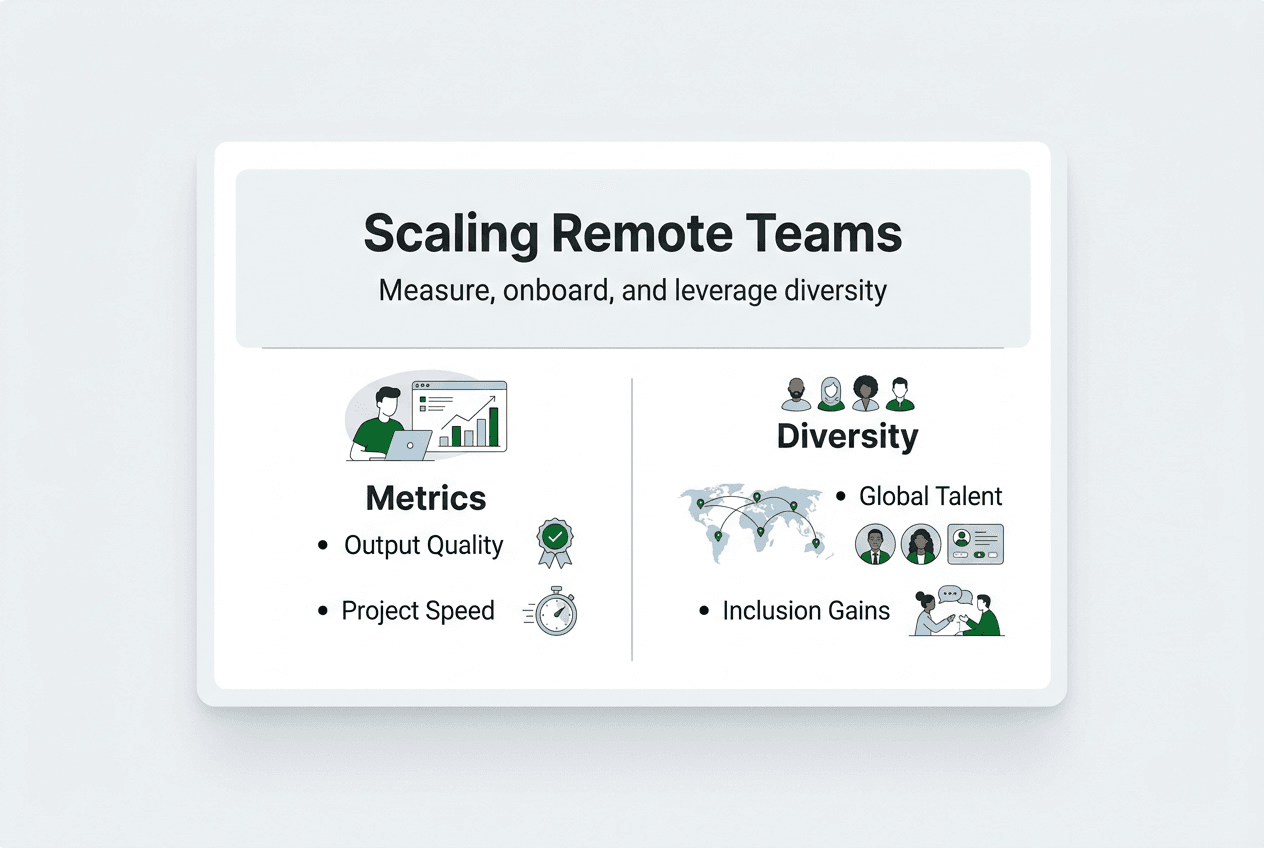
Remote work expands your talent pool beyond geographic constraints, creating meaningful diversity benefits. Fully remote work increased the share of women, including married women, rural and smaller-town residents in the workforce. This broader access to underrepresented groups strengthens team perspectives and drives innovation through diverse viewpoints and experiences.
Consider the success story of Zapier, which demonstrates remote team potential at scale. Zapier reached $100 million in Annual Recurring Revenue with minimal venture capital while operating as a remote team. Their distributed model enabled lean operations and access to global talent without the overhead of physical offices, proving that remote teams can achieve exceptional growth.
Initial in-person training, even for remote roles, can accelerate long-term success. Bringing new hires to headquarters for the first week builds relationships and cultural understanding that persist throughout their tenure. While this approach requires upfront investment, it typically reduces attrition and improves performance over time.
| Metric | Traditional Teams | Remote Teams |
|---|---|---|
| Talent Pool Size | Local market only | Global access |
| Diversity Representation | Limited by geography | Significantly broader |
| Productivity Gains | Baseline | 10% higher on average |
| Overhead Costs | Office space required | Reduced facility expenses |
| Attrition Risk | Moderate | Lower with proper onboarding |
Best practices for measuring and scaling remote team success:
- Track project completion rates and quality metrics rather than activity indicators
- Survey team members regularly about communication effectiveness and support needs
- Monitor time-to-productivity for new hires to refine your onboarding process
- Measure stakeholder satisfaction with remote team deliverables and responsiveness
- Analyze retention rates and exit interview feedback to identify improvement areas
Scaling remote teams successfully requires maintaining culture and communication quality as headcount grows. Growing diverse remote talent pools gives you access to specialized skills that might not exist in your local market. This geographic flexibility becomes a competitive advantage, allowing you to build capabilities that would be impossible with location-constrained hiring.
The remote work diversity study provides compelling evidence that distributed teams drive meaningful workforce inclusion. By removing geographic barriers, you can hire exceptional talent regardless of where they live, creating teams that reflect diverse perspectives and experiences.
Scale your remote teams faster with Fuerza’s AI-powered staffing
Building effective remote teams requires time, expertise, and systematic processes that many organizations lack. Fuerza’s AI-powered staffing platform accelerates your remote hiring by connecting you with pre-vetted AI and tech professionals who already understand distributed work dynamics. Our talent matching optimizes role fit while dramatically reducing time-to-hire.
Whether you need freelancers for project work or full-time team members for long-term growth, our flexible staffing services overview adapts to enterprise and startup needs alike. We focus on nearshore and onshore resources for US clients, ensuring time zone alignment and cultural fit while maintaining the diversity benefits of remote hiring.
Key benefits of partnering with Fuerza:
- Pre-vetted talent eliminates initial screening and reduces hiring risk
- AI-driven matching identifies candidates who fit your specific requirements
- Faster hiring timelines without sacrificing quality or thoroughness
- Ongoing support ensures smooth onboarding and long-term success
Join the Fuerza waitlist to access our network of remote professionals and start building your distributed team with confidence. Our Miami-based team understands the unique challenges US companies face when scaling remote operations.
FAQ
What tools are essential for remote team management?
Project management software like Asana or Monday provides transparent task tracking and progress visibility. Video conferencing platforms such as Zoom enable face-to-face connection for relationship building and complex discussions. Documentation hubs like Notion or Confluence centralize knowledge and processes so information remains accessible. Clear communication norms around response times and channel usage make these remote team management tools effective rather than just present.
How long does remote onboarding typically take compared to in-office?
Remote onboarding takes 30-50% longer than in-office onboarding, typically extending from 4-5 weeks to 6-8 weeks. This additional time allows for explicit teaching of communication norms, cultural values, and collaboration processes that office workers absorb through ambient observation. The extended timeline is an investment that improves retention and accelerates long-term productivity.
What are the diversity benefits of building remote teams?
Fully remote work increased the share of women, including married women, rural and smaller-town residents in the workforce by removing geographic barriers to employment. This broader talent pool enhances team innovation through diverse perspectives and experiences. Remote hiring allows you to build teams that reflect varied backgrounds and viewpoints regardless of proximity to your physical office.
How can I measure productivity in a remote team?
Focus on output-based metrics such as project completion rates, deliverable quality, and stakeholder satisfaction rather than activity indicators like hours logged. Workforce productivity rose by 10% for remote employees when evaluated on outcomes instead of presence. Monitor communication efficiency through response times on critical issues and track employee engagement through regular surveys about support needs and obstacles.
Recommended
- Fuerza — Hire Pre-Vetted AI & Tech Talent | AI-Powered Staffing
- Fuerza — Hire Pre-Vetted AI & Tech Talent | AI-Powered Staffing
- Fuerza — Hire Pre-Vetted AI & Tech Talent | AI-Powered Staffing
- Fuerza — Hire Pre-Vetted AI & Tech Talent | AI-Powered Staffing
- Scale your fitness business with automation in 2026 | TrainingPro