
How AI transforms contract workforce management in 2026
How AI transforms contract workforce management in 2026

Managing a contract workforce can drain millions from your bottom line without you realizing it. EXL discovered 20% of their workforce skills were not deployable, costing them $4 million in lost revenue annually. Fragmented data, siloed systems, and manual allocation processes create blind spots that leave talented contractors idle while urgent projects go understaffed. AI-powered platforms are changing this equation entirely. By centralizing workforce data and automating intelligent matching, these systems cut allocation cycle times in half while unlocking millions in previously hidden revenue. This guide explores how AI revolutionizes contract workforce management, the measurable benefits it delivers, and practical steps to implement these solutions in your organization.
Table of Contents
Quantifiable Benefits Of AI In Contract Workforce Management
How AI Platforms Streamline Contract Workforce Allocation Workflows
Applying AI Insights For Effective Contract Workforce Management
Discover AI-Powered Contract Workforce Solutions With Fuerza
Key takeaways
PointDetailsSpeed gainsAI reduces resource allocation cycle times by 50%, accelerating project staffing and deploymentRevenue impactAI-driven workforce management generates multimillion-dollar annual revenue increases through better utilizationData centralizationUnified AI platforms eliminate fragmented systems, enabling accurate talent deployment decisionsSkill optimizationProactive identification and allocation of contractor skills prevents costly underutilization
Understanding AI’s impact on contract workforce management
Contract workforce management presents unique challenges that traditional HR systems struggle to address. Fragmented data and no centralized reporting system make it difficult to accurately assess and allocate resources timely, leaving hiring managers flying blind when matching contractors to projects. When your workforce data lives in spreadsheets, email threads, and disconnected databases, you cannot see the full picture of available skills and capacity.
This fragmentation creates a vicious cycle. Skills mismatch becomes inevitable when you lack visibility into contractor capabilities across your entire talent pool. A software developer with specialized machine learning expertise sits idle on a legacy maintenance project while your AI initiative scrambles to find qualified talent externally. These misalignments translate directly to lost revenue, missed deadlines, and frustrated team members on both sides.
AI platforms solve this fundamental visibility problem by creating a single source of truth for your contract workforce:
Centralized databases capture comprehensive skill profiles, certifications, project history, and availability status
Real-time dashboards surface capacity constraints and skill gaps before they impact delivery
Automated alerts notify managers when contractor assignments end, preventing idle time between projects
Historical analytics identify patterns in successful placements to improve future matching
The algorithms powering these platforms analyze your global contract workforce continuously, processing variables human managers cannot track manually. They evaluate technical skills, soft skills, industry experience, client preferences, timezone compatibility, and dozens of other factors simultaneously. This computational power enables matching decisions that optimize for multiple objectives: project requirements, contractor development goals, client satisfaction, and revenue maximization.
“AI transforms contract workforce management from reactive firefighting into proactive strategic planning. Instead of scrambling to fill urgent needs, you anticipate demand and position talent before projects even kick off.”
For distributed contract workforces spanning multiple countries and time zones, this enhanced transparency becomes even more critical. AI solves data fragmentation by maintaining unified profiles that follow contractors across projects, teams, and geographies. Hiring managers gain unprecedented responsiveness, answering “who’s available with Python and healthcare domain knowledge?” in seconds instead of days.
Quantifiable benefits of AI in contract workforce management
The business case for AI in contract workforce management rests on concrete, measurable improvements that impact your P&L directly. EXL halved resource allocation cycle times and achieved million-dollar savings using a single ServiceNow AI platform, demonstrating returns that justify investment within months, not years. Speed matters because every day a skilled contractor sits unassigned represents pure revenue loss.
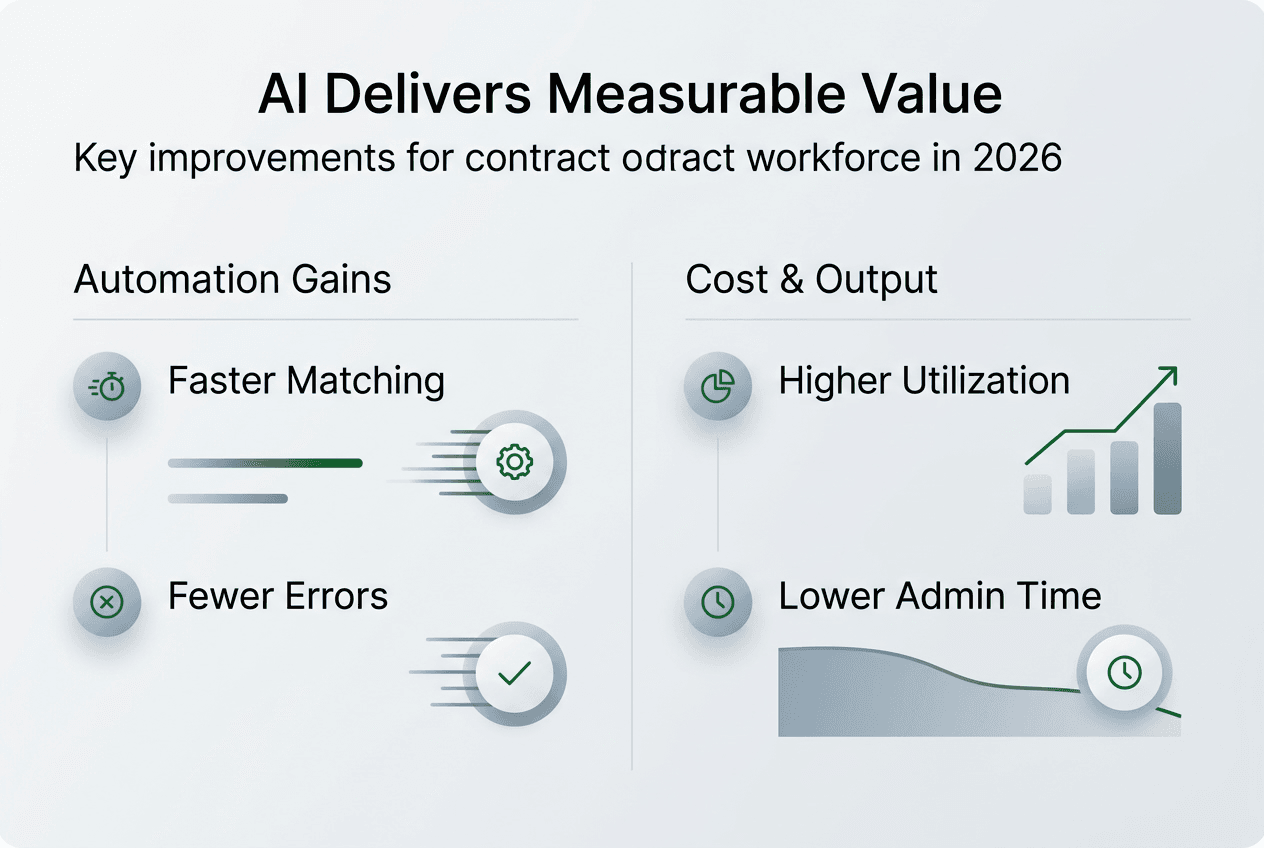
Consider the math on cycle time reduction. If your current process takes 10 days to match a contractor to a project, and AI cuts that to 5 days, you recover 5 billable days per placement. Multiply that across hundreds of contractors and dozens of projects annually, and the revenue impact becomes substantial. Faster allocation also improves contractor satisfaction since top talent dislikes idle time between assignments.
The revenue gains extend beyond speed improvements. By identifying and deploying previously non-deployable skills, organizations recover millions in lost capacity. When 20% of your contractor skills go unused, you are essentially paying for talent you cannot monetize. AI-driven skill mapping and proactive allocation convert this dormant capacity into billable hours and project value.
MetricBefore AIAfter AIImprovementAllocation cycle time10 days5 days50% reductionNon-deployable skills20%8%60% improvementAnnual revenue impactBaseline+$4MSignificant gainUtilization rate72%89%17 point increase
These improvements compound over time. Higher utilization rates mean you can deliver more projects with your existing contractor base, or reduce the total headcount needed for the same workload. Better matching reduces project failures and rework caused by skill mismatches. Contractors who consistently land roles aligned with their expertise deliver higher quality work and achieve better outcomes.
Pro Tip: Track allocation cycle time as your primary AI success metric during initial implementation. This KPI directly correlates with revenue impact and provides clear before/after comparison data that demonstrates ROI to stakeholders.
The cost savings extend beyond direct revenue gains. AI resource allocation timing strategies reduce the administrative burden on hiring managers and project leads who previously spent hours manually searching for available talent. This freed capacity allows them to focus on strategic workforce planning rather than tactical firefighting. AI enhances project capacity by ensuring every contractor operates in their zone of genius, maximizing both productivity and job satisfaction.
How AI platforms streamline contract workforce allocation workflows
AI platforms fundamentally redesign contract workforce workflows by integrating previously disconnected processes into seamless, automated systems. ServiceNow gives the ability to capture, assess, and manage resource allocations and fulfillments on one AI platform, eliminating the context switching and data re-entry that plague manual approaches. Instead of maintaining separate systems for contractor profiles, project requirements, and allocation tracking, everything lives in one intelligent environment.

The workflow transformation starts with data collection. Modern AI platforms automatically ingest contractor information from multiple sources: resumes, certifications, project completion records, client feedback, and skills assessments. Natural language processing extracts relevant skills and experience without manual data entry. As contractors complete projects, the system updates their profiles automatically, maintaining an always-current view of capabilities and availability.
Skills matching algorithms represent the core intelligence that drives allocation decisions. These systems evaluate hundreds of variables simultaneously:
Technical skills match between contractor profile and project requirements
Availability windows that align with project timelines
Previous performance on similar projects or with similar clients
Contractor preferences for project types, industries, or team structures
Client feedback and satisfaction scores from past engagements
Learning and development goals that align with project opportunities
The platform generates ranked recommendations rather than binary matches, allowing hiring managers to make informed decisions quickly. You see why the system recommends each contractor, what trade-offs exist between options, and how confident the algorithm is in each match.
Integrated workflows improve communication and tracking throughout the allocation lifecycle. When a project need arises, the system notifies relevant stakeholders automatically. Contractors receive opportunities that match their profiles without manual outreach. Approvals route through proper channels with full context and audit trails. Everyone sees real-time status updates, eliminating the “did you get my email?” follow-ups that consume manager time.
ApproachData managementMatching processCommunicationTrackingManualSpreadsheets, emailManager intuitionAd hoc emailsStatus meetingsAI-poweredCentralized databaseAlgorithm recommendationsAutomated notificationsReal-time dashboards
Pro Tip: Implement quarterly skill profile reviews where contractors update their capabilities, certifications, and project preferences. This practice ensures AI matching algorithms work with current data, dramatically improving recommendation accuracy and contractor satisfaction with assignments.
Centralized AI reporting benefits extend to strategic workforce planning. Instead of reacting to immediate needs, you analyze trends in skill demand, identify capability gaps before they become critical, and make informed decisions about contractor recruitment and development. AI skill matching platforms provide predictive analytics that forecast future resource needs based on pipeline projects and historical patterns.
The fulfillment tracking capabilities close the loop on allocation decisions. You monitor project progress, contractor performance, and client satisfaction in real time. When issues arise, the system flags them early, allowing proactive intervention before small problems become project failures. This continuous feedback improves future matching decisions, creating a virtuous cycle of better allocations and outcomes. AI workforce management services integrate these workflows end to end, from initial contractor onboarding through project completion and performance review.
Applying AI insights for effective contract workforce management
Implementing AI-driven contract workforce management requires deliberate planning and systematic execution. Enhancing resource planning and talent management with AI leads to annual revenue gains of $4 million, but realizing these benefits demands more than software deployment. You need organizational readiness, clean data, and change management that brings stakeholders along the journey.
Follow this roadmap for successful AI adoption in contract workforce management:
Assess your current state by documenting existing allocation processes, data sources, pain points, and success metrics
Define clear objectives tied to business outcomes like cycle time reduction, utilization improvement, or revenue growth
Audit data quality across all contractor information sources and remediate gaps or inconsistencies
Select an AI platform that integrates with your existing HR and project management systems
Launch a focused pilot with one business unit or project type to prove value before scaling
Train hiring managers and contractors on new workflows and set clear expectations for adoption
Monitor pilot metrics rigorously and iterate based on feedback and results
Scale successful approaches across the organization while maintaining data hygiene and continuous improvement
Data hygiene makes or breaks AI effectiveness. Garbage in, garbage out applies ruthlessly to workforce algorithms. Before implementing AI, invest time cleaning contractor profiles, standardizing skill taxonomies, and establishing data governance processes. Create clear ownership for maintaining data quality over time. Appoint data stewards who ensure profiles stay current as contractors gain new certifications or complete significant projects.
Continuous skill profiling separates good AI implementations from great ones. Contractor capabilities evolve constantly through training, project work, and industry experience. Static profiles become outdated within months, degrading matching accuracy. Establish regular touchpoints where contractors update their skills, preferences, and availability. Make this process lightweight and valuable for contractors by showing how better profiles lead to more relevant, engaging project opportunities.
Essential features to evaluate when selecting AI workforce platforms:
Automated skill extraction from resumes, certifications, and project records
Configurable matching algorithms that reflect your organization’s priorities and constraints
Integration capabilities with existing HRIS, ATS, and project management tools
Real-time dashboards providing visibility into capacity, utilization, and allocation status
Mobile accessibility for contractors to update profiles and respond to opportunities
Robust reporting and analytics for strategic workforce planning
Compliance tracking for contractor certifications, background checks, and legal requirements
Pro Tip: Start your AI pilot with high-impact contract areas where allocation challenges cause the most pain or revenue loss. Quick wins in critical areas build organizational momentum and executive support for broader rollout.
Change management determines whether AI adoption succeeds or stalls. Hiring managers accustomed to manual processes may resist algorithmic recommendations initially. Address this resistance by emphasizing that AI augments rather than replaces human judgment. The platform provides data-driven insights and handles administrative grunt work, freeing managers to focus on strategic decisions and relationship building. Involve skeptical managers early in pilot design so they feel ownership over the approach.
Contractor communication matters equally. Explain how AI benefits them through better project matches, reduced idle time, and opportunities aligned with their development goals. Transparency about how the algorithm works builds trust and encourages contractors to maintain accurate, comprehensive profiles. AI-driven talent solutions succeed when both sides of the marketplace see clear value from participation.
Measure success through metrics that matter to your business. Track allocation cycle times, utilization rates, contractor satisfaction scores, project success rates, and revenue per contractor. Establish baselines before AI implementation and monitor improvements monthly. Share wins broadly to maintain momentum and justify continued investment. AI workforce management services deliver compounding returns as data quality improves and algorithms learn from successful placements over time.
Discover AI-powered contract workforce solutions with Fuerza
Transforming your contract workforce management from manual chaos to AI-powered precision requires the right platform partner. Fuerza delivers AI-driven staffing solutions that connect you with pre-vetted contract professionals across technical, creative, and operational roles. Our platform streamlines the entire hiring and allocation process, from initial talent search through project completion and performance tracking.
Based in Miami and focused on nearshore and onshore resources for US clients, Fuerza combines AI matching algorithms with human expertise to ensure every placement succeeds. Whether you need freelancers for short-term projects or full-time contractors for extended engagements, our AI workforce management services scale with your needs. Access pre-vetted AI tech talent that matches your specific requirements without the weeks of searching and screening that traditional approaches demand. Explore flexible AI staffing pricing plans designed for enterprises and startups alike, with transparent costs and no hidden fees.
FAQ
How can AI improve contract workforce allocation?
AI analyzes skill sets, project requirements, availability windows, and historical performance data in real time to match the right contractors to opportunities quickly and accurately. This intelligent matching reduces idle time between assignments, maximizes billable utilization, and ensures project teams have the exact capabilities they need when they need them.
What challenges do organizations face without AI in workforce management?
Siloed data across disconnected systems makes it nearly impossible to assess total workforce capacity or identify available skills accurately, causing slow, inefficient allocation decisions. Without centralized insights, talented contractors sit idle while urgent projects struggle to find qualified resources, resulting in revenue loss from underutilized capacity and missed delivery commitments.
How should companies start implementing AI for contract workforce management?
Begin with focused pilot projects in high-impact areas where allocation challenges cause significant pain or revenue loss, allowing you to demonstrate value quickly and build organizational support. Ensure your contractor data is clean and centralized before launching AI tools, and continuously update skill profiles to maintain matching accuracy. Involve key stakeholders including hiring managers, project leads, and contractors early in the process to manage change effectively and address concerns proactively.
What ROI can organizations expect from AI workforce platforms?
Organizations typically see allocation cycle times cut by 50% within the first six months of implementation, translating to faster project staffing and reduced administrative overhead. Revenue gains from improved utilization and skill deployment can reach millions annually, as demonstrated by companies that recovered previously non-deployable contractor capacity and converted it into billable project work.
How does AI handle the complexity of matching contractors to projects?
AI algorithms evaluate hundreds of variables simultaneously, including technical skills, soft skills, industry experience, client preferences, timezone compatibility, past performance ratings, and contractor development goals. The platform generates ranked recommendations with confidence scores and explanations, allowing hiring managers to make informed decisions quickly while understanding the trade-offs between different contractor options.
Recommended
Fuerza — Hire Pre-Vetted AI & Tech Talent | AI-Powered Staffing
Fuerza — Hire Pre-Vetted AI & Tech Talent | AI-Powered Staffing
Fuerza — Hire Pre-Vetted AI & Tech Talent | AI-Powered Staffing
Fuerza — Hire Pre-Vetted AI & Tech Talent | AI-Powered Staffing
AI Tools for Entrepreneurs: Automate 80% of Workloads in 2026 – Starfireblast
AI Automation for Businesses in 2026 | Virtual Innovation NZ