
Definition of remote teams: Guide for effective management

Many managers use ‘remote teams’ and ‘distributed teams’ interchangeably, but the distinction matters more than you think. Remote teams operate without any physical office, while distributed teams may span multiple locations including offices. Understanding this difference shapes how you communicate, set accountability, and build culture. This guide clarifies what remote teams truly are, explores proven management practices backed by research, and shows you how to navigate challenges like timezone gaps and cultural nuances to unlock productivity gains of 10% or more.
Table of Contents
- Key takeaways
- Understanding what defines a remote team
- Core mechanics and best practices of managing remote teams
- Challenges and nuanced considerations in remote team management
- Productivity impacts and performance comparisons of remote teams
- How Fuerza supports your remote team hiring and management
- FAQ
Key Takeaways
| Point | Details |
|---|---|
| Remote vs distributed | Remote teams have no physical offices and operate from individual locations, while distributed teams span multiple sites and may include offices. |
| Async first communication | Async communication and centralized documentation reduce meetings and ensure access to decisions across time zones. |
| Outcome based accountability | Focus on delivered value and clear objectives rather than hours worked to build trust and predictability. |
| Tools and workflows | Leverage Slack Notion and Asana to support quick questions knowledge repositories and project tracking. |
Understanding what defines a remote team
Remote teams operate without any physical company offices. Every team member works from their chosen location, whether that’s a home office, coworking space, or coffee shop. This all-remote model ensures equality among members because no one has proximity advantages or access to informal hallway conversations that shape decisions.
Distributed teams differ significantly. They span multiple locations but may include company offices where some employees gather. A distributed team might have engineers in San Francisco, designers in Austin, and support staff in Miami offices. This creates potential information asymmetries where office workers gain advantages through face-to-face interactions.
Hybrid teams mix remote and office work, with individuals splitting time between locations. Some team members might work from home three days weekly while coming to the office twice. Others might be fully remote while colleagues are fully in-office. This flexibility appeals to many organizations but introduces complexity in maintaining equal access to information and decision-making.
Understanding these distinctions matters for management because each model requires different communication protocols, tools, and cultural norms. Remote teams need robust asynchronous workflows since synchronous meetings become challenging across timezones. Distributed teams must prevent two-tier systems where office workers dominate. Hybrid teams need clear guidelines about when presence matters versus when remote work suffices. AI-powered staffing solutions can help you build the right team structure for your specific needs.
Core mechanics and best practices of managing remote teams
Asynchronous communication forms the foundation of successful remote teams. Rather than expecting immediate responses, async-first approaches let team members reply when their schedules allow. This respects different timezones and work styles while reducing meeting overload. Document decisions in shared spaces like Notion or Confluence so anyone can catch up regardless of when they’re online.
Outcome-based accountability replaces time-tracking and micromanagement. Focus on what team members deliver rather than when they’re online. Set clear objectives and key results for each role, then evaluate performance against those benchmarks. This approach builds trust and empowers professionals to manage their own schedules while meeting commitments.

Transparent documentation becomes non-negotiable in remote settings. Record meeting notes, decision rationale, and project updates in centralized locations accessible to everyone. When someone joins a project mid-stream or returns from vacation, they should find everything they need without scheduling catch-up calls. Structured onboarding timing ensures new hires integrate smoothly into these documentation practices.
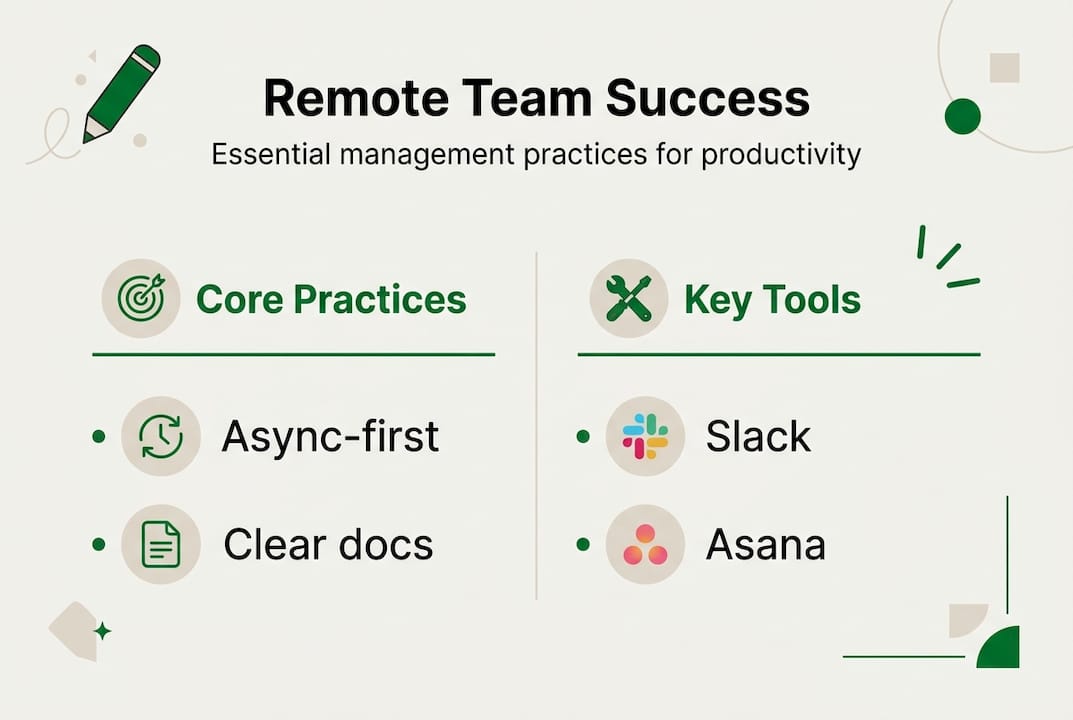
Async-first communication, outcome accountability, clear documentation, and tools like Slack, Notion, and Asana form the operational backbone of effective remote management. Slack handles quick questions and team chat. Notion or Confluence stores knowledge bases and process documentation. Asana, Trello, or Linear track project progress and task ownership. Zoom or Google Meet facilitate occasional synchronous collaboration when needed.
Shared working hours accelerate project completion even in remote settings. Teams with 3+ shared hours complete projects 12% faster because they can resolve blockers quickly during overlap periods. Identify timezone overlaps across your team and designate those hours for collaborative work, leaving other times for deep focus. This balances async benefits with synchronous efficiency.
Rotate meeting times to ensure fairness across timezones. If your team spans California to Poland, don’t always schedule calls at 9am Pacific, which forces European colleagues into evening meetings. Alternate between times that favor different regions so everyone shares the inconvenience equally. This prevents hierarchy based on geography and shows respect for all team members.
Pro Tip: Avoid surveillance tools that track mouse movements or screenshot activity. These technologies erode trust and signal that you doubt your team’s professionalism. Instead, focus on output quality and communication responsiveness. Our staffing services connect you with pre-vetted professionals who thrive in trust-based remote environments, and remote work management frameworks provide additional guidance on building that trust.
Challenges and nuanced considerations in remote team management
Timezone differences create coordination complexity, especially with gaps exceeding eight hours. When your team spans San Francisco to Singapore, finding overlap becomes nearly impossible. Address this by creating sub-teams with better timezone alignment for projects requiring frequent collaboration. Use async workflows as default, reserving synchronous time for critical decisions or brainstorming.
Scaling remote teams beyond 20 members requires structural changes. The team-of-teams model works well, where you organize into smaller pods of 5-8 people with clear ownership areas. Each pod operates semi-autonomously with its own goals while coordinating with other pods through designated liaisons. This prevents communication overhead from exploding as headcount grows. Staffing services for scaling remote teams can help you build these structures effectively.
Cultural misunderstandings multiply in offshore arrangements where team members come from vastly different professional norms. Direct communication styles common in the US may seem rude in cultures valuing indirect feedback. Deadlines interpreted as flexible suggestions in some regions clash with strict accountability expectations elsewhere. Mitigate these risks through explicit cultural training, clear escalation paths, and regular check-ins that surface misalignments early.
Extreme time zones, scaling, cultural misreads, security, and onboarding require special handling in remote contexts. Data security becomes paramount when team members access sensitive information from home networks. Implement VPNs, two-factor authentication, and endpoint protection across all devices. Use distributed version control for codebases so no single location holds all intellectual property. Remote work security standards provide frameworks for protecting distributed operations.
Onboarding remote employees demands extra intentionality. Without casual desk-side conversations, new hires struggle to absorb company culture and build relationships. Consider flying new team members to headquarters or a central location for their first week. This in-person immersion accelerates relationship building and cultural absorption in ways video calls cannot replicate. Follow up with a structured 90-day onboarding plan that pairs new hires with mentors and sets clear milestones. Structured onboarding approaches improve retention and time-to-productivity significantly.
| Challenge | Impact | Solution |
|---|---|---|
| Timezone gaps | Delayed responses, limited collaboration windows | Sub-teams by region, async-first workflows |
| Scaling complexity | Communication overhead, unclear ownership | Team-of-teams model, designated liaisons |
| Cultural differences | Misinterpreted feedback, missed expectations | Explicit training, regular alignment check-ins |
| Security risks | Data breaches, IP exposure | VPNs, 2FA, distributed systems |
| Onboarding difficulty | Slow ramp-up, weak culture fit | In-person week, 90-day mentorship plans |
Pro Tip: Build intentional culture to combat loneliness and burnout in remote settings. Schedule virtual coffee chats, celebrate wins publicly in team channels, and create space for non-work conversation. Remote work offers flexibility but can feel isolating without deliberate community building. Invest in team retreats twice yearly where everyone gathers in person to strengthen bonds and align on strategic direction.
Productivity impacts and performance comparisons of remote teams
Remote teams boost productivity 10-13% in call centers and software development, particularly for experienced remote workers. Quiet home environments eliminate open office distractions, letting professionals enter deep focus states more easily. Commute elimination adds 30-60 minutes of productive time daily. Flexibility to work during personal peak hours rather than rigid 9-to-5 schedules further enhances output quality.
Hybrid work proves 5% more productive overall compared to fully office-based arrangements, balancing individual focus time with collaborative innovation. Hybrid models let teams reserve office days for brainstorming, strategic planning, and relationship building while using remote days for execution and deep work. This intentional separation optimizes each work mode’s strengths.
Office settings excel at spontaneous collaboration and career advancement. Unplanned hallway conversations spark ideas that scheduled meetings miss. Junior employees gain mentorship through observation and casual questions. Promotions favor office workers who build stronger relationships with decision makers. For roles requiring constant real-time coordination or where presence signals commitment, offices maintain advantages.
Remote work satisfaction runs 20-22% higher than office-based work, driven by autonomy, flexibility, and work-life integration. Employees appreciate controlling their environment, avoiding commutes, and managing personal responsibilities without rigid schedules. This satisfaction translates to lower turnover and higher engagement when companies support remote work properly.
“The key to remote team success isn’t the tools you use but the communication architecture you build. Tools enable workflows, but intentional processes and cultural norms determine whether remote teams thrive or struggle.” - Remote work researcher
| Model | Productivity strengths | Collaboration benefits | Employee satisfaction | Best for |
|---|---|---|---|---|
| Remote | Deep focus work, elimination of commute distractions, flexible schedules | Async documentation, global talent access | Highest autonomy and flexibility | Software development, writing, data analysis |
| Hybrid | Balance of focus and collaboration, intentional office use | Scheduled in-person for brainstorming, remote for execution | High flexibility with social connection | Product teams, creative work, client services |
| Office | Spontaneous innovation, mentorship through proximity | Real-time problem solving, relationship building | Lower flexibility, higher social engagement | Early-career development, rapid iteration projects |
Task type determines optimal work location more than blanket policies. Focused analytical work like coding, financial modeling, or writing benefits from remote quiet. Creative brainstorming and strategic planning gain from in-person energy. Client-facing roles may need office presence for credibility or collaboration space. Match work mode to task requirements rather than mandating one approach for everything.
Employee preferences vary significantly by life stage and personality. Parents value remote flexibility for childcare coordination. Extroverts crave office social interaction. Early-career professionals benefit from in-person mentorship. Senior individual contributors prioritize deep focus time. Rigid policies that ignore these differences drive talent away. Pre-vetted talent insights help you understand candidate preferences and match them to appropriate work arrangements.
How Fuerza supports your remote team hiring and management
Building effective remote teams requires more than understanding best practices. You need access to professionals who thrive in distributed environments and possess the self-direction remote work demands. Fuerza’s AI-powered staffing platform connects you with pre-vetted experts across AI, software development, and technical roles who excel in remote settings.
Our nearshore and onshore focus ensures timezone alignment with US clients, addressing one of the core challenges this article explored. You gain access to talent pools in Latin America and North America with cultural compatibility and overlapping work hours that facilitate collaboration. Our vetting process evaluates not just technical skills but also communication abilities and remote work experience.
Hiring services from Fuerza align with the structured onboarding and outcome-based accountability frameworks discussed earlier. We help you define clear role expectations, match candidates to your specific needs, and support integration into your existing workflows. Whether you need freelancers for project work or full-time team members for ongoing initiatives, our platform scales with your requirements. Explore access to pre-vetted talent and see how AI-powered matching accelerates your hiring while maintaining quality standards.
FAQ
What is the difference between remote and distributed teams?
Remote teams operate without any physical company offices, with all members working from diverse locations. This creates equality since no one has proximity advantages. Distributed teams may include company offices in multiple locations where some employees gather, potentially creating information asymmetries between office and remote workers.
How can I ensure effective communication in a remote team?
Adopt async-first communication that respects different timezones and work styles, using tools like Slack for quick exchanges and Notion for documentation. Document all decisions and processes transparently so team members can catch up anytime. Rotate meeting times across timezones to ensure fairness and prevent geography-based hierarchy.
What are common challenges with remote teams and how to overcome them?
Timezone differences complicate coordination, especially with gaps exceeding eight hours. Cultural misunderstandings arise when team members come from different professional norms. Security risks increase with distributed access to sensitive data. Onboarding becomes harder without casual in-person interactions. Mitigate these through sub-teams aligned by timezone, explicit cultural training, robust security protocols, and in-person onboarding weeks for new hires.
Is hybrid work better than fully remote or office?
Hybrid work balances individual productivity during remote days with collaborative innovation during office days, proving 5% more productive overall. Fully remote excels for focused analytical work and offers highest employee satisfaction. Office settings support spontaneous collaboration and career mentorship better. Choose your model based on task types, team preferences, and strategic priorities rather than following trends.
Recommended
- Fuerza — Hire Pre-Vetted AI & Tech Talent | AI-Powered Staffing
- Fuerza — Hire Pre-Vetted AI & Tech Talent | AI-Powered Staffing
- Fuerza — Hire Pre-Vetted AI & Tech Talent | AI-Powered Staffing
- Fuerza — Hire Pre-Vetted AI & Tech Talent | AI-Powered Staffing
- Understanding the Advantages of Remote Work | Jigsaw Conferences