
Building agile teams guide for 2026: optimize collaboration
Building agile teams guide for 2026: optimize collaboration

Optimizing team dynamics and project delivery is a persistent challenge for product and hiring managers. Many teams struggle with rigid structures and weak collaboration that slow progress and frustrate stakeholders. Agile methodologies paired with the right team structures can dramatically boost efficiency, responsiveness, and product quality. This guide walks you through building agile teams that enhance adaptability, foster collaboration, and drive delivery success. You’ll learn foundational principles, team setup strategies, execution best practices, and measurement techniques to transform your team into a high-performing agile unit ready to meet 2026’s market demands.
Table of Contents
Key takeaways
PointDetailsAgile teams deliver iterativelySelf-organizing teams produce functional products in short sprints through collaboration and flexibility.Structure determines successChoosing the right team structure is critical for product outcomes and scales with team size.Avoid common pitfallsOvercommitment and poor sprint planning negotiation harm team morale and delivery rates.Dedicated teams offer stabilityStable, scalable talent access aligns with agile principles and supports dynamic environments.Continuous improvement mattersEffective agile implementation requires ongoing evaluation and team ownership of processes.
Understanding the foundations of agile teams
Agile teams excel in self-organization, collaboration, and adaptability, delivering functional products at the end of each sprint. These teams thrive on iterative delivery cycles that allow rapid feedback and course correction. You build agility by empowering team members to make decisions, share ownership, and respond quickly to changing requirements.
Core agile methodologies emphasize flexibility, customer collaboration, iterative progress, and rapid response to change. Instead of rigid waterfall planning, agile teams break work into manageable increments called sprints, typically lasting two to four weeks. Each sprint produces a potentially shippable product increment, enabling stakeholders to see progress and provide feedback early and often.
The benefits of agile teams extend beyond faster delivery. You gain increased productivity through focused work periods, better product quality from continuous testing and integration, and responsive market adaptation as customer needs evolve. Teams become more engaged and motivated when they see their work deployed quickly and receive direct user feedback. This creates a virtuous cycle of improvement and innovation.
Key agile roles include the Product Owner, who represents stakeholder interests and prioritizes the backlog, the Scrum Master, who facilitates agile processes and removes impediments, and cross-functional team members who possess diverse skills to deliver complete features. These roles ensure clear accountability while promoting teamwork and adaptability across disciplines.
Continuous improvement and regular feedback loops form the heartbeat of agile teams. You should conduct sprint retrospectives to identify what worked well and what needs adjustment. Daily standups keep everyone aligned on progress and blockers. Sprint reviews demonstrate completed work to stakeholders and gather input. These ceremonies create transparency and shared understanding that drive team effectiveness.
Self-organizing teams make autonomous decisions within their domain
Iterative delivery produces working software every sprint
Customer collaboration ensures product-market fit
Cross-functional members reduce handoff delays
Regular retrospectives drive continuous improvement
Preparing your team: structures and roles for success
Selecting the right agile team structure determines whether your product thrives or struggles. Common structures include feature teams that own end-to-end user-facing capabilities, component teams that specialize in technical layers or services, and dedicated teams that maintain stable membership over time. The right team structure can determine the success or failure of a product, so choose deliberately based on your product complexity and organizational context.

Dedicated teams offer particular advantages for dynamic environments. These teams maintain stable membership, allowing members to develop deep domain knowledge and strong working relationships. You gain scalability because dedicated teams can ramp up or down based on project needs while preserving institutional knowledge. They align naturally with agile principles by fostering ownership, accountability, and long-term thinking about technical debt and architecture.
Role definitions provide clarity and prevent confusion. The Product Owner facilitates communication between stakeholders and the development team, translating business needs into actionable user stories. They prioritize the backlog based on value, risk, and dependencies. The Scrum Master guides the agile process, coaches team members on agile practices, and shields the team from external distractions. They don’t manage people but serve the team by removing obstacles and fostering a productive environment.
Your team structure should evolve with team size and project scope. Small teams of five to seven members can operate with minimal structure, often with one person wearing multiple hats. As you grow beyond ten members, consider splitting into multiple feature teams with clear ownership boundaries. Large organizations may need tribes, squads, and chapters to maintain agility at scale while preserving alignment.
Pro Tip: Avoid forcing people into roles that don’t fit their strengths or interests. Structure should serve the work and the people doing it, not impose arbitrary constraints. If someone excels at facilitation, let them guide ceremonies even if they’re not officially the Scrum Master. Flexibility in role boundaries often produces better outcomes than rigid adherence to textbook definitions.
Feature teams own complete user-facing capabilities
Component teams specialize in technical layers
Dedicated teams maintain stable membership for continuity
Product Owners prioritize and communicate requirements
Scrum Masters facilitate processes and remove impediments
Explore professional services and agile methods to accelerate your team structure design and role clarity.
Executing agile projects: sprint planning and avoiding common pitfalls
Effective sprint planning sets the foundation for successful delivery. Begin by reviewing the prioritized backlog with your Product Owner to understand upcoming work. The team then estimates effort for each item using story points or time-based estimates. Sprint planning should be a negotiation between the Product Owner and the development team, not a dictation of scope. You collaboratively determine how much work fits in the sprint based on team capacity and historical velocity.
Common agile pitfalls sabotage even well-intentioned teams. Teams following Scrum often struggle with overcommitment, leading to unfinished work and burnout. This happens when Product Owners push too much work into sprints or teams overestimate their capacity. Backlog refinement mistakes compound the problem when user stories lack acceptance criteria or contain hidden complexity. Excessive estimation debates waste time without improving accuracy.
Negotiation rather than dictation of scope improves team morale and delivery rates. When teams have input on sprint commitments, they feel ownership and accountability. You build trust by respecting capacity limits and allowing teams to push back on unrealistic expectations. This creates a sustainable pace where teams consistently deliver what they commit to, building credibility with stakeholders.
Best practices for sprint execution include:
Define clear sprint goals that describe the business value to be delivered
Refine backlog items continuously, not just during planning
Limit work in progress to maintain focus and flow
Conduct daily standups to identify blockers early
Update progress transparently using burndown charts or task boards
Hold sprint reviews to demonstrate completed work
Facilitate retrospectives to identify improvements
Pro Tip: Keep sprint planning focused on planning, not excessive estimation. Time-box estimation discussions to 10 minutes per story. If you can’t reach consensus quickly, break the story into smaller pieces or defer it for more refinement. You’ll save hours of unproductive debate and still deliver effectively.
Overcommitment creates a vicious cycle where teams rush to finish work, cut corners on quality, accumulate technical debt, and slow down in future sprints. Breaking this cycle requires honest capacity planning and the courage to say no.
Understand how dedicated teams impact project delivery and reduce the risk of overcommitment through stable velocity patterns. You can also learn techniques for resolving team conflict that may arise during sprint planning negotiations.
Measuring and sustaining agility in your team
Assessing agile maturity helps you identify strengths and improvement opportunities. The Agile Team Practice Inventory for Software Development provides a systematically developed instrument for assessing agility across multiple dimensions. This validated tool measures how well your team embodies agile principles in practice, not just in theory.
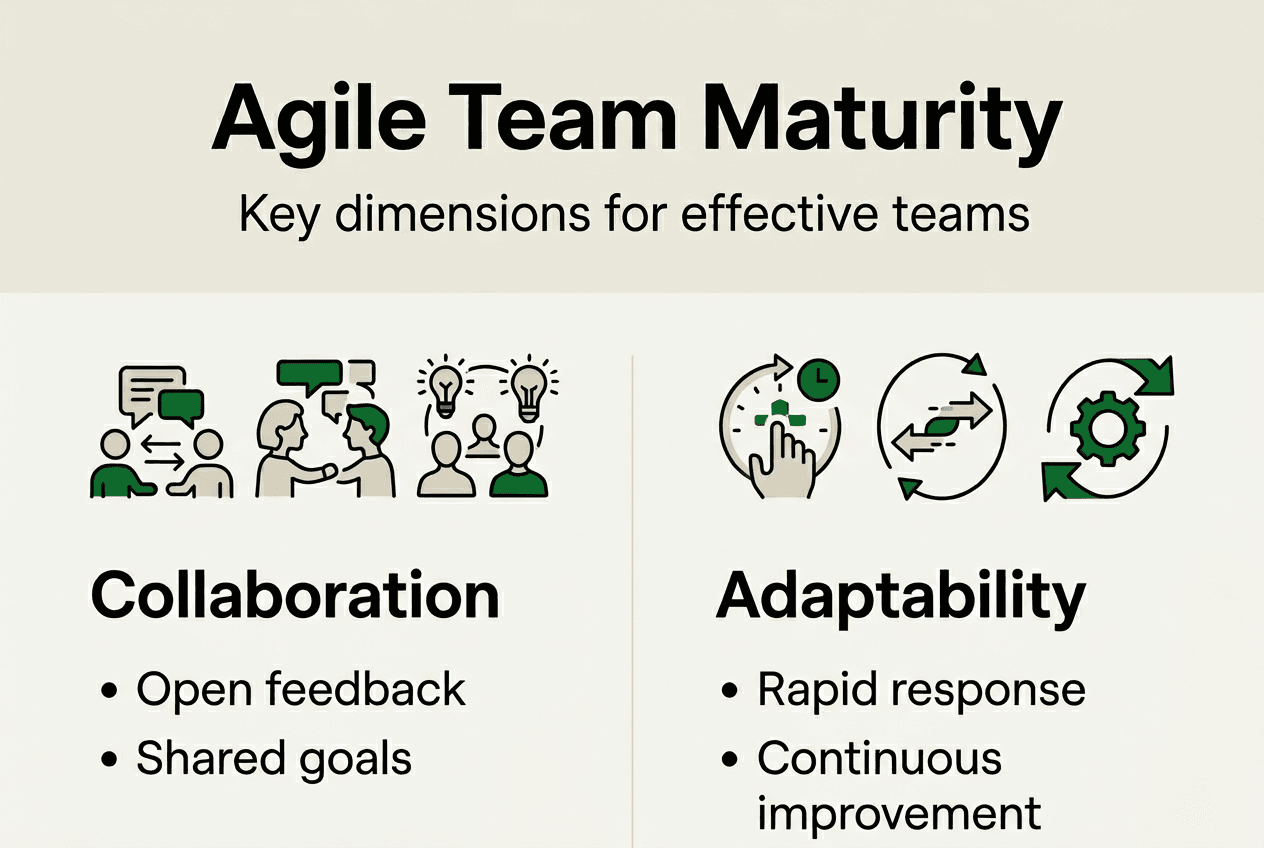
The ATPI-SD framework evaluates four key dimensions that define agile teams:
DimensionKey CharacteristicsFocus AreasCustomer InvolvementActive stakeholder participation in developmentFeedback loops, user story validation, sprint reviewsTeam CollaborationCross-functional cooperation and communicationPair programming, knowledge sharing, collective ownershipIterative DevelopmentIncremental delivery and adaptationSprint cycles, continuous integration, refactoringContinuous ImprovementRegular reflection and process refinementRetrospectives, metrics analysis, experimentation
Challenges in measuring agility stem from the qualitative nature of many agile practices. Accurate measurement of team agility remains a significant challenge due to a lack of validated instruments. You can’t simply count story points or measure velocity and claim your team is agile. True agility encompasses mindset, culture, and behaviors that resist simple quantification.
Continuous assessment requires regular check-ins on agile practices. Conduct quarterly agility assessments using frameworks like ATPI-SD to track progress over time. Survey team members anonymously to gather honest feedback about what’s working and what’s not. Review metrics like cycle time, defect rates, and customer satisfaction alongside qualitative observations about team morale and collaboration quality.
Cultural change approaches embed agile values deeply within your team. You can’t mandate agility through policy. Instead, model agile behaviors yourself by embracing transparency, admitting mistakes, and soliciting feedback. Celebrate learning and experimentation, even when initiatives fail. Recognize and reward collaboration over individual heroics. These actions signal what you truly value and shape team culture more powerfully than any training program.
Recommended practices for sustaining agility include:
Schedule regular training on agile practices and principles
Rotate team members through different roles to build empathy
Invite external coaches for periodic assessments and guidance
Create communities of practice to share learnings across teams
Experiment with new techniques and tools in time-boxed trials
Document and share success stories to reinforce positive behaviors
Explore team adaptability techniques to strengthen your agile culture and measurement practices.
Build your agile team with expert AI-powered staffing
Building and scaling agile teams requires access to talent experienced in collaborative, iterative environments. Fuerza offers AI-powered staffing solutions that connect you with pre-vetted AI and tech experts who thrive in agile settings. You gain rapid access to professionals who understand sprint cycles, user story refinement, and cross-functional collaboration.
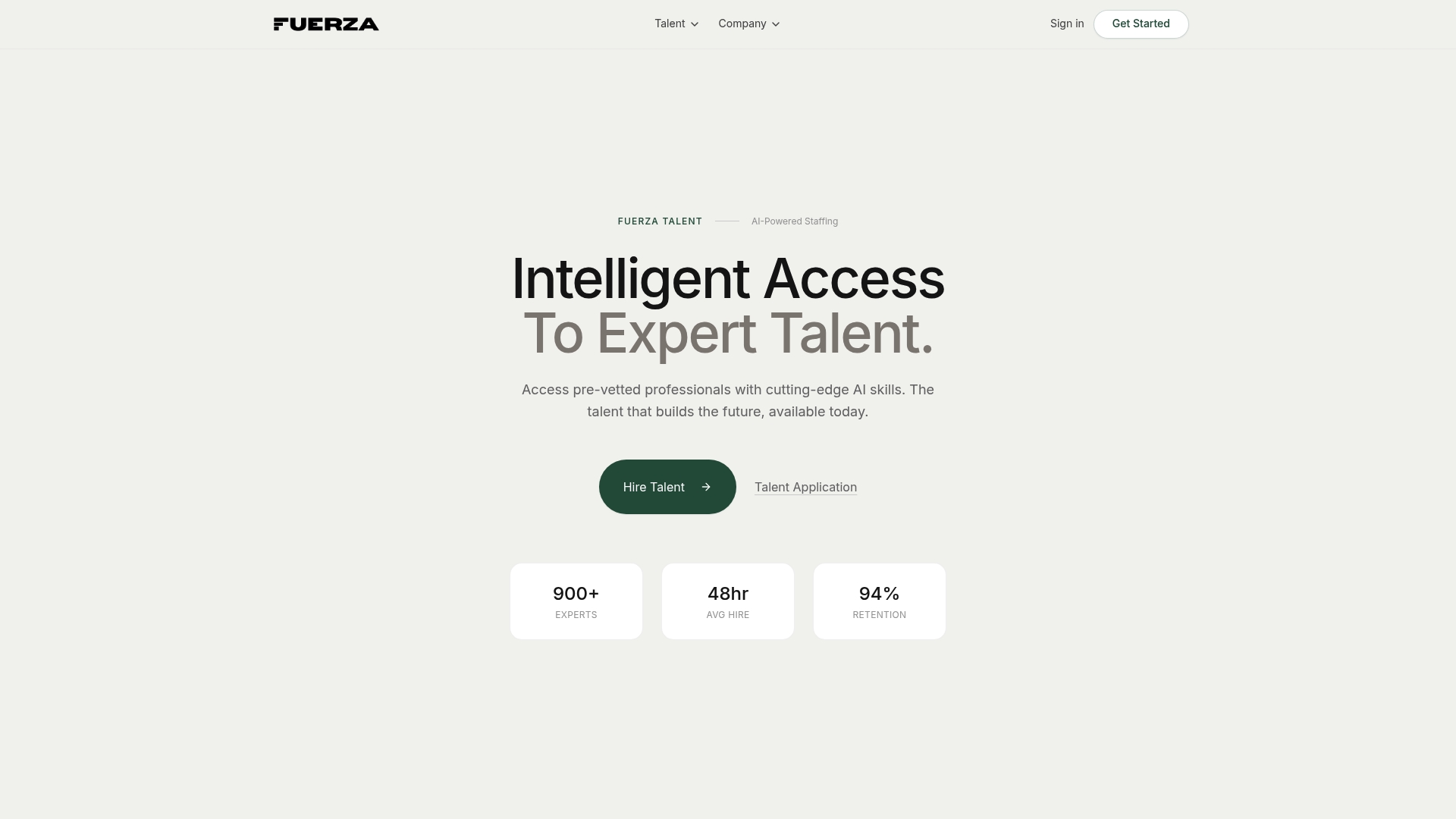
Their platform helps you scale dedicated teams tailored to your specific project needs and technical requirements. Whether you need frontend developers, data engineers, or product designers, Fuerza’s AI-driven matching ensures you find candidates whose skills and work styles align with your agile methodology. Professional agile services assist in embedding best practices effectively within your teams, from sprint facilitation to backlog management.
Partner with Fuerza to ensure your agile team is staffed for success and adaptable to evolving market demands. Their focus on nearshore and onshore pre-vetted tech talent for US clients means you get time zone alignment and cultural fit alongside technical excellence.
Frequently asked questions
What are the key benefits of agile team structures?
Agile team structures deliver faster time to market through iterative releases, higher product quality from continuous testing, and better alignment with customer needs through regular feedback. You also gain improved team morale and engagement because members have more autonomy and see the direct impact of their work.
How can I prevent overcommitment during sprint planning?
Prevent overcommitment by basing sprint commitments on historical velocity data, not wishful thinking. Negotiate scope collaboratively with your Product Owner rather than accepting dictated workloads. Build in buffer capacity for unexpected issues and technical debt, typically 20 to 30 percent of sprint capacity.
What roles are essential in agile teams?
Essential roles include the Product Owner who prioritizes work and represents stakeholders, the Scrum Master who facilitates agile processes and removes blockers, and cross-functional team members who deliver complete features. In smaller teams, individuals may wear multiple hats, but these core responsibilities must be covered.
How do dedicated teams improve project stability?
Dedicated teams maintain stable membership over time, allowing deep domain knowledge and strong working relationships to develop. You reduce ramp-up time for new projects because team members already understand your systems and processes. This stability enables more accurate planning and consistent velocity.
How can I measure my team’s agile maturity effectively?
Measure agile maturity using validated instruments like the Agile Team Practice Inventory for Software Development, which assesses customer involvement, team collaboration, iterative development, and continuous improvement. Combine quantitative metrics like cycle time and defect rates with qualitative feedback from team surveys and retrospectives for a complete picture.
Recommended
Fuerza — Hire Pre-Vetted AI & Tech Talent | AI-Powered Staffing
Fuerza — Hire Pre-Vetted AI & Tech Talent | AI-Powered Staffing
Fuerza — Hire Pre-Vetted AI & Tech Talent | AI-Powered Staffing
Fuerza — Hire Pre-Vetted AI & Tech Talent | AI-Powered Staffing
Meeting Room in Zoom: Maximising Corporate Collaboration | Jigsaw Conferences