
Role of AI in workforce planning: 40% faster hiring

AI boosts workforce forecasting accuracy by up to 85%, transforming how US enterprises and startups approach staffing challenges. This technology doesn’t just automate tasks. It predicts demand patterns, identifies skill gaps before they emerge, and optimizes resource allocation in ways traditional methods never could. You’re about to discover how AI mechanisms work, what benefits you can expect, which challenges require attention, and how to integrate these tools into your existing workforce planning framework.
Table of Contents
- How AI Enhances Workforce Planning Accuracy And Efficiency
- Common Misconceptions About AI In Workforce Planning
- Ethical And Bias Challenges In Implementing AI Workforce Tools
- Frameworks And Best Practices For Integrating AI In Workforce Planning
- Real-World Applications And Case Studies Of AI Workforce Planning
- Conclusion: Harnessing AI For Strategic Workforce Planning Success
- Discover AI-Powered Staffing Solutions With Fuerza
- Frequently Asked Questions
Key takeaways
| Point | Details |
|---|---|
| Forecasting accuracy | AI improves demand forecasting accuracy by up to 85% through predictive analytics |
| Workload reduction | Automation cuts routine HR tasks by 35%, freeing managers for strategic decisions |
| Decision quality | Hybrid AI-human frameworks boost staffing decisions by 20% |
| Hiring speed | Real implementations show 40% faster hiring cycles with AI adoption |
| Ethical oversight | Bias management requires continuous monitoring and human review processes |
How AI enhances workforce planning accuracy and efficiency
Predictive analytics transform workforce forecasting by processing historical patterns and real-time market data. Predictive analytics improve workforce forecasting accuracy by up to 85%, giving you confidence in staffing decisions months ahead. Machine learning algorithms detect seasonal trends, project growth patterns, and flag potential talent shortages before they become critical.
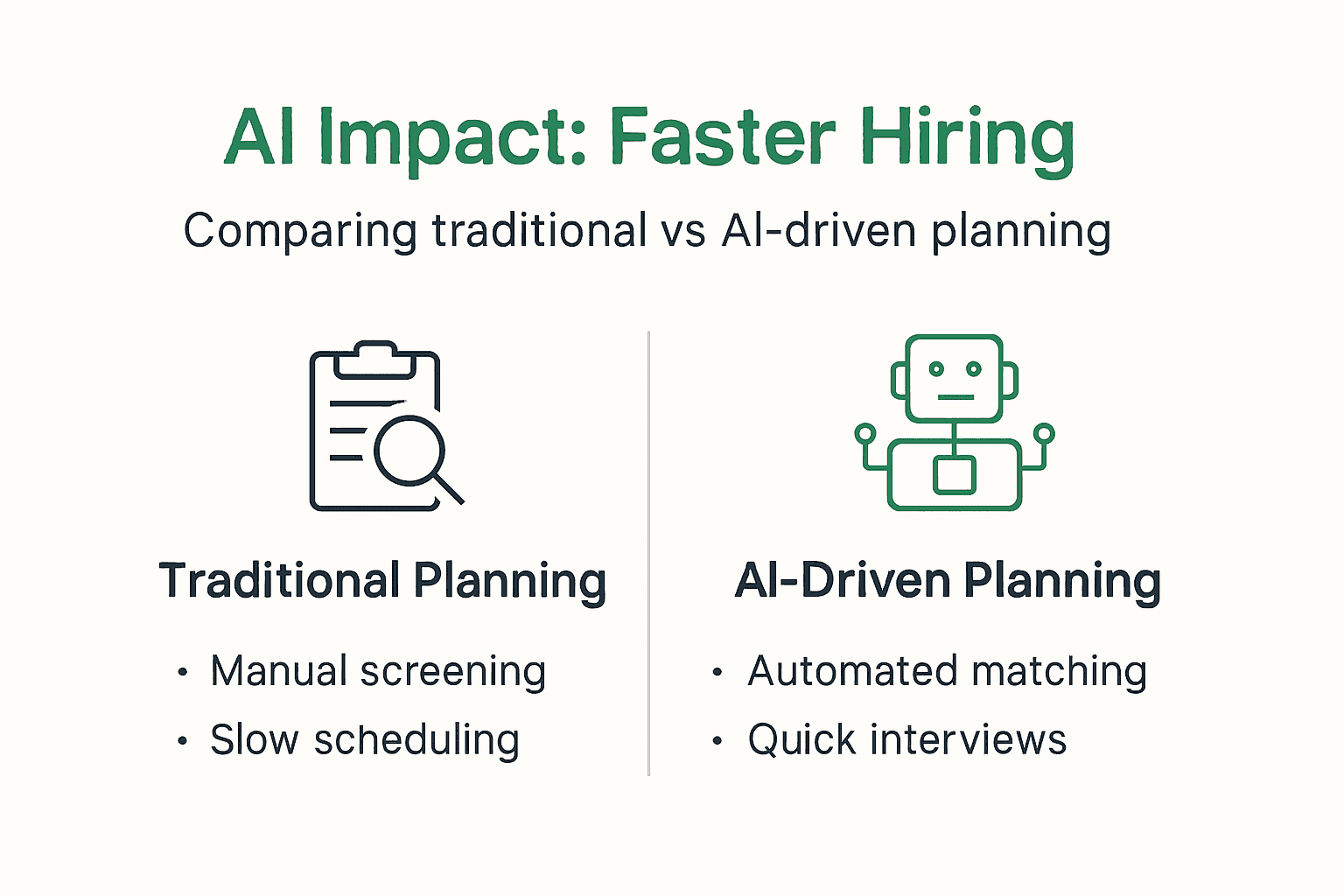
Automation handles repetitive HR tasks that consume valuable time. Resume screening, interview scheduling, and initial candidate assessments run automatically. This automation reduces routine workload by 35%, letting you focus on strategic initiatives like culture building and leadership development.
Integration with existing systems amplifies these benefits. When AI connects to your HRIS and ATS platforms, data flows seamlessly. Candidate information updates in real time, approval workflows accelerate, and AI-powered staffing solutions reduce time-to-hire by approximately 30%.
| Metric | Traditional Planning | AI-Driven Planning | Improvement |
|---|---|---|---|
| Forecasting accuracy | 45-60% | 80-85% | +35% |
| Time to hire | 42 days | 28 days | 33% faster |
| Administrative workload | 100% baseline | 65% baseline | 35% reduction |
| Turnover prediction | Reactive | 3-6 months ahead | Proactive |
Pro Tip: Validate your AI model outputs against actual hiring outcomes quarterly. This feedback loop catches drift in predictions and keeps your system calibrated to current market conditions.
Common misconceptions about AI in workforce planning
The biggest myth claims AI will replace hiring managers entirely. Reality shows a different story. AI augments rather than replaces human hiring managers, handling data analysis while humans provide judgment on cultural fit and leadership potential. You remain the final decision maker, equipped with better information.
Another misconception assumes AI guarantees perfect predictions every time. Your results depend heavily on data quality and completeness. Garbage in means garbage out. If historical hiring data contains gaps or inconsistencies, predictions suffer accordingly. Clean, comprehensive datasets produce reliable forecasts.
Many believe AI algorithms operate without bias. This assumption proves dangerous. Algorithms learn from historical data that often reflects existing workplace inequalities. Without careful monitoring, AI perpetuates gender, race, and age discrimination patterns. Your oversight prevents these issues from scaling.
Some managers think AI implementation requires massive technical expertise. Modern platforms offer user-friendly interfaces designed for HR professionals, not data scientists. You don’t need to understand neural networks to benefit from AI augmentation in hiring.
The notion that AI delivers instant results sets unrealistic expectations. Most organizations need 3-6 months to see meaningful improvements. Systems require training periods, data accumulation, and refinement cycles before performance peaks.
Pro Tip: Schedule bias audits every six months to review AI recommendations for fairness across demographic groups. Use diverse review teams to catch subtle discrimination patterns.
Ethical and bias challenges in implementing AI workforce tools
Bias risks emerge from multiple sources in AI systems. Training data reflecting past discrimination teaches algorithms to repeat those patterns. Documented cases show AI bias in hiring tools that favored certain demographics over equally qualified candidates. Model design choices can amplify these problems when engineers don’t consider fairness metrics.
Transparency becomes essential for ethical AI deployment. You need visibility into how algorithms make recommendations. Black box systems that can’t explain their logic create accountability gaps. When you can’t justify a hiring decision, you face legal and ethical exposure.
Human oversight provides the necessary checks on automated systems. Establish review processes where managers examine AI recommendations before final decisions. This dual layer catches errors and ensures consideration of factors AI misses, like unique candidate circumstances or evolving team dynamics.
- Diversify training data to include underrepresented groups and varied career paths
- Conduct regular algorithm audits using fairness metrics across protected classes
- Implement human review checkpoints for all final hiring and promotion decisions
- Document AI decision factors to enable appeal processes and accountability
- Train staff on recognizing and correcting algorithmic bias in recommendations
Regulatory pressure intensifies around AI fairness. US agencies increasingly scrutinize automated employment decisions. The EEOC examines whether AI tools produce disparate impact. State laws like those in California and New York mandate transparency in automated hiring systems.
Balancing AI efficiency with ethical governance isn’t optional anymore. It’s the foundation of sustainable workforce planning that protects both your organization and candidates from discrimination while maximizing the technology’s benefits.
You can explore deeper perspectives on AI bias and ethics research to inform your governance framework. Regular training keeps your team current on emerging ethical standards.
Frameworks and best practices for integrating AI in workforce planning
Successful AI integration follows a structured approach that minimizes disruption and maximizes value. Start with these proven steps:
- Assess your current workforce planning needs and identify specific pain points AI can address
- Evaluate AI workforce planning integration tips and select tools compatible with existing HR systems
- Design human oversight protocols defining when managers must review AI recommendations
- Train your HR team and hiring managers on system capabilities and limitations
- Launch pilot programs in one department before company-wide rollout
- Monitor performance metrics and gather user feedback for continuous optimization
Different adoption models suit different organizational contexts. Choosing the right approach affects implementation speed and long-term success.
| Model | Description | Pros | Cons |
|---|---|---|---|
| Standalone tools | Dedicated AI platform separate from HRIS | Quick setup, specialized features | Data silos, manual integration work |
| Integrated HRIS/ATS | AI built into existing HR systems | Seamless data flow, unified interface | Limited customization, vendor lock-in |
| Hybrid framework | AI tools plus mandatory human review | Balances efficiency with judgment | Requires clear protocols, longer decisions |
| Phased rollout | Gradual expansion across departments | Lower risk, learning opportunity | Slower benefits realization |
Hybrid frameworks combining AI analysis with human decision-making deliver the strongest results. This approach yields 20% improvements in staffing decisions by capturing both data-driven insights and nuanced human judgment. You get algorithmic pattern recognition plus the contextual understanding only experienced managers provide.
Integration with the AI staffing waitlist and similar platforms accelerates access to pre-vetted talent pools. These connections expand your candidate reach while maintaining quality standards. Timing matters too. Understanding optimal AI adoption timing helps you launch when your organization has the data maturity and resources for success.
You’ll find additional guidance in comprehensive AI integration frameworks that address technical and organizational change management aspects.
Pro Tip: Run pilot programs for 90 days in controlled environments before scaling across your organization. This testing period reveals unexpected challenges while limiting exposure and allowing refinement based on real user feedback.
Real-world applications and case studies of AI workforce planning
A US tech startup accelerated hiring cycles by 40% and lowered turnover by 15% using AI workforce planning at BrightTech. They implemented predictive analytics to forecast seasonal demand spikes and automated initial screening for technical roles. The system identified candidates with skill profiles matching long-term success patterns, improving retention significantly.

Large enterprises report similar gains. Fortune 500 companies achieve 25% cost savings through AI-based staffing optimization. These savings come from reduced agency fees, faster time-to-productivity, and better role-candidate matching that prevents costly mis-hires.
Combining AI with nearshore staffing strategies produces even stronger results. Organizations leveraging both approaches increase talent sourcing speed by 20% while accessing broader skill pools. Geographic flexibility paired with AI matching creates powerful competitive advantages.
Diverse sectors demonstrate AI workforce planning value:
- Healthcare systems use AI to predict nursing shortages and optimize shift scheduling
- Retail chains forecast seasonal staffing needs with 80% accuracy for holiday periods
- Financial services firms identify skill gaps in emerging technology areas 6 months ahead
- Manufacturing companies optimize production staffing based on order pipeline predictions
- Professional services balance project staffing across offices using demand forecasting
The BrightTech AI workforce case study details their implementation journey, challenges overcome, and specific metrics achieved. Their experience shows that medium-sized organizations can achieve enterprise-level results with proper planning.
Smaller startups benefit too. Companies with 50-200 employees see proportionally larger impacts because AI helps them compete for talent against larger rivals. Automated sourcing and assessment level the playing field when recruiting specialized technical roles.
Conclusion: Harnessing AI for strategic workforce planning success
AI delivers measurable improvements in workforce planning accuracy, efficiency, and agility. You’ve seen how predictive analytics boost forecasting to 85% accuracy, automation cuts workload by 35%, and hybrid frameworks improve decisions by 20%. These aren’t theoretical benefits. Real organizations achieve 40% faster hiring and significant cost savings.
Ethical challenges require your active attention. Bias monitoring, transparency standards, and human oversight protect against discrimination while preserving AI’s advantages. Regulatory scrutiny makes this governance work essential, not optional.
Phased implementation approaches minimize risk while maximizing learning. Start with pilot programs, validate results, then scale systematically. Choose adoption models matching your organizational readiness and technical capabilities.
AI functions as a collaborative tool augmenting your expertise, not replacing it. The technology handles data analysis and pattern recognition. You provide judgment on culture, leadership potential, and strategic fit. This partnership positions your organization to respond quickly to market changes and talent opportunities.
Your next steps include evaluating data readiness, assessing current pain points, and selecting AI solutions aligned with your workforce planning goals. The competitive advantage belongs to organizations that move decisively while maintaining ethical standards.
Discover AI-powered staffing solutions with Fuerza
Transforming workforce planning requires the right technology and the right talent. Fuerza AI-powered staffing platform connects you with pre-vetted AI specialists, developers, and tech professionals who can implement and optimize these systems. Their platform uses AI matching to identify candidates whose skills align precisely with your requirements.
Integration with your existing workforce planning happens seamlessly. Whether you need nearshore resources, onshore contractors, or full-time team members, Fuerza’s vetting process ensures quality. You reduce hiring time while improving candidate fit.
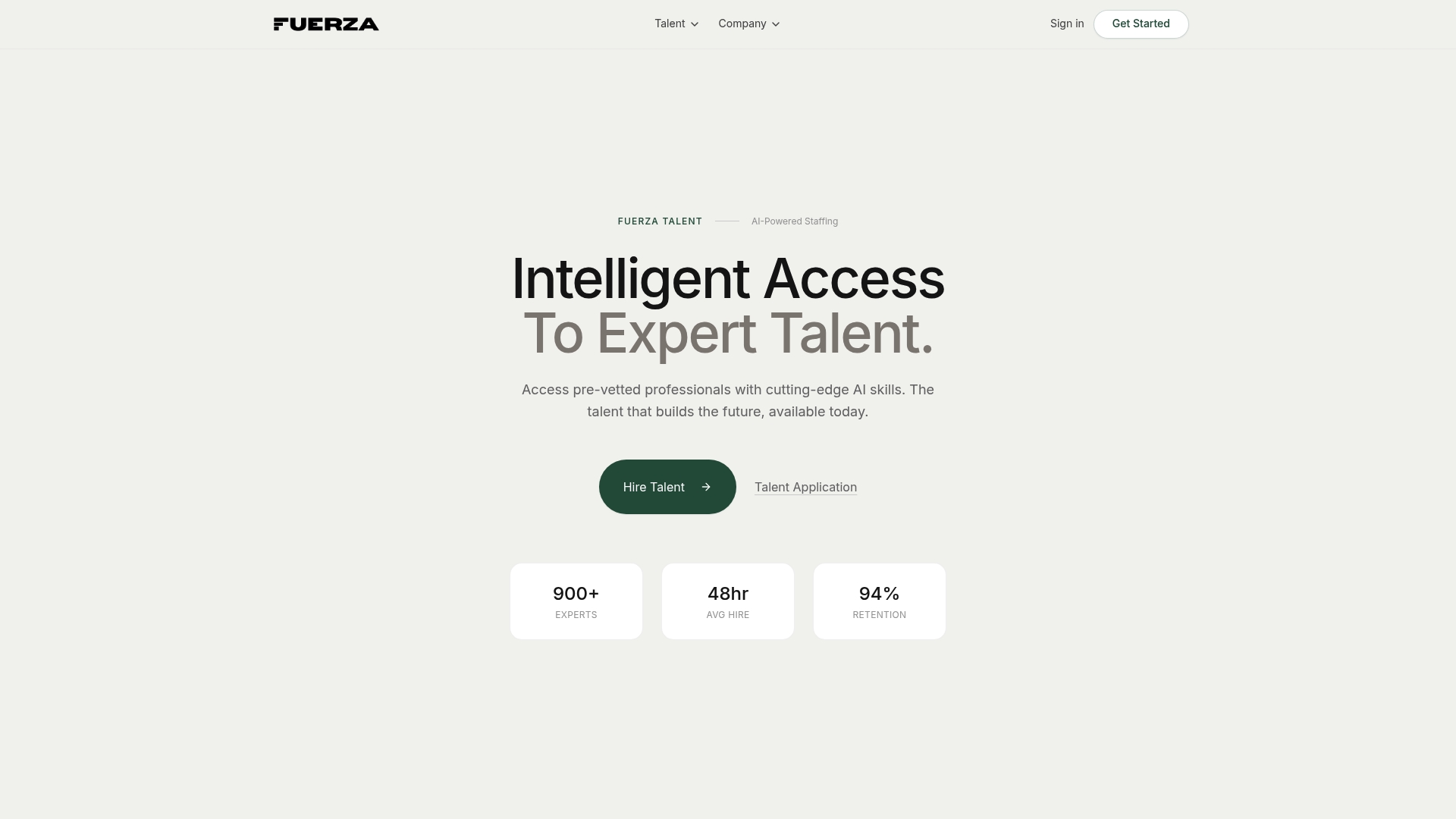
Ready to accelerate your AI-driven workforce transformation? Join the Fuerza waitlist for early access to their expanded platform features. Explore Fuerza staffing services to find the specialized talent that turns workforce planning insights into competitive advantages.
Frequently asked questions
What types of AI tools improve workforce planning?
Predictive analytics platforms forecast demand using historical patterns and market data. Automation tools handle resume screening, interview scheduling, and candidate assessments. Integrated HR systems connect these capabilities with your existing HRIS and ATS platforms for seamless data flow. Machine learning models identify skill gaps and recommend training investments.
How do I start integrating AI into my workforce planning?
Begin by auditing your current data quality and identifying specific pain points like long time-to-hire or inaccurate forecasts. Select tools compatible with your existing HR technology stack. Train your team on system capabilities and establish human review protocols. Launch a 90-day pilot in one department before scaling.
Can AI replace human judgment in hiring decisions?
No, AI augments human decision-making but cannot fully replace it. Algorithms excel at data analysis and pattern recognition but miss nuances like cultural fit and leadership potential. Effective implementation combines AI recommendations with experienced manager judgment for optimal results.
What are the ethical risks of using AI in hiring?
Bias represents the primary concern. AI systems trained on historical data can perpetuate gender, race, and age discrimination. Lack of transparency creates accountability gaps. Without proper oversight, automated decisions may violate fair employment regulations. Regular audits and human review processes mitigate these risks.
How quickly can AI show benefits in workforce planning?
Most organizations see initial improvements within 3-6 months. Some metrics like automated screening efficiency appear immediately. Others like improved retention from better matching take longer to measure. Organizations implementing AI properly report 30-40% faster hiring cycles within the first year.
Recommended
- Fuerza — Hire Pre-Vetted AI & Tech Talent | AI-Powered Staffing
- Fuerza — Hire Pre-Vetted AI & Tech Talent | AI-Powered Staffing
- Fuerza — Hire Pre-Vetted AI & Tech Talent | AI-Powered Staffing
- Fuerza — Hire Pre-Vetted AI & Tech Talent | AI-Powered Staffing
- Multi-User Scheduling: Faster Team Event Planning - WhenNOT Blog