
AI in Team Building: 60% Productivity Gains in 2026

Over 60% of enterprise workers now leverage AI tools in their workflows, fundamentally transforming how product and hiring managers build teams. This shift from manual processes to AI-augmented staffing represents the most significant change in talent acquisition since digital recruitment began. This article guides you through AI’s specific impact on team building, debunks common myths, and provides practical frameworks to implement AI-powered staffing strategies that deliver measurable results while maintaining essential human leadership.
Table of Contents
- AI’s Impact on Talent Sourcing and Candidate Pre-vetting
- Human-AI Collaboration for Effective Team Decision-Making
- Common Misconceptions About AI in Team Building
- Frameworks and Comparisons: Traditional vs AI-Augmented Team Building
- Practical Implementation: Integrating AI Into Your Team Building Strategy
- Conclusion: Unlocking the Full Potential of AI in Team Building
- Optimize Your Hiring with AI-Powered Staffing Solutions
- Frequently Asked Questions About AI in Team Building
Key Takeaways
| Point | Details |
|---|---|
| AI Sourcing Speed | AI-driven platforms reduce time-to-hire by automating candidate screening with improving precision |
| Collaboration Gains | Human-AI partnerships boost team decision-making productivity by 60% in 2026 |
| Myth vs Reality | AI augments rather than replaces human leadership in vision, culture, and ethics |
| Framework Value | Comparing traditional and AI methods reveals faster hiring, better scalability, and consistent quality |
| Implementation Path | Pilot programs, leadership training, and governance frameworks ensure effective AI adoption |
AI’s Impact on Talent Sourcing and Candidate Pre-vetting
AI transforms talent sourcing from a time-intensive manual process into a precision-driven workflow that identifies qualified candidates faster and more accurately. AI accuracy in candidate screening is expected to surpass human accuracy for many tasks in 2026, marking a fundamental shift in how teams evaluate talent. This advancement allows product and hiring managers to focus on strategic decisions while AI handles repetitive screening tasks.
Modern AI-powered staffing solutions deploy role-based agents that manage complex talent matching workflows autonomously. These systems analyze candidate profiles against job requirements, evaluating technical skills, experience levels, and cultural fit indicators simultaneously. The technology proves particularly valuable for nearshore and onshore talent acquisition, where AI algorithms optimize geographic matching to balance time zones, language proficiency, and regulatory requirements.
Key advantages of AI in sourcing include:
- Automated resume parsing that extracts relevant qualifications in seconds
- Behavioral pattern analysis predicting candidate success rates
- Continuous learning algorithms that improve matching accuracy over time
- Integration with existing applicant tracking systems for seamless workflows
- Real-time candidate ranking based on multi-dimensional criteria
Pro Tip: Start with AI screening for high-volume positions where pattern recognition provides the clearest value, then expand to specialized roles as your team gains confidence with the technology.
The speed gains are substantial. Traditional sourcing might take weeks to identify qualified candidates for technical roles. AI platforms reduce this timeline to days or even hours by simultaneously searching multiple talent pools, pre-screening based on defined parameters, and presenting ranked candidate lists. Quality improvements accompany speed gains, as AI systems maintain consistent evaluation criteria across all candidates, reducing the unconscious bias that creeps into manual reviews.
Integration remains critical. AI tools deliver maximum value when connected to your existing HR infrastructure, allowing seamless data flow between sourcing, screening, and interview scheduling systems. Tools like AI resume building platforms help candidates present information in AI-readable formats, improving match accuracy from both sides of the hiring equation.
Human-AI Collaboration for Effective Team Decision-Making
The most successful team building strategies in 2026 combine AI’s analytical power with human judgment’s contextual wisdom. 66% of organizations report productivity gains via human-AI collaboration in team building, demonstrating that partnership outperforms either approach alone. This synergy emerges when managers use AI-generated insights as decision support rather than final verdicts.
Human leaders provide irreplaceable elements that AI cannot replicate. You bring organizational vision, understanding of team dynamics, and cultural alignment considerations that algorithms miss. When evaluating candidates, you assess subtle communication styles, leadership potential, and how individuals might complement existing team members. AI provides data on skills and experience; you provide judgment on fit and potential.
The productivity boost from human-AI collaboration in staffing stems from efficient task division:
- AI handles high-volume data processing and pattern recognition
- Humans conduct nuanced interviews and assess cultural alignment
- AI tracks performance metrics and identifies improvement opportunities
- Humans mentor, coach, and build trust within teams
- AI flags potential issues through predictive analytics
- Humans make final hiring decisions based on comprehensive evaluation
Pro Tip: Establish clear decision protocols that specify which hiring criteria AI evaluates and which require human judgment, preventing confusion and ensuring both contribute their strengths.
Organizations investing in reskilling programs see faster AI adoption and better outcomes. Training product and hiring managers to interpret AI recommendations, question algorithmic outputs, and override suggestions when context demands builds confidence in the collaborative model. This education transforms AI from a mysterious black box into a transparent tool that augments your expertise.
Guardrails matter. Effective collaboration requires frameworks that prevent over-reliance on AI while maximizing its benefits. Set thresholds where AI recommendations trigger human review. Create feedback loops where hiring outcomes inform algorithm improvements. Document cases where human judgment contradicts AI suggestions, using these instances to refine both your decision criteria and the AI’s training data.
The result is faster hiring cycles without sacrificing quality. AI eliminates bottlenecks in initial screening while you focus time on high-value interactions with top candidates. This division of labor improves team cohesion by ensuring new hires receive thorough evaluation on both technical and interpersonal dimensions.

Common Misconceptions About AI in Team Building
Myths about AI capabilities limit adoption among managers who could benefit most from the technology. Clearing these misconceptions helps you make informed decisions about integrating AI into your staffing strategy.
-
AI will replace hiring managers. AI complements human leadership but cannot replace uniquely human tasks such as setting vision and managing trust. You remain essential for strategic direction, final hiring decisions, and team culture development. AI handles data-heavy tasks, freeing you for higher-level responsibilities.
-
AI eliminates bias completely. AI reduces certain biases by applying consistent criteria, but algorithms can perpetuate biases present in training data. Continuous oversight ensures AI tools promote fairness rather than encoding historical inequities. Regular audits of AI recommendations against diversity goals keep systems accountable.
-
AI adoption is plug-and-play. Successful implementation requires organizational change, leadership commitment, and workflow redesign. You cannot simply install AI software and expect transformation. Training, integration planning, and change management determine whether AI delivers value or creates frustration.
-
More AI always means better results. Over-reliance without clear role definitions impedes success. AI works best for well-defined tasks with measurable criteria. Complex judgments requiring contextual understanding still need human decision-makers. Balance is key.
-
Teams will resist AI automatically. Resistance typically stems from uncertainty rather than opposition. Educating teams about AI’s role, demonstrating how it makes their work easier, and involving them in implementation builds trust and smoother adoption.
Understanding AI’s actual capabilities and limitations positions you to leverage its strengths while avoiding pitfalls. The technology evolves rapidly, so staying informed about improvements and emerging best practices ensures your team building strategy remains current.
Frameworks and Comparisons: Traditional vs AI-Augmented Team Building
Comparing manual and AI-assisted methods clarifies the transformation occurring in team building. This framework helps you understand where AI adds value and where human leadership remains essential.
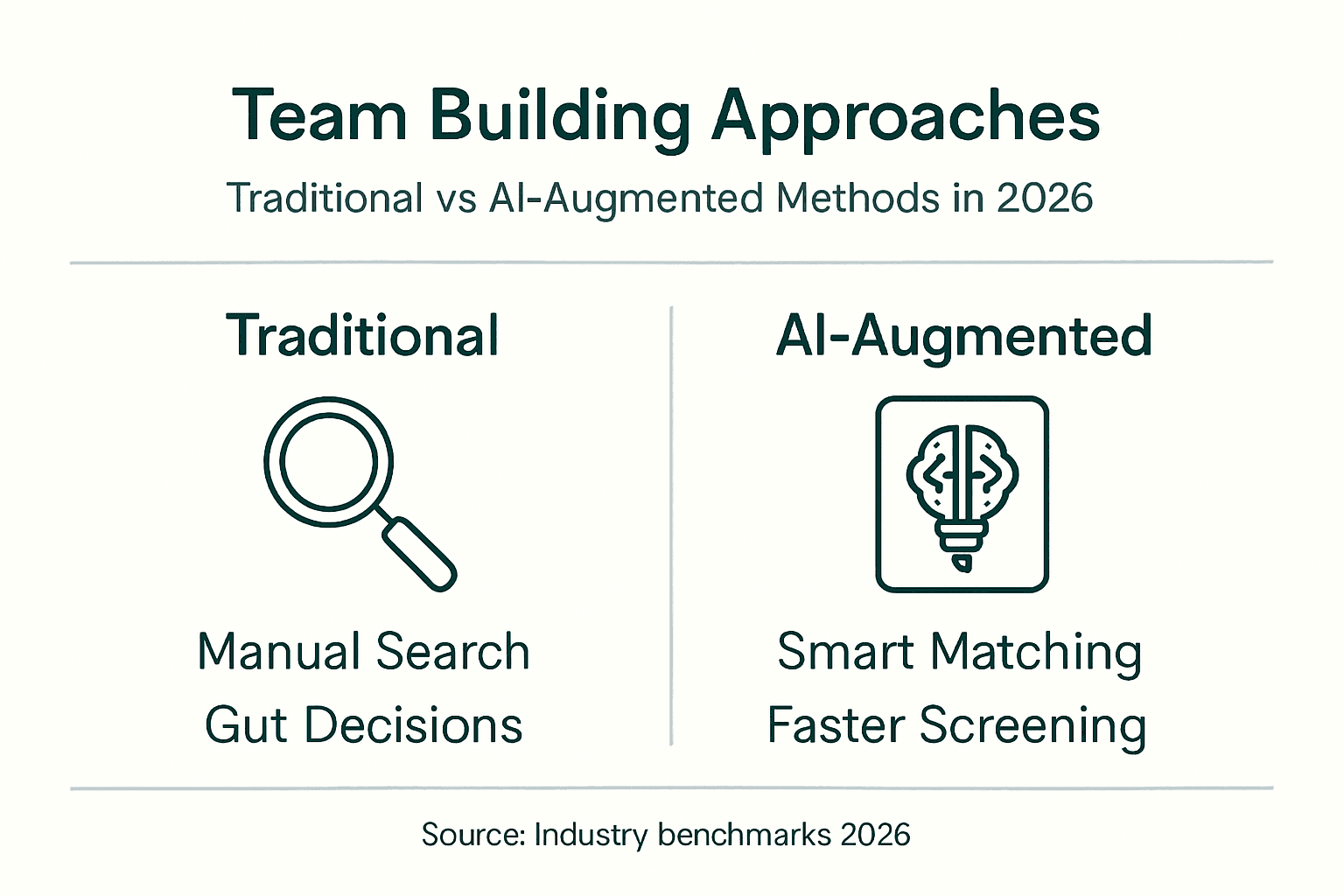
| Aspect | Traditional Approach | AI-Augmented Approach |
|---|---|---|
| Initial Screening | Manual resume review taking hours per candidate | Automated parsing and ranking in minutes |
| Candidate Sourcing | Limited to known networks and job boards | AI digital workers access global talent pools continuously |
| Bias Management | Susceptible to unconscious bias in evaluation | Consistent criteria application with audit trails |
| Time-to-Hire | 4-6 weeks average for specialized roles | 1-2 weeks with AI pre-screening and matching |
| Scalability | Linear relationship between volume and resources | Handles volume increases without proportional resource growth |
| Cost per Hire | Higher due to extended timelines and manual labor | Lower through automation and efficiency gains |
A layered framework illustrates how components work together in modern team building. The foundation layer consists of AI-based talent matching systems that continuously scan talent pools, evaluate candidates, and maintain updated rankings. The middle layer comprises augmented workflows where AI recommendations meet human evaluation, creating a collaborative decision process. The top layer preserves essential human leadership for vision setting, final approvals, and cultural alignment.
Key differences in practice:
- Traditional methods excel at relationship building but struggle with scale
- AI platforms handle volume efficiently but need guidance on nuanced requirements
- Hybrid approaches combine AI’s speed with human judgment’s depth
- Breaking geographic barriers through AI enables truly global team building
- Continuous workflows powered by AI agents eliminate downtime between hiring stages
This framework reveals that AI does not replace your existing process but transforms it into a more efficient system. You retain control over strategy and final decisions while AI amplifies your capacity to identify and evaluate talent. The result is faster hiring without quality compromise, scalability without proportional cost increases, and consistency without sacrificing the personal touch that attracts top candidates.
Practical Implementation: Integrating AI Into Your Team Building Strategy
Moving from understanding to action requires a structured approach that minimizes risk while maximizing learning. Follow these steps to integrate AI into your staffing strategy effectively.
-
Assess current pain points. Identify where your team building process encounters bottlenecks, delays, or quality issues. Common problems include slow resume screening, limited candidate pools, or inconsistent evaluation criteria. Target AI implementation at your most pressing challenges for immediate impact.
-
Pilot with defined scope. Start with AI staffing services for a single role type or department rather than organization-wide deployment. This controlled approach generates data on effectiveness, reveals integration challenges, and builds internal expertise without overwhelming your team.
-
Train leadership and teams. Educate managers on interpreting AI recommendations, understanding confidence scores, and knowing when to implement AI in team building processes. Training reduces resistance, builds confidence, and ensures everyone understands their role in the human-AI partnership.
-
Establish governance frameworks. Create clear policies on AI ethics, data privacy, algorithmic transparency, and compliance with employment regulations. Document how AI recommendations inform decisions, who has override authority, and what appeals process exists for candidates who question AI evaluations.
-
Monitor and iterate. Track metrics including time-to-hire, candidate quality ratings, diversity outcomes, and team satisfaction. Compare results against pre-AI baselines. Use this data to refine AI configurations, adjust decision thresholds, and improve integration with existing workflows.
-
Scale gradually. Expand AI use to additional roles and departments based on pilot success. Address resistance through transparent communication about benefits and limitations. Celebrate wins to build organizational momentum.
Pro Tip: Create a cross-functional AI adoption team including HR, IT, and department managers to ensure technical implementation aligns with practical needs and organizational culture.
Implementation success depends on realistic expectations. AI will not solve every hiring challenge immediately. Early adopters encounter learning curves, integration hiccups, and unexpected edge cases requiring human intervention. View these as opportunities to refine your approach rather than failures.
The investment pays dividends over time. Organizations that commit to thoughtful AI integration report sustained improvements in hiring speed, candidate quality, and team satisfaction. The key is balancing technology adoption with attention to human elements that make teams successful.
Conclusion: Unlocking the Full Potential of AI in Team Building
AI has moved from experimental technology to essential tool for product and hiring managers who need to build effective teams efficiently. The evidence is clear: AI enhances productivity, accelerates hiring timelines, and improves candidate quality through data-driven support. Yet human leadership remains irreplaceable for vision, ethics, and cultural alignment.
Successful adoption requires more than technology installation. You need investment in training that helps teams understand and trust AI recommendations. Governance frameworks ensure ethical use and regulatory compliance. Continuous monitoring reveals what works and what needs adjustment.
The organizations thriving in 2026 recognize AI as a powerful augmentation tool rather than a replacement for human judgment. They leverage AI’s strengths in data processing and pattern recognition while preserving human expertise in contextual evaluation and relationship building. This balanced approach delivers faster hiring, better matches, and stronger teams.
Looking ahead, AI capabilities will continue improving. Algorithms will become more sophisticated at predicting candidate success, identifying skill gaps, and recommending development opportunities. The challenge for managers is staying current with these advancements while maintaining focus on fundamentals: building diverse, capable teams aligned with organizational goals.
Your next step is moving from understanding to action. Assess where AI can address your specific team building challenges, pilot solutions with clear success metrics, and build organizational capability to leverage this technology effectively. The competitive advantage goes to leaders who embrace AI as a collaborative partner in building exceptional teams.
Optimize Your Hiring with AI-Powered Staffing Solutions
Ready to transform your team building process with AI? Fuerza connects you with pre-vetted AI and tech talent through an AI-powered staffing platform that streamlines sourcing and evaluation. Whether you need freelancers, full-time employees, or contractors, our nearshore and onshore talent pools deliver the expertise your projects demand.
Our platform combines sophisticated matching algorithms with human expertise to ensure you get candidates who fit both technical requirements and cultural needs. Explore AI staffing services tailored to enterprise and startup environments, backed by training and support for effective human-AI collaboration. Join the Fuerza waitlist to access the next generation of intelligent staffing solutions that help you build better teams faster.
Frequently Asked Questions About AI in Team Building
What tasks can AI reliably handle in team building?
AI excels at resume screening, candidate sourcing across multiple platforms, initial qualification assessment, interview scheduling, and performance metric tracking. It handles high-volume data processing tasks with consistency and speed that humans cannot match. AI struggles with nuanced cultural fit assessment, leadership potential evaluation, and complex interpersonal dynamics that require contextual judgment.
How do I balance AI insights with human judgment?
Use AI recommendations as decision support rather than final verdicts. Review AI rankings and scores, then apply your understanding of team dynamics, organizational culture, and strategic priorities. Establish clear protocols for which decisions require human override and document cases where you diverge from AI suggestions to improve future recommendations.
What are early signs of successful AI adoption in hiring?
Look for reduced time-to-hire metrics, improved candidate quality ratings from hiring managers, increased diversity in candidate pools, and positive feedback from teams using AI tools. Successful adoption shows declining manual screening time and rising confidence among managers in interpreting AI recommendations. Cost per hire should decrease while team satisfaction with new hires increases.
How do I address ethical concerns with AI in staffing?
Implement transparent governance frameworks that audit AI recommendations for bias, ensure data privacy compliance, and maintain human oversight of final decisions. Regular reviews of hiring outcomes across demographic groups reveal whether AI promotes or hinders diversity goals. Provide candidates with explanation of how AI informs evaluation and establish appeals processes for disputed assessments.
What training do managers need for using AI tools?
Managers require education on interpreting confidence scores, understanding algorithmic limitations, knowing when human judgment should override AI recommendations, and recognizing potential bias in automated systems. Training should cover practical workflows for integrating AI outputs into decision processes, legal compliance considerations, and effective communication with candidates about AI’s role in evaluation.
Recommended
- Fuerza — Hire Pre-Vetted AI & Tech Talent | AI-Powered Staffing
- Fuerza — Hire Pre-Vetted AI & Tech Talent | AI-Powered Staffing
- Fuerza — Hire Pre-Vetted AI & Tech Talent | AI-Powered Staffing
- Fuerza — Hire Pre-Vetted AI & Tech Talent | AI-Powered Staffing
- Team Building for Remote Workers: How Video Can Help - Kicker Video
- Employee Retention Solutions, Lower Turnover | OpenElevator