
AI-powered staffing: reduce hiring time by 45% in 2026

US hiring managers face a perfect storm in 2026. Traditional recruitment methods drown teams in thousands of resumes while critical roles stay empty for months. AI-powered staffing platforms reduce time-to-hire by up to 45%, transforming how enterprises and startups find pre-vetted nearshore and onshore talent. This shift addresses urgent needs for speed, quality, and cost control in competitive markets.
Table of Contents
- Introduction: The Hiring Challenges Facing US Enterprises And Startups
- How AI Powers Faster And More Effective Staffing
- Benefits Of AI In Staffing Speed And Efficiency
- Common Misconceptions About AI In Staffing
- Comparison: AI-Powered Staffing Vs Traditional Recruiting
- Practical Applications And Benefits For Startups Vs Enterprises
- Conceptual Framework For AI-Powered Staffing
- Discover The Power Of AI-Powered Staffing With Fuerza
- Frequently Asked Questions
Key takeaways
| Point | Details |
|---|---|
| Speed gains | AI-powered staffing cuts time-to-hire by up to 45% through automated screening and matching. |
| Quality improvement | Data-driven vetting boosts retention by 15-25% compared to traditional methods. |
| Cost efficiency | Nearshore and onshore hiring reduces expenses while improving team collaboration. |
| Human-AI partnership | AI complements recruiters by automating tasks, not replacing human judgment. |
| Scalable solutions | Startups accelerate growth while enterprises maintain quality across volume hires. |
Introduction: the hiring challenges facing US enterprises and startups
US companies in 2026 face recruiting obstacles that traditional methods struggle to solve. Candidate overload creates massive evaluation bottlenecks. A single software engineer posting attracts 250+ applications, forcing recruiters to spend weeks on manual screening. This volume problem delays critical hires and frustrates hiring managers who need talent now.
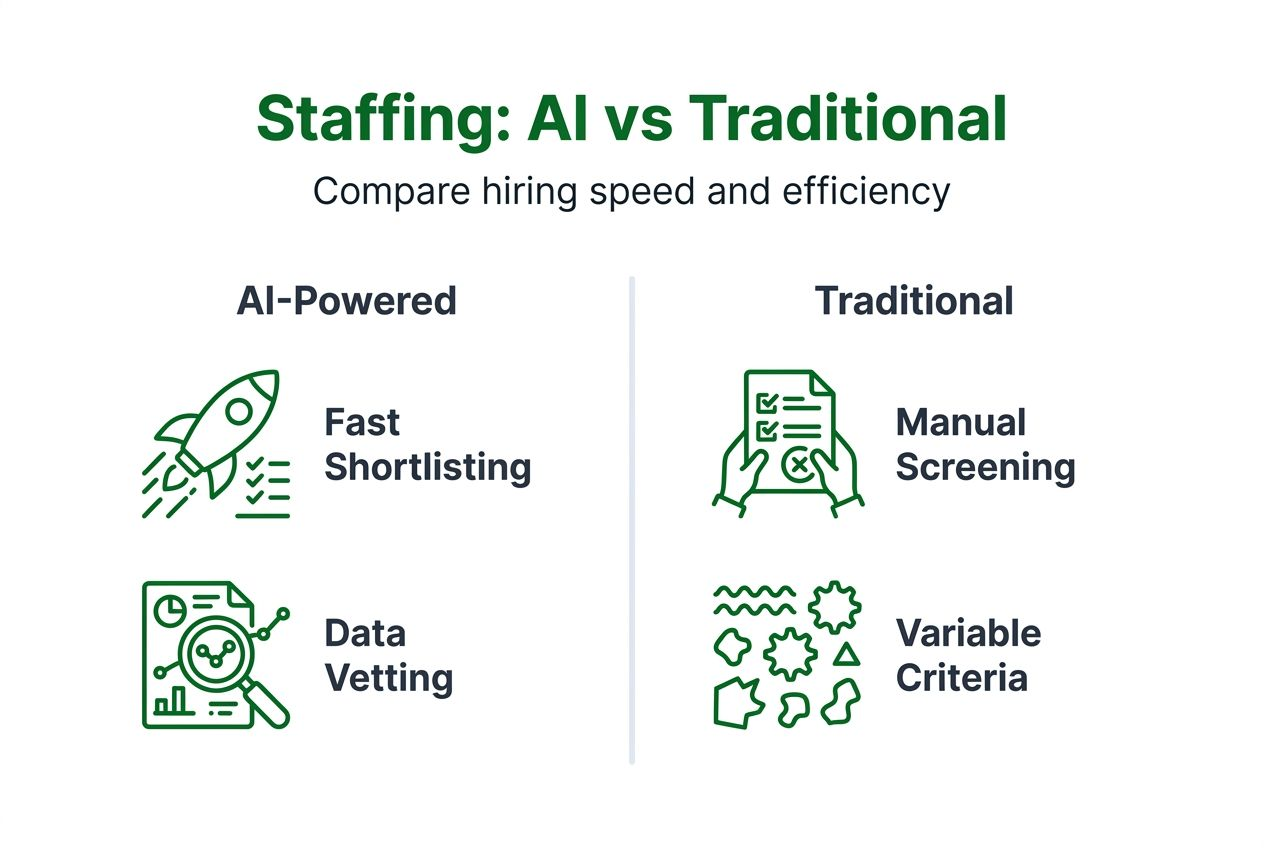
Manual vetting introduces inconsistency and potential bias. Different recruiters evaluate candidates using varied criteria, leading to unpredictable hire quality. Traditional recruitment methods struggle with slow time-to-hire and inconsistent vetting, particularly when scaling teams rapidly. Human reviewers tire after reviewing dozens of resumes, causing qualified candidates to slip through cracks.
The demand for pre-vetted talent has exploded as companies seek nearshore and onshore resources. US enterprises want team members in compatible time zones who understand business culture and communication norms. Offshore alternatives often create coordination headaches and hidden costs that negate initial savings.
Both startups and enterprises face mounting pressure:
- Startups need to scale technical teams quickly to meet product deadlines and investor expectations
- Enterprises require consistent quality across hundreds of hires while controlling recruitment budgets
- All companies compete for the same limited pool of top talent in hot markets
- Remote work has expanded candidate pools but also increased screening complexity
AI-powered staffing emerged as the solution to these converging challenges. The technology addresses speed, quality, and cost simultaneously. Technical interview automation demonstrates how AI handles repetitive evaluation tasks that bog down human recruiters.
Pro Tip: Track your current time-to-hire metrics before implementing AI staffing. Baseline data helps you measure real improvement and justify investment to leadership.
How AI powers faster and more effective staffing
AI transforms recruitment through three core mechanisms that directly address traditional hiring pain points. Understanding these technologies helps hiring managers set realistic expectations and maximize platform value.
Automation handles the grunt work that consumes recruiter time. AI reduces manual resume screening workload by up to 60%, freeing recruiters to focus on candidate relationships and final evaluations. Natural language processing scans resumes for specific skills, experience levels, and qualifications in seconds. The system matches job requirements against candidate profiles with consistent criteria every time.
Predictive analytics take automation further by forecasting candidate success. Machine learning models analyze patterns from thousands of past hires to identify which backgrounds correlate with strong performance and long tenure. These insights help recruiters prioritize candidates most likely to thrive in specific roles and company cultures.
Anonymized screening reduces potential bias by removing identifying information during initial reviews. The AI focuses purely on skills, experience, and qualifications without seeing names, photos, or demographic details. However, bias reduction requires ongoing monitoring. AI systems can perpetuate historical biases if training data contains patterns from discriminatory past practices.
Here’s how AI staffing improves recruiter productivity:
- Initial screening filters out clearly unqualified candidates in minutes, not days
- Skills matching ranks remaining candidates by fit score, creating a prioritized review queue
- Automated outreach sends personalized messages to top prospects at scale
- Interview scheduling integrates with calendars to eliminate back-and-forth emails
- Performance predictions highlight candidates with the highest success probability
AI staffing timing matters because implementation works best when you have clear hiring needs and baseline metrics. Companies see the strongest results when AI complements experienced recruiters rather than replacing junior staff entirely.
The technology excels at pattern recognition and data processing. It identifies qualified candidates faster than humans while maintaining consistent evaluation standards. However, AI lacks the contextual judgment and relationship skills that make great recruiters valuable. The best outcomes happen when AI handles repetitive analysis while humans manage strategy, candidate experience, and final decisions.
Access to pre-vetted talent pools amplifies AI’s value. Platforms that combine AI matching with human vetting create a powerful hybrid. Candidates undergo rigorous technical assessments and soft skills evaluation before entering the database. AI then matches pre-qualified talent to specific roles, dramatically shortening the path from job posting to offer.
Pro Tip: Start with one role or department when implementing AI staffing. Learn what works in a controlled environment before expanding to company-wide adoption.
Benefits of AI in staffing speed and efficiency
Quantifiable improvements in hiring metrics prove AI staffing’s value beyond theoretical advantages. US companies in 2026 report significant gains across speed, quality, and cost dimensions.
AI staffing can reduce time-to-hire by up to 45% compared to traditional methods. This acceleration comes from eliminating manual screening bottlenecks and automating coordination tasks. A role that previously took 60 days from posting to offer now closes in 33 days. For startups racing to launch products, this speed difference determines success or failure.

Quality improvements deliver even greater long-term value. Retention improves by 15-25% with AI-vetted hires because predictive analytics identify candidates who match both technical requirements and cultural fit. Better retention reduces replacement costs and preserves team knowledge. A developer who stays three years instead of 18 months represents massive savings in recruiting, onboarding, and lost productivity.
Nearshore and onshore hiring through AI platforms combines cost efficiency with collaboration benefits:
| Benefit Category | Impact | Why It Matters |
|---|---|---|
| Time zone alignment | 6-8 hour overlap | Enables real-time collaboration and faster problem resolution |
| Cultural compatibility | Higher engagement | Reduces miscommunication and improves team cohesion |
| Cost savings | 30-50% vs US rates | Enterprise-quality talent at sustainable budgets |
| Legal simplicity | Easier compliance | Fewer cross-border employment complications than offshore |
| Travel accessibility | 2-5 hour flights | Facilitates in-person meetings and team building |
Nearshore and onshore staffing services deliver these advantages while maintaining the speed and quality of AI-powered matching. Companies avoid the coordination headaches and hidden costs of offshore teams without paying full US market rates.
Efficiency gains translate directly to cost savings. Reducing time-to-hire by 45% means recruiters handle more requisitions with existing headcount. Lower turnover eliminates repeated hiring costs for the same position. Better candidate matching reduces failed hires that drain productivity and morale.
The math works at every company size. A startup hiring 10 developers saves $50,000+ in recruiting costs and months of delayed product development. An enterprise filling 200 positions annually saves millions while improving workforce quality. The ROI becomes obvious within the first quarter of implementation.
Pro Tip: Calculate your cost-per-hire before using AI staffing, then measure again after three months. Include recruiter time, job board fees, and failed hire replacements for accurate comparison.
Common misconceptions about AI in staffing
Five persistent myths prevent companies from adopting AI staffing despite clear benefits. Understanding the reality behind each misconception helps hiring managers make informed decisions.
Myth 1: AI will replace human recruiters entirely. Reality shows AI staffing complements human recruiters and requires oversight to mitigate bias. The technology automates repetitive tasks like resume screening and initial outreach. Recruiters focus on relationship building, candidate experience, and final evaluations. Companies that try to eliminate recruiters entirely miss the human judgment that ensures cultural fit and handles sensitive negotiations.
Myth 2: AI completely eliminates hiring bias. AI reduces certain biases by standardizing evaluation criteria and anonymizing initial screening. However, algorithms trained on historical data can perpetuate existing biases unless carefully monitored. Human oversight remains essential to catch edge cases and ensure fair treatment. The best practice combines AI consistency with human accountability.
Myth 3: AI staffing only works for technical roles. Modern platforms serve diverse functions across industries. AI staffing facts demonstrate success in marketing, finance, operations, and creative positions. The technology matches skills and experience regardless of job category. While tech hiring pioneered AI adoption, the benefits apply anywhere high-volume recruiting creates bottlenecks.
Myth 4: AI-powered staffing replaces traditional recruiting completely. Integration works better than replacement. Companies achieve optimal results by using AI for initial screening and matching while maintaining traditional methods for relationship building and final candidate evaluation. This hybrid approach combines technological efficiency with human insight.
Myth 5: Nearshore and onshore sourcing costs more than offshore alternatives. The total cost calculation tells a different story. Nearshore rates run 30-50% below US market while offering better collaboration than offshore options. Hidden offshore costs include coordination overhead, quality issues from communication gaps, and turnover from cultural misalignment. Nearshore and onshore talent often delivers better value when factoring in productivity and retention.
These misconceptions stem from early AI implementations that overpromised and underdelivered. Modern platforms learned from those mistakes. They position AI as a recruiter’s assistant, not a replacement. Transparency about limitations builds trust and sets realistic expectations.
The key insight: AI staffing works best when companies understand what it does well (pattern matching, data processing, consistency) and what humans do better (judgment, relationships, context). Trying to force AI into roles requiring human skills creates frustration. Using it for its strengths delivers the 45% time savings and quality improvements the data shows.
Comparison: AI-powered staffing vs traditional recruiting
Side-by-side analysis reveals how AI-powered and traditional methods differ across critical dimensions. This comparison helps hiring managers choose the right approach for specific situations.
| Factor | AI-Powered Staffing | Traditional Recruiting |
|---|---|---|
| Candidate sourcing | Automated scanning of databases and platforms | Manual searches and referrals |
| Initial screening | AI filters hundreds of resumes in minutes | Recruiters review each resume individually |
| Skills matching | 35% higher match accuracy through data analysis | Subjective evaluation based on recruiter experience |
| Time-to-hire | 45% faster average | Standard timelines of 45-60+ days |
| Cost per hire | Lower through efficiency gains | Higher due to manual labor intensity |
| Bias reduction | Anonymized screening with oversight needed | Varies by recruiter awareness and training |
| Scalability | Handles volume spikes without proportional cost increases | Requires more recruiters for more roles |
| Talent location | Optimized for nearshore/onshore pre-vetted pools | Relies on local networks and job boards |
The decision framework for choosing between approaches:
- Assess your hiring volume and urgency. High-volume needs or compressed timelines favor AI-powered staffing.
- Evaluate your internal recruiting capacity. Small teams gain more from AI augmentation than large, established recruiting departments.
- Consider role requirements. Standardized positions with clear skills criteria work best for AI matching.
- Determine your budget constraints. AI platforms require upfront investment but deliver ROI through efficiency.
- Review your quality standards. If you need specialized nearshore or onshore talent, AI platforms with pre-vetted pools outperform traditional methods.
Startups benefit most from AI staffing when scaling quickly without building large recruiting teams. The technology lets them compete for talent against enterprises with bigger HR budgets. A five-person startup can effectively source candidates as well as a company with dedicated recruiters.
Enterprises gain volume hiring efficiency and quality consistency. When filling 50+ similar roles, AI ensures every candidate gets evaluated against identical criteria. This standardization reduces bad hires and supports defensible, equitable hiring practices.
AI staffing comparison data shows hybrid approaches often work best. Use AI for initial screening and matching, then apply traditional recruiter skills for relationship building and final evaluation. This combination captures efficiency gains without losing the human touch that closes top candidates.
The reality in 2026: most successful companies use both methods strategically. Executive and highly specialized roles may still require traditional recruiting’s relationship-driven approach. High-volume technical and operational hiring leverages AI’s speed and consistency. Matching method to situation delivers optimal results.
Practical applications and benefits for startups vs enterprises
Company size determines which AI staffing features deliver maximum value. Tailored strategies optimize outcomes for different organizational contexts.
Enterprise applications focus on volume and consistency. Large companies hiring hundreds of employees annually need standardized processes that maintain quality at scale. AI staffing provides:
- Consistent evaluation criteria across all candidates, reducing bias and supporting compliance
- Volume hiring capabilities that don’t require proportional increases in recruiting headcount
- Cost-effective access to nearshore talent pools for technical and operational roles
- Data analytics showing hiring funnel metrics and bottlenecks for continuous improvement
Enterprises improve volume hiring by 40% while maintaining or improving candidate quality. The combination of speed and consistency matters most at scale. A Fortune 500 company filling 500 positions saves millions in recruiting costs and weeks of productivity loss from unfilled roles.
Startup applications emphasize speed and access. Fast-growing companies need to build teams quickly without large HR departments. AI staffing enables:
- Rapid scaling that matches aggressive product development timelines
- Access to pre-vetted nearshore talent that would be hard to source independently
- Efficient use of founder and early employee time by eliminating resume screening
- Flexible hiring for contractors, freelancers, and full-time roles as needs evolve
Startups double their hiring velocity with AI-powered platforms. A Series A company can build a 20-person engineering team in three months instead of six. This acceleration directly impacts runway and product launch dates.
Nearshore and onshore sourcing delivers specific advantages for both:
- Real-time collaboration during overlapping work hours improves productivity
- Cultural alignment reduces miscommunication and speeds onboarding
- Time zone compatibility enables synchronous meetings and faster decision making
- Cost savings of 30-50% versus US market rates while maintaining quality
Customized approaches optimize value extraction. Enterprises should focus on standardizing high-volume roles first, then expand to specialized positions. Startups benefit from starting with their most urgent technical hires where speed matters most.
AI staffing services offer flexibility for different hiring models. Companies can fill full-time positions, engage contractors for project work, or use freelancers for specialized tasks. This versatility adapts to changing business needs without switching platforms.
Pro Tip: Enterprises should pilot AI staffing with one business unit before company-wide rollout. Startups can implement across all roles immediately since smaller scale reduces risk.
Conceptual framework for AI-powered staffing
Three interconnected components create a mental model for understanding how AI staffing solves recruitment challenges. This framework helps hiring managers implement and optimize the technology.
Component 1: Automated candidate sourcing. AI systems scan multiple talent databases, job boards, and professional networks simultaneously. They identify candidates matching specific criteria without human intervention. This automation solves the volume problem by processing thousands of profiles in minutes. The system works continuously, finding passive candidates who aren’t actively job hunting but match requirements perfectly.
Component 2: Data-driven vetting. AI applies consistent evaluation criteria to every candidate using skills assessments, experience analysis, and predictive modeling. Machine learning algorithms identify patterns correlating with successful hires and long tenure. This data approach reduces human bias and improves match quality. Pre-vetted talent pools add another layer by combining AI analysis with human expert review.
Component 3: Strategic talent location. Geographic optimization focuses on nearshore and onshore resources that balance cost, collaboration, and quality. AI matches candidates not just by skills but by location factors that impact team effectiveness. Time zone alignment, cultural compatibility, and communication norms become quantifiable selection criteria alongside technical abilities.
These three components work together:
- Automation finds the candidates traditional methods would miss due to time constraints
- Data-driven vetting evaluates those candidates more accurately and consistently than manual review
- Strategic location sourcing ensures selected candidates integrate effectively with existing teams
- The combined effect addresses speed, quality, and cost challenges simultaneously
The combined effects of automation, data vetting, and strategic talent location optimize recruitment for companies of all sizes. Each component solves a specific pain point. Together they transform the entire hiring process.
The framework applies universally whether you’re a startup hiring your first developer or an enterprise filling 200 positions quarterly. Scale the intensity of each component based on your needs. Small companies might emphasize automation to compensate for limited recruiting resources. Large enterprises might focus on data-driven vetting to maintain consistency across high volumes.
Implementation success requires balancing all three components. Automation without good vetting creates speed but poor quality. Great vetting without strategic location sourcing misses cost and collaboration benefits. AI staffing framework thinking helps teams avoid optimizing one dimension while ignoring others.
This mental model also clarifies where human recruiters add unique value. They set the initial search criteria (what to automate), interpret vetting results in context (how to apply data), and build relationships with selected candidates (why location strategy matters). AI handles the heavy computational lifting. Humans provide judgment, strategy, and personal connection.
Discover the power of AI-powered staffing with Fuerza
You’ve seen how AI staffing transforms recruitment speed, quality, and cost. Now it’s time to experience those benefits directly. Fuerza AI-powered staffing connects you with pre-vetted nearshore and onshore talent through intelligent matching that cuts time-to-hire by 45%.
Our platform combines automated sourcing with human expert vetting. You get access to developers, designers, marketers, and specialists who’ve passed rigorous technical and soft skills assessments. Every candidate in our database works in compatible time zones and understands US business culture.
The integration process takes days, not months. Our AI tools plug into your existing recruiting workflows without requiring wholesale process changes. Your recruiters focus on relationship building and final decisions while our technology handles screening and matching. Fuerza staffing services support full-time hires, contractors, and freelancers across multiple engagement models.
Pricing scales with your needs. Whether you’re a startup making your first technical hire or an enterprise filling hundreds of positions, Fuerza pricing plans align costs with value delivered. You pay for successful placements, not endless searching.
Frequently asked questions
How do I maintain control over hiring decisions using AI staffing?
Recruiters use AI outputs as decision support, not as final arbiters. The system provides ranked candidate lists and match scores, but humans make all hiring decisions. Establish checkpoints for human review at screening completion, after initial interviews, and before offers. This oversight ensures AI recommendations align with company culture and strategic needs.
Is AI-powered staffing suitable for startups with limited budgets?
AI staffing can lower costs by cutting recruitment time and inefficiencies that drain startup resources. Many platforms offer startup-friendly pricing tied to successful placements rather than upfront fees. The 45% time savings and improved hire quality deliver ROI quickly. Check Fuerza pricing plans for options matching early-stage budgets.
Can AI-powered staffing find candidates beyond the tech sector?
AI staffing platforms have expanded talent databases for marketing, finance, operations, creative, and other functions. They provide specialized vetting for non-technical roles through skills assessments and experience matching. The same automation and data-driven approaches that work for developers apply to any role with definable requirements. Explore diverse talent pools across industries.
What are the best practices for integrating AI staffing into existing recruitment workflows?
Start with supplementing manual processes rather than full replacement. Use AI for initial screening while recruiters handle later stages. Establish monitoring of time-to-hire and candidate quality metrics to track improvement. Provide recruiter training on interpreting AI insights and using platform features effectively. Review AI staffing implementation timing guidance for phased rollout strategies that minimize disruption.
Recommended
- Fuerza — Hire Pre-Vetted AI & Tech Talent | AI-Powered Staffing
- Fuerza — Hire Pre-Vetted AI & Tech Talent | AI-Powered Staffing
- Fuerza — Hire Pre-Vetted AI & Tech Talent | AI-Powered Staffing
- Fuerza — Hire Pre-Vetted AI & Tech Talent | AI-Powered Staffing
- Managed IT Houston: Transform Your Business Today - CinchOps, Inc.