
How AI staffing platforms transform talent hiring in 2026
How AI staffing platforms transform talent hiring in 2026

Traditional hiring processes can consume weeks or months of recruiter time, yet AI-powered platforms compress 40-hour screening cycles into 4 minutes, fundamentally reshaping how organizations source and place talent. This dramatic efficiency gain represents just one dimension of the transformation AI staffing platforms deliver to product managers and hiring leaders navigating competitive talent markets. Throughout this article, you will discover how these platforms work, the quantifiable benefits they provide, the challenges organizations face during implementation, and practical strategies for maximizing your investment in AI-driven recruitment technology.
Table of Contents
Understanding AI-Powered Staffing Platforms: What They Are And How They Work
Benefits Of AI Staffing Platforms: Speed, Quality, And Market Growth
Challenges And Nuances: Human Oversight And Recruiter Workload In AI Staffing
Applying AI Staffing Platforms Effectively: Best Practices And Future Outlook
Key takeaways
PointDetailsSpeed advantageAI staffing platforms accelerate resume screening time by up to 600x compared to manual processes.Quality improvementCandidate evaluation powered by AI increases quality of hire by 35% through data-driven matching.Core modulesModern platforms integrate active searching, skills extraction, matching algorithms, and automated engagement.Human oversightBalancing AI autonomy with recruiter judgment prevents quality issues and maintains candidate experience.Market validationForrester reports nearly 50% reduction in time to hire using contemporary AI recruiting solutions.
Understanding AI-powered staffing platforms: what they are and how they work
AI staffing platforms represent specialized recruitment technology that automates candidate sourcing, evaluation, and engagement through machine learning algorithms and natural language processing. These systems eliminate manual resume review bottlenecks while surfacing qualified candidates hiring teams might otherwise overlook. At their core, modern platforms operate through four interconnected AI modules that work together to transform raw candidate data into actionable hiring intelligence.
The first module handles active searching by continuously scanning job boards, professional networks, and talent databases to identify potential matches based on role requirements. Skills extraction follows, using natural language processing to parse resumes and profiles, identifying technical competencies, soft skills, and experience markers that traditional keyword searches miss. The AI-based active sourcing structured around active searching, skills extraction, skills matching, and automated personalized approaches creates a comprehensive talent pipeline without manual intervention.
Skills matching algorithms then compare extracted candidate profiles against job specifications, scoring alignment across multiple dimensions including technical fit, experience level, and cultural indicators. This matching process considers both explicit requirements and implicit patterns learned from successful past placements. The fourth module automates personalized engagement, generating customized outreach messages, scheduling interviews, and maintaining candidate communication throughout the hiring funnel.
Beyond these core functions, sophisticated platforms integrate public data sources to enrich candidate profiles with professional achievements, project portfolios, and peer endorsements that provide deeper context for hiring decisions. Employer analytics dashboards surface hiring funnel metrics, candidate quality trends, and process bottlenecks, enabling data-driven optimization of recruitment strategies. These automation modules and candidate matching capabilities transform hiring from a reactive, labor-intensive process into a proactive, intelligence-driven operation.
Pro Tip: The most effective implementations combine AI insight with human judgment at critical decision points, using technology to handle high-volume screening while reserving recruiter expertise for candidate assessment, relationship building, and final selection decisions.
Benefits of AI staffing platforms: speed, quality, and market growth
The quantifiable advantages of AI staffing platforms extend across three primary dimensions: dramatic time savings, measurable quality improvements, and validated market adoption. Organizations implementing these systems report screening cycle reductions from days or weeks to minutes, with AI screening compressing 40-hour screening cycles into 4 minutes representing the upper end of efficiency gains. This speed advantage compounds throughout the hiring funnel, accelerating candidate engagement, interview scheduling, and offer delivery.

Quality improvements prove equally compelling. Research demonstrates that AI screening can increase quality of hire by 35% through more consistent evaluation criteria and reduced human bias in initial screening stages. Platforms analyze hundreds of candidate attributes simultaneously, identifying high-potential matches that manual review processes overlook due to time constraints or unconscious filtering. This enhanced matching precision translates to lower turnover rates, faster time to productivity, and stronger cultural fit.
Market data validates the business case for AI staffing investment. The HR tech market is $30 billion, growing at 12% annually, reflecting widespread enterprise adoption and continued innovation investment. Organizations report time to hire reductions of nearly half with modern recruiting platforms, delivering measurable return on investment through reduced vacancy costs and improved hiring manager satisfaction.
MetricTraditional HiringAI-Driven HiringImprovementResume screening time40 hours per role4 minutes per role600x fasterQuality of hire scoreBaseline 10013535% increaseTime to hire45 days average23 days average49% reductionCandidate engagement rate15% response38% response153% increase
Pro Tip: When building your business case for AI staffing platforms, focus on measurable ROI metrics like cost per hire reduction, time to productivity improvements, and hiring manager satisfaction scores rather than purely technology features.
“The convergence of AI-powered candidate matching with automated engagement workflows has fundamentally altered talent acquisition economics, enabling organizations to compete for top talent through speed and personalization at scale.” - HR Technology Research, 2026
The overview of AI-driven staffing transformation reveals how these platforms create competitive advantage not just through operational efficiency but through access to talent pools that manual processes cannot effectively reach or engage.
Challenges and nuances: human oversight and recruiter workload in AI staffing
Despite compelling benefits, AI staffing platform implementation introduces operational challenges that organizations must address to achieve sustainable results. The most significant concern involves increased recruiter workloads when AI tools generate candidate volume without corresponding quality filters or workflow integration. Data shows recruiter workload increased 26% in late 2024 due to generic AI tools that flooded pipelines with marginally qualified candidates, creating review bottlenecks rather than eliminating them.
This workload paradox emerges when organizations deploy AI screening without sufficient human oversight mechanisms or quality thresholds. Platforms configured to maximize candidate volume rather than match precision overwhelm recruiters with false positives, degrading both efficiency and candidate experience. The solution requires calibrating AI autonomy levels to organizational capacity, ensuring technology amplifies rather than replaces human judgment at critical evaluation stages.
Balanced human oversight proves essential for scaling AI-powered recruiting agents safely and effectively. Research emphasizes that organizations must embed controls balancing AI autonomy with human oversight to prevent algorithmic drift, maintain candidate relationship quality, and adapt to evolving role requirements that rigid automation cannot accommodate. This oversight takes multiple forms across the hiring funnel.
Common challenges organizations encounter include:
Managing candidate volume spikes that exceed recruiter capacity for meaningful engagement
Validating AI-generated candidate quality scores against actual job performance outcomes
Identifying and correcting algorithmic biases that emerge from historical hiring data patterns
Maintaining personalized candidate communication when automation handles initial outreach
Adapting platform configurations as role requirements and talent market conditions shift
Integrating AI with human workflows effectively requires deliberate process design. Follow these steps:
Define clear quality thresholds where AI screening hands off to human review, typically after initial skills matching but before interview scheduling.
Establish feedback loops where recruiter assessments and hiring outcomes train AI models to improve future candidate scoring accuracy.
Create escalation protocols for edge cases, non-standard candidate profiles, or sensitive hiring situations requiring human judgment.
Monitor candidate experience metrics to ensure automation enhances rather than degrades communication quality and responsiveness.
Schedule regular platform calibration reviews to adjust matching algorithms based on evolving role requirements and market conditions.
“The future of recruitment technology lies not in replacing human recruiters but in transforming static platforms into dynamic ecosystems where AI agents handle repetitive tasks while humans focus on relationship building, strategic talent planning, and complex candidate assessment.” - Enterprise AI Implementation Study, 2026
Successful implementations recognize that embedding organizational controls with AI agents creates sustainable competitive advantage by combining technological efficiency with human insight, avoiding the pitfalls of either pure automation or purely manual processes.
Applying AI staffing platforms effectively: best practices and future outlook
Maximizing AI staffing platform impact requires strategic implementation approaches that align technology capabilities with organizational hiring needs and culture. Leading organizations adopt specific best practices that accelerate value realization while minimizing common deployment pitfalls. These practices span initial platform selection, phased rollout strategies, ongoing optimization processes, and performance measurement frameworks.
Best practices for adopting AI staffing platforms include:
Start with high-volume, well-defined roles where consistent evaluation criteria and large candidate pools maximize AI matching effectiveness
Invest in recruiter training that builds AI literacy and clarifies how technology augments rather than replaces human expertise
Establish baseline metrics before implementation to quantify improvements in time to hire, quality of hire, and cost per hire
Configure platforms to surface candidate insights and recommendations rather than making autonomous hiring decisions
Integrate AI staffing tools with existing applicant tracking systems and HRIS platforms to maintain unified candidate data
A structured deployment roadmap ensures smooth adoption:
Conduct a pilot program with 2-3 high-priority roles, measuring screening time, candidate quality, and recruiter satisfaction over 60-90 days.
Gather recruiter feedback on platform usability, candidate quality, and workflow integration, adjusting configurations before broader rollout.
Expand to additional role families gradually, customizing matching algorithms and engagement templates for different talent segments.
Implement continuous monitoring of key performance indicators including screening efficiency, interview-to-offer ratios, and new hire performance.
Schedule quarterly platform optimization reviews to refine matching algorithms, update skills taxonomies, and incorporate new data sources.
Workflow StageManual ProcessAI Staffing ProcessEfficiency GainCandidate sourcing8 hours per role15 minutes per role97% reductionResume screening40 hours per role4 minutes per role99% reductionSkills assessment6 hours per candidate2 minutes per candidate99% reductionInterview scheduling45 minutes per candidate3 minutes per candidate93% reductionCandidate engagement30 minutes per touchpoint2 minutes per touchpoint93% reduction
Pro Tip: Leverage AI-optimized hardware infrastructure and continuous learning capabilities to sustain performance gains, as AI agents can accelerate business processes 30% to 50% when supported by adequate computing resources and regular model updates.
Emerging trends shaping AI hiring technology include multimodal candidate assessment combining resume analysis with video interviews and skills testing, predictive analytics forecasting candidate success probability and retention likelihood, and conversational AI agents handling complete candidate engagement journeys from initial outreach through offer negotiation. Advanced platforms now incorporate computing power and AI chips that reduce errors and low-value work by 25% to 40%, enabling more sophisticated matching algorithms and real-time candidate insights.
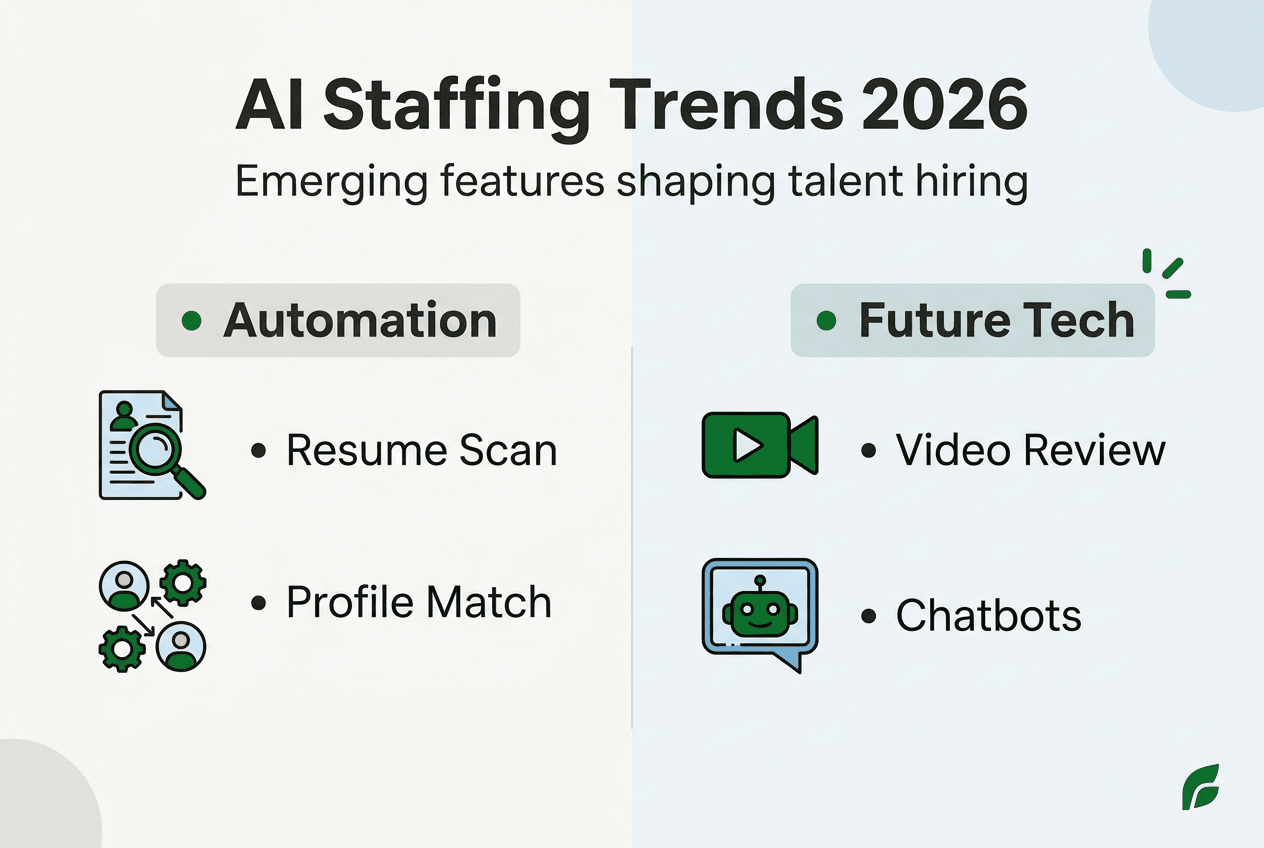
The trajectory points toward increasingly autonomous recruiting agents that handle end-to-end hiring workflows while maintaining human oversight at strategic decision points. Organizations positioning themselves to capitalize on these advances invest in foundational AI literacy, data infrastructure, and change management capabilities that enable rapid adoption of emerging capabilities. Explore AI staffing platform services and solutions to understand how leading providers are implementing these advanced capabilities today.
Explore AI-powered staffing solutions with Fuerza
The transformation AI staffing platforms bring to talent hiring speed, quality, and cost efficiency creates compelling opportunities for product managers and hiring leaders seeking competitive advantage in tight talent markets. Fuerza delivers these benefits through an AI-powered staffing platform connecting pre-vetted technology experts with enterprise and startup teams across nearshore and onshore locations optimized for US clients.
Our platform leverages the automation modules, candidate matching algorithms, and engagement workflows discussed throughout this article to accelerate your hiring cycles while maintaining the quality standards your projects demand. Whether you need freelance specialists, full-time team members, or contractor resources, our AI-powered staffing platform streamlines the entire sourcing and placement process.
Explore our comprehensive staffing platform services to discover how Fuerza can transform your talent acquisition strategy, or join the Fuerza waitlist to gain early access to our latest AI-driven hiring capabilities and pre-vetted talent networks.
Frequently asked questions
What is the role of AI in modern staffing platforms?
AI powers the core functions of contemporary staffing platforms by automating candidate sourcing, resume screening, skills matching, and initial engagement workflows. These systems use machine learning algorithms to identify qualified candidates faster and more accurately than manual processes, while natural language processing extracts skills and experience from unstructured candidate data. The technology enables recruiters to focus on relationship building and strategic talent planning rather than administrative screening tasks.
How do AI staffing platforms improve hiring speed?
AI automates time-consuming resume screening and candidate matching tasks that traditionally require days or weeks of recruiter effort, with AI compressing 40-hour screening cycles into 4 minutes in optimized implementations. Integration with communication tools enables rapid interview scheduling, automated candidate follow-ups, and real-time pipeline status updates. These efficiency gains compound throughout the hiring funnel, reducing overall time to hire by nearly half compared to manual processes.
What challenges should organizations consider with AI hiring tools?
Poorly configured AI tools can increase recruiter workload rather than reduce it, as recruiter workload increased 26% in late 2024 due to generic platforms flooding pipelines with marginally qualified candidates. Organizations must balance AI autonomy with human oversight to maintain candidate quality, prevent algorithmic bias, and preserve personalized candidate experiences. Successful implementations require clear quality thresholds, feedback loops that improve AI accuracy over time, and escalation protocols for complex hiring situations requiring human judgment.
Can AI staffing platforms help startups and enterprises equally?
Modern AI staffing platforms offer scalable solutions designed to serve both resource-constrained startups and large enterprises with complex hiring needs. Customizable automation modules address diverse recruitment volumes, from startups hiring their first technical team members to enterprises managing hundreds of concurrent requisitions across multiple locations. The key differentiator lies in platform flexibility, allowing organizations to adjust AI autonomy levels, matching criteria, and workflow integration based on their specific hiring maturity and resource availability.
How do organizations measure ROI from AI staffing platform investments?
Effective ROI measurement tracks multiple dimensions including reduced time to hire, lower cost per hire, improved quality of hire scores, and enhanced hiring manager satisfaction. Organizations should establish baseline metrics before implementation, then monitor improvements in screening efficiency, interview-to-offer conversion rates, new hire performance ratings, and first-year retention. Leading implementations report 30-50% acceleration in business processes and 25-40% reduction in low-value administrative work, translating to substantial cost savings and competitive talent acquisition advantages.
Recommended
Fuerza — Hire Pre-Vetted AI & Tech Talent | AI-Powered Staffing
Fuerza — Hire Pre-Vetted AI & Tech Talent | AI-Powered Staffing
Fuerza — Hire Pre-Vetted AI & Tech Talent | AI-Powered Staffing
Fuerza — Hire Pre-Vetted AI & Tech Talent | AI-Powered Staffing
AI Tools for Entrepreneurs: Automate 80% of Workloads in 2026 – Starfireblast
AI Automation for Businesses in 2026 | Virtual Innovation NZ