
Role of AI in Candidate Screening: Transforming Hiring

Sorting through hundreds of resumes can feel endless for fast-growing US tech startups. With the pressure to hire quickly and fairly, many teams are turning to AI-powered candidate screening as a way to handle volume and save time. In fact, up to 98.4% of Fortune 500 companies are already using AI tools in their hiring process, which raises real questions about efficiency, fairness, and the impact on your own recruitment strategy.
Table of Contents
Key Takeaways
| Point | Details |
| AI-Powered Efficiency | AI screening accelerates the recruitment process, allowing startups to process thousands of applications quickly and focus on meaningful candidate interactions. |
| Bias and Fairness | AI does not eliminate bias but rather reflects the values of its design choices; careful monitoring and oversight are essential to mitigate unintended biases. |
| Legal Compliance | Using AI in hiring does not exempt organizations from discrimination laws; continuous auditing and transparency are crucial to ensure compliance. |
| Human Oversight | Effective deployment of AI requires meaningful human engagement at decision points to evaluate candidate rejections and validate the screening process. |
Defining AI-Powered Candidate Screening
AI-powered candidate screening uses algorithmic systems to automatically evaluate resumes, cover letters, and applicant materials against job requirements. Instead of hiring managers manually reviewing each submission, these systems process candidate information at scale, identifying top contenders in seconds.
Up to 98.4% of Fortune 500 companies now use AI tools in their recruitment processes, showing how widespread this technology has become. For startup hiring managers like you, this means the competitive pressure is real—candidates expect faster feedback, and your team needs efficiency gains to keep up with high application volumes.
How AI Screening Works
These systems operate through several key mechanisms:
-
Resume parsing extracts information like skills, experience, and education from unstructured documents
-
Pattern matching compares candidate qualifications against job descriptions and ideal candidate profiles
-
Scoring algorithms rank applicants based on weighted criteria you define (years of experience, specific skills, certifications)
-
Language model analysis evaluates how candidates communicate and demonstrate cultural alignment
The goal is straightforward: reduce time-to-hire and eliminate the repetitive work of initial screening, letting your team focus on meaningful conversations with qualified candidates.
The Promise and the Reality
AI screening promises significant benefits. Systems claim to increase fairness by reducing human bias in candidate evaluation. They work 24/7 without fatigue, apply consistent criteria across all applicants, and handle thousands of submissions that would overwhelm your recruiting team.
But here’s what matters for your startup: these systems don’t eliminate bias—they redefine it. Designer choices about what qualifications matter, how to weight different factors, and which candidates look “similar” to past hires all embed assumptions into the algorithm. A system optimized for speed might accidentally filter out qualified candidates who don’t follow conventional career paths.
AI screening speeds up hiring, but the algorithms reflect the values and assumptions of whoever designed them.
Why This Matters for Tech Startups
In the competitive tech talent market, especially when recruiting nearshore and onshore resources, screening bias has real consequences. You might inadvertently narrow your candidate pool to people who match existing team members, missing diverse talent that could strengthen your organization. Legal compliance around equal employment opportunity (EEO) isn’t optional—it’s a regulatory requirement that directly impacts your hiring decisions.
The best AI screening systems combine automated efficiency with human judgment. Your hiring managers should understand what the algorithm is actually doing, why certain candidates rank higher, and when to override recommendations that don’t align with your actual needs.
Pro tip: Start by defining exactly which candidate qualifications genuinely predict job performance for your roles—then verify your AI system actually measures those factors, not proxy characteristics that might introduce legal risk.
AI Screening Methods and Technologies Explained
AI screening relies on several core technologies working together to evaluate candidates at scale. Understanding how these systems actually work helps you choose the right tool and spot potential blind spots before they affect your hiring.
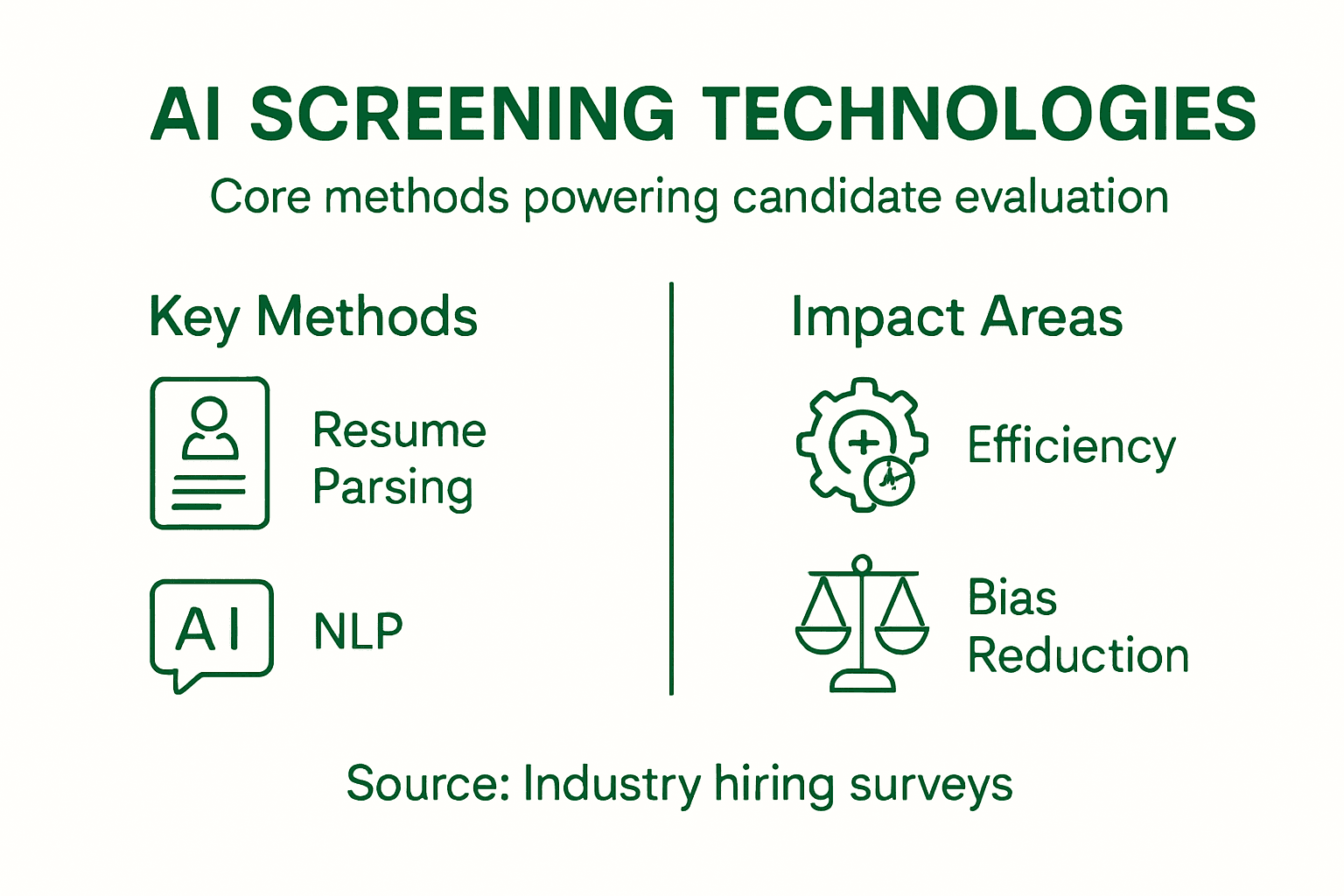
Core Technologies Behind AI Screening
Most AI screening systems combine multiple approaches:
-
Natural Language Processing (NLP) reads and understands resume text, identifying skills, experience, and qualifications without human intervention
-
Machine Learning models improve over time by learning from past hiring decisions and outcomes, adjusting their evaluation criteria
-
Resume parsing engines extract structured data from unstructured documents, converting messy PDFs and Word docs into clean, searchable databases
-
Semantic matching understands context and meaning, recognizing that “Ruby developer” and “Rails engineer” describe similar skills despite using different words
-
Behavioral scoring evaluates how candidates communicate, sometimes measuring cultural fit or communication style through language analysis
Each technology addresses a specific part of screening, but their combination creates the overall system you interact with.
Here’s how core AI screening technologies impact recruitment:
| Technology | Primary Function | Startup Impact |
| Natural Language Processing (NLP) | Analyzes resume text for key info | Speeds up skill identification |
| Machine Learning Models | Learns from hiring decisions | Improves ranking accuracy |
| Resume Parsing Engines | Converts documents to structured data | Enables database searchability |
| Semantic Matching | Finds contextual skill similarities | Broadens candidate pool |
| Behavioral Scoring | Analyzes communication or fit | Adds layer on cultural screening |
Evaluation Standards That Matter
NIST research on AI metrics provides benchmarks for testing AI screening quality. Organizations now evaluate these systems across multiple dimensions: accuracy (does the system rank candidates correctly?), robustness (does it perform consistently across different resume formats?), bias (does it treat demographic groups fairly?), and interpretability (can you understand why a candidate was ranked high or low?).
For your startup, this means asking vendors tough questions about how their system was tested and validated. Has anyone actually measured whether the system’s top-ranked candidates perform better in the role?
The best AI screening tools are transparent about their testing methods and acknowledge limitations.
How Design Choices Shape Outcomes
Understanding AI use taxonomy frameworks reveals how human decisions embedded in AI systems affect results. Someone decided which resume fields matter most, how much weight to give each factor, and what “culture fit” means for your company. These aren’t neutral technical choices—they’re value judgments that directly influence who gets screened in and out.
A system trained on your past hires will naturally favor candidates similar to people you’ve already hired. If your team lacks diversity, the algorithm amplifies that pattern. If you prioritized speed over fit in past hiring, the system learns to do the same.
The technology itself isn’t the problem. The problem is assuming the algorithm is objective when it’s actually reflecting human choices made during design and training.
Pro tip: Request your AI screening vendor’s validation report showing how their system performs on diverse candidate pools and different resume formats—then ask what they found and how they address gaps.
How AI Enhances Efficiency and Reduces Bias
AI screening delivers real efficiency gains that matter to startups managing high application volumes. But the bias reduction story is more complicated than vendors claim. Understanding both benefits and pitfalls helps you use AI strategically without creating new problems.
The Efficiency Gains Are Real
Here’s what AI actually delivers on the efficiency front:
-
Speed at scale processes thousands of resumes in hours, not weeks of manual review
-
Consistent evaluation applies the same criteria to every candidate, eliminating the unconscious variation that happens when reviewers get tired
-
Cost reduction cuts recruiting team time spent on initial screening by up to 70 percent
-
Focus on quality conversations frees your managers to spend time on interviews instead of resume reading
For a startup hiring multiple positions simultaneously, this matters. Your recruiting team can focus on relationship-building and deeper candidate assessment instead of drowning in administrative screening tasks.
Compare traditional vs. AI-powered candidate screening below:
| Aspect | Traditional Screening | AI-Powered Screening |
| Speed | Manually reviews each resume | Processes thousands in hours |
| Consistency | Varies by individual reviewer | Applies same metrics for all |
| Bias Risk | Influenced by human judgment | Reflects training data patterns |
| Cost Efficiency | High time investment | Reduces screening labor costs |
| Transparency | Decision criteria often implicit | Algorithmic logic can be explained |
The Bias Reduction Promise Needs Nuance
AI can theoretically reduce human bias by automating initial screening and standardizing criteria. When you remove individual hiring manager preferences from the first pass, you eliminate some sources of inconsistent judgment.
But here’s the catch: AI doesn’t eliminate bias. It redirects it. If your historical hiring data reflects past biases—like preferring candidates from certain schools or backgrounds—the algorithm learns and amplifies those patterns. The bias becomes invisible and scalable.
AI makes bias consistent, not fair.
Where the Real Problems Emerge
Research shows AI systems demonstrate measurable gender and racial biases, especially when deployed across large candidate pools. Language model analysis of “culture fit” can penalize candidates with different communication styles or non-traditional career paths.
These aren’t technical glitches. They’re design choices reflecting who trained the system and what data they used. A system optimized for your past hires will naturally screen out people different from them.
Effective AI screening requires three things happening simultaneously: continuous human oversight of who’s getting filtered out, regular audits measuring fairness across demographic groups, and willingness to override or adjust the system when it produces unfair results.
Making It Work for Your Team
The path forward isn’t abandoning AI. It’s using it deliberately with guardrails:
-
Treat AI as a triage tool, not a final decision-maker
-
Audit results regularly to see who’s being filtered at each stage
-
Have hiring managers review candidates the algorithm rejected to catch mistakes
-
Monitor outcomes by gender, race, and other factors quarterly
-
Adjust system weights when patterns emerge
Pro tip: Run a bias audit on your first 200 screenings—compare the algorithm’s top 50 candidates against your actual hires to see if there’s a mismatch suggesting the system is filtering based on irrelevant factors.
Legal and Ethical Risks in AI Screening
Using AI in hiring isn’t optional compliance anymore. The EEOC is actively enforcing civil rights law in AI systems, and your startup faces real liability if your screening process discriminates. Understanding the legal landscape protects both your candidates and your company.
Your Legal Obligations Haven’t Changed
Here’s the critical part: AI doesn’t exempt you from discrimination law. The EEOC makes clear that employers remain responsible for nondiscriminatory hiring practices regardless of whether humans or algorithms make decisions.
If your AI system screens out women, people of color, or candidates with disabilities at higher rates than others, you’re violating Title VII of the Civil Rights Act. The fact that an algorithm did the filtering doesn’t matter legally. You’re liable.
This applies to every stage of screening. Resume filtering, phone interview analysis, video assessment scoring—all subject to the same equal employment opportunity laws that govern traditional hiring.
Automation transfers responsibility, not liability.
Specific Legal Risks to Watch
These are the actual legal violations that have triggered EEOC investigations and lawsuits:
-
Disparate impact when AI filters disproportionately affect protected classes, regardless of intent
-
Lack of transparency when you can’t explain to the EEOC why candidates were rejected
-
Inadequate validation if you can’t prove your AI system actually predicts job performance
-
Failure to audit for bias, suggesting you’re negligent about discrimination risks
-
Privacy violations when collecting sensitive personal data without proper consent
The enforcement trend is clear. The EEOC is launching investigations into algorithmic fairness in hiring specifically because they know AI systems are creating barriers to employment.
Ethical Frameworks Add Protection
Beyond legal requirements, UNESCO’s ethics recommendation highlights key concerns including bias mitigation, transparency, privacy safeguards, and human accountability. These aren’t just nice-to-have principles. They’re increasingly becoming industry standards that regulators reference.
Building ethical AI screening means designing systems that safeguard human rights, not just legal compliance. It means transparency about how decisions are made and accountability when things go wrong.
What You Need to Document
Protect yourself by maintaining a clear audit trail:
-
Record how your AI system was built and what data trained it
-
Document validation testing showing it predicts job performance
-
Track hiring outcomes by protected class monthly
-
Keep records of candidates the system rejected that you hired anyway
-
Document any bias concerns raised and how you addressed them
This documentation proves you took discrimination risks seriously. It’s your defense if regulators come calling.
Pro tip: Have your legal counsel review your AI screening system before deployment, specifically asking them to identify disparate impact risks and what documentation you’ll need if the EEOC investigates.
Best Practices for Implementing AI Screening Tools
Implementing AI screening successfully requires deliberate choices at every stage. Rushing into deployment without planning creates legal exposure and damages candidate trust. These practices help you get efficiency gains while maintaining fairness and compliance.
Start With Clear Goals and Data
Before selecting any tool, define what you’re actually trying to measure. Are you screening for technical skills, communication ability, cultural alignment, or something else entirely?
This matters because your definition determines what data you collect and how the algorithm works. Bad goal-setting cascades into bias later. Be specific: “five years of Python experience” beats “strong technical background.”
Next, audit your historical hiring data. If your past hires skew toward one demographic, the AI will learn and amplify that pattern. Knowing this upfront lets you build guardrails against it.
Implement Meaningful Human Oversight
The U.S. Department of Labor emphasizes meaningful human oversight in AI employment decisions as a core best practice. This doesn’t mean having someone rubber-stamp what the algorithm recommends. It means genuine human judgment at critical decision points.
Specifically:
-
Have hiring managers review the system’s rejections, not just approvals
-
Set aside time to examine candidates the algorithm ranked lower that your team finds interesting
-
Empower recruiters to override the system when they spot errors or unfairness
-
Track these overrides to see if patterns emerge
AI screening works best when humans treat it as advice, not gospel.
Build in Transparency and Auditability
You must be able to explain why any candidate was accepted or rejected. If you can’t articulate the reason, you have a legal problem.
Transparency requires documenting:
-
Which criteria the system prioritizes and why
-
How weights were assigned to different factors
-
What training data shaped the algorithm
-
How validation testing proved it works
-
Regular audit results showing outcomes by demographic group
This isn’t bureaucratic overhead. It’s your defense against discrimination claims and the foundation for continuous improvement.
Establish Regular Bias Auditing
Run monthly reports comparing AI recommendations against actual hiring outcomes. Look for disparities in:
-
Rejection rates by gender, race, age, and disability status
-
Time-to-hire for different demographic groups
-
Quality of hires from different screening paths
If you spot concerning patterns, investigate why and adjust. Quality assurance and responsible innovation require ongoing monitoring and adjustment, not one-time implementation.
Communicate With Candidates
Tell candidates upfront that AI screens resumes. Explain what you’re evaluating and why. If someone wants to appeal or understand their rejection, make that process available.
Transparency builds trust. Candidates are more likely to accept a rejection they understand than one that feels arbitrary and black-box.
Pro tip: Implement a 90-day pilot with one hiring manager before deploying AI screening company-wide, measuring outcomes and gathering feedback on where the system helps and where it creates friction.
Harness AI for Smarter, Fairer Hiring at Your Startup
The article highlights the challenge of balancing efficiency and fairness in AI-powered candidate screening. You want to speed up hiring, avoid hidden bias, and ensure compliance with legal standards. The pain points include navigating algorithmic transparency, maintaining human oversight, and finding qualified nearshore and onshore talent without sacrificing diversity or candidate experience. Concepts like resume parsing, machine learning, and meaningful human supervision are key to transforming your hiring.
At Fuerza, we connect your team with pre-vetted experts using AI-enhanced staffing that respects these challenges. Our system blends automated screening with real human evaluation to deliver faster, fairer hiring outcomes. Whether you need freelancers, full-time team members, or contractors focused on the US market, Fuerza helps you find the right fit while reducing bias and legal risk.
Take control of your recruiting process today with Fuerza and explore how AI and human insight combine to transform candidate screening. Discover how our AI-powered staffing solutions can accelerate your growth without compromising quality or fairness.
Start hiring smarter now. Visit Fuerza to connect with top nearshore and onshore talent and see how AI can empower your startup’s recruiting strategy.
Frequently Asked Questions
What is AI-powered candidate screening?
AI-powered candidate screening utilizes algorithmic systems to automatically evaluate resumes and applicant materials against job requirements, streamlining the recruitment process.
How does AI screening reduce hiring bias?
AI screening aims to reduce bias by applying consistent criteria across all applicants, but it’s essential to understand that it can also reflect and amplify existing biases in training data.
What technologies are commonly used in AI candidate screening?
Common technologies include Natural Language Processing (NLP), Machine Learning models, resume parsing engines, semantic matching, and behavioral scoring to evaluate candidates effectively.
What are the legal considerations when using AI for hiring?
Employers must ensure that their AI screening processes comply with discrimination laws, maintaining transparency and auditing results for bias to avoid potential liabilities.