
AI hiring advantages for tech teams in 2026
AI hiring advantages for tech teams in 2026

Selecting the right AI hiring tool transforms how tech teams recruit top talent. With countless platforms promising faster hires and better candidates, hiring managers need clear criteria to evaluate which solutions deliver real value. This article breaks down the key advantages of AI hiring tools and how to assess them for your full-time and contract staffing needs.
Table of Contents
Advantage 5: Use Case Differentiation For Full-Time Vs. Contract Staffing
Situational Recommendations: Choosing AI Hiring Solutions Based On Staffing Needs
Accelerate Your Tech Hiring With Fuerza’s AI-Powered Solutions
Key takeaways
PointDetailsAI accelerates tech hiring by 30%Automated screening and matching reduce time-to-fill while cutting recruiter workload by 25%.Candidate quality improves retention 15-22%Data-driven matching and pre-vetted pools increase skill fit and long-term employee success.Diversity gains reach 20% with bias mitigationBlind screening and algorithmic fairness create more inclusive, innovative tech teams.Emerging skills tracking future-proofs hiring50% of tech roles now require AI skills; platforms identify evolving competencies early.Tailored workflows for full-time vs contractContract sourcing speeds up 35% while full-time hiring optimizes for cultural fit and retention.
Key criteria for evaluating AI hiring solutions
Before exploring specific advantages, you need a framework to assess AI hiring platforms. The right evaluation criteria ensure your investment delivers measurable improvements in hiring speed, candidate quality, and team diversity.
Start by measuring time-to-hire impact. Track how quickly the platform sources qualified candidates and shortens your recruitment cycle. Next, evaluate candidate quality through skill match accuracy and retention rates after hire. Look for platforms with built-in bias reduction features that enhance workforce diversity through blind screening and algorithmic fairness.
Integration capability matters tremendously. Your AI hiring tool should connect seamlessly with existing HR systems, applicant tracking software, and interview scheduling platforms. This prevents workflow disruptions and maximizes efficiency gains. Cost-effectiveness and scalability round out your evaluation. Calculate total investment against hiring volume, and confirm the platform can grow with your team’s needs.
Finally, match tool capabilities to your specific staffing requirements. Full-time hiring demands different features than contract or freelance recruitment. AI hiring solution timing impacts your implementation strategy significantly. Consider these factors:
Speed metrics: Average time reduction from job posting to offer acceptance
Quality indicators: Skills match percentage, cultural fit scores, retention rates
Diversity analytics: Candidate pool composition, bias detection reports
System compatibility: API availability, data migration support, workflow automation
Pricing models: Per-hire fees vs subscription costs, volume discounts
Staffing flexibility: Support for full-time, contract, freelance, and hybrid roles
Research shows 89% of HR leaders expect AI to significantly impact hiring and job design within the next 12 months, with emphasis shifting toward skill-based hiring over traditional credentials. This underscores the urgency of selecting AI tools that align with evolving recruitment paradigms.
Advantage 1: Accelerated hiring timelines
AI dramatically cuts the time needed to fill technical positions. Automated resume parsing analyzes hundreds of applications in minutes, ranking candidates by skill relevance and experience level. This speed advantage compounds when you consider interview scheduling automation and integrated skills assessments.
The data backs this up. AI hiring reduces time to fill technical positions by up to 30% through automated resume screening and candidate matching. For a role that traditionally takes 60 days to fill, AI can shrink that timeline to 42 days. This acceleration becomes critical when competing for in-demand tech talent who receive multiple offers quickly.
Beyond speed, AI frees your recruitment team for strategic work. Incorporating AI in hiring workflow reduces recruiting team workloads by automating repetitive tasks, leading to a 25% decrease in recruiter time spent on initial candidate screening. Your recruiters can focus on relationship building, candidate experience enhancement, and hiring strategy refinement instead of manually reviewing resumes.
This efficiency gain extends throughout your organization. AI adoption correlates with higher firm growth and improved employee productivity by enabling workers to focus on high-value tasks while automating routine ones. When recruiters spend less time on administrative screening, they invest more energy in evaluating cultural fit and conducting meaningful interviews.
Key timeline improvements include:
Resume screening: Hours reduced to minutes for initial candidate filtering
Candidate ranking: Automatic prioritization based on skills and experience
Interview coordination: Automated scheduling eliminates back-and-forth emails
Assessment delivery: Integrated technical tests with instant scoring
Pro Tip: Track your baseline time-to-hire metrics before implementing AI tools. This creates a clear benchmark to measure ROI and identify which hiring stages benefit most from automation. Focus on your slowest bottlenecks first for maximum impact.
The speed advantage particularly shines in AI hiring timing advantages for competitive markets where talent scarcity drives urgency.
Advantage 2: Enhanced candidate quality and fit
Speed means nothing if you hire the wrong people. AI hiring platforms improve candidate quality through sophisticated matching algorithms that analyze skills, experience patterns, and team compatibility factors beyond what manual screening can achieve.
Data-driven matching identifies subtle skill alignments that predict success. AI systems compare candidate profiles against historical hiring data, identifying which qualifications and experience combinations lead to high performance in your specific roles. This predictive capability surfaces candidates who might be overlooked in traditional screening but excel once hired.

Access to pre-vetted talent pools amplifies this advantage. Pre-vetted AI recruitment platforms improve candidate quality by delivering resumes with higher skills match, increasing technical role retention rates by 15%. When candidates undergo AI-powered skills verification before reaching your pipeline, you invest interview time in qualified prospects rather than sorting through mismatched applications.
The retention impact proves substantial. Companies deploying AI hiring see a 22% improvement in quality of hire metrics compared to traditional recruitment processes. Better initial matches mean employees stay longer, reducing costly turnover and maintaining team stability. This retention boost compounds over time as you build institutional knowledge and stronger team dynamics.
Quality improvements manifest across multiple dimensions:
Technical skills accuracy: AI validates certifications and experience claims
Cultural alignment: Algorithms assess work style preferences and team fit indicators
Growth potential: Pattern recognition identifies candidates with learning agility
Communication skills: Natural language processing evaluates written communication quality
Platforms like pre-vetted AI talent platforms combine human expertise with AI screening to ensure candidates meet technical requirements and demonstrate soft skills essential for team success. This hybrid approach delivers higher quality matches than pure automation or manual screening alone.
Advantage 3: Bias reduction and diversity enhancement
Building diverse tech teams requires intentional effort to counteract unconscious bias in hiring decisions. AI tools support this goal through blind screening that removes identifying information and focuses evaluation on skills and qualifications.
The diversity impact can be significant. AI-driven hiring solutions can reduce unconscious bias, helping to increase workforce diversity by up to 20%. This improvement stems from algorithmic objectivity that evaluates all candidates against consistent criteria, reducing the influence of affinity bias and demographic assumptions that affect human decisions.
Bias mitigation works through multiple mechanisms. Blind screening removes names, photos, and demographic indicators from initial resume review. Standardized evaluation criteria ensure every candidate answers the same questions and receives scoring based on predetermined competencies. Regular algorithm audits catch and correct any patterns that disadvantage protected groups.
AI hiring tools with bias mitigation algorithms and blind screening positively impact team innovation and culture. Diverse teams bring varied perspectives that enhance problem-solving and drive creative solutions to technical challenges.
The benefits extend beyond compliance and fairness. Diverse teams demonstrate stronger innovation capacity, better market understanding, and improved employee satisfaction. When your hiring process actively counters bias, you access a wider talent pool and build teams that reflect the users you serve.
Key diversity enhancement features include:
Anonymous resume screening: Removes demographic identifiers during initial review
Structured interviews: Standardized questions ensure consistent candidate evaluation
Bias alerts: Flags potentially discriminatory language in job descriptions
Diversity analytics: Tracks candidate pool composition and hiring outcomes
AI supplements rather than replaces human judgment. While algorithms reduce bias in initial screening, your team still makes final hiring decisions. The technology surfaces qualified diverse candidates who might otherwise be filtered out, but recruiters evaluate cultural fit and make nuanced assessments that require human insight.
Explore how AI hiring and diversity initiatives can transform your team composition and innovation capacity.
Advantage 4: Alignment with emerging skills demands
Technology skills evolve rapidly, and hiring strategies must keep pace. AI hiring platforms track emerging competencies and help you identify candidates prepared for future requirements, not just current job descriptions.
The skills landscape is shifting dramatically. 50% of tech jobs now require AI skills as of 2025; 75% of hiring will include AI proficiency certifications by 2027. This acceleration means yesterday’s job requirements quickly become outdated. AI platforms monitor industry trends and skill demand patterns, helping you adjust hiring criteria to match market evolution.
Credential priorities are changing too. Hiring increasingly emphasizes skill certifications and demonstrated competencies over traditional degrees. AI systems validate these alternative credentials more effectively than manual screening, assessing practical skills through portfolio analysis and technical assessments rather than relying solely on educational pedigree.
AI platforms provide workforce analytics that inform strategic planning. You can identify skill gaps in your current team, forecast future needs based on project pipelines, and target recruitment toward competencies that drive competitive advantage. This proactive approach prevents scrambling to fill urgent needs with limited candidate pools.
Skills alignment benefits include:
Trend monitoring: Real-time tracking of emerging technical competencies
Skills gap analysis: Identification of team capability weaknesses
Credential validation: Verification of certifications and demonstrated competencies
Future-focused matching: Candidate evaluation based on learning agility and adaptability
When you understand which skills your industry demands, you recruit candidates who contribute immediately and grow with your organization. AI hiring and skill alignment capabilities ensure your team remains competitive as technology advances.
Advantage 5: Use case differentiation for full-time vs. contract staffing
Different hiring needs require different AI tool capabilities. Full-time positions prioritize cultural fit and retention, while contract roles emphasize speed and immediate skill availability. Understanding these distinctions helps you select platforms optimized for your specific staffing mix.
Contract hiring benefits from extreme speed optimization. AI hiring tools supporting contract and freelance hiring improve speed and candidate quality by using data-driven matching, reducing lead times by up to 35%. When you need a developer for a three-month project, quick identification and onboarding matter more than long-term cultural integration.
Full-time hiring demands deeper evaluation. AI tools for permanent positions analyze soft skills, career trajectory alignment, and team compatibility factors that predict long-term success. The matching algorithms weigh retention indicators more heavily, recognizing that turnover costs far exceed the investment in thorough initial screening.
Staffing TypePrimary AI FocusKey MetricsTypical TimelineFull-timeCultural fit, retention, growth potentialQuality of hire, 90-day retention, promotion rates4-8 weeksContractSpeed, availability, immediate skillsTime-to-start, project completion, skill match1-2 weeksFreelanceFlexibility, niche expertise, portfolio qualityDelivery speed, specialized skills, hourly rate3-7 days
Candidate pool dynamics differ significantly. Contract hiring draws from professionals seeking project variety and flexible schedules. Full-time recruitment targets candidates prioritizing stability, benefits, and career advancement. AI platforms optimized for each use case maintain separate talent networks and apply distinct matching criteria.
Workflow integration requirements vary too. Contract hiring needs rapid onboarding, simplified compliance processing, and flexible engagement management. Full-time hiring requires deeper HRIS integration, benefits enrollment coordination, and long-term performance tracking. Your AI tool should support the administrative complexity of your specific staffing model.
Consider these factors when evaluating platforms:
Candidate pool composition: Percentage of contract vs full-time seekers
Matching algorithm priorities: Speed vs depth of evaluation
Onboarding workflows: Simplified vs comprehensive processes
Engagement management: Project-based vs permanent employment tracking
Explore AI hiring solutions for staffing types that align with your mix of permanent and flexible workforce needs.
Summary comparison table: AI hiring advantages at a glance
This consolidated view helps you quickly assess which AI hiring advantages matter most for your specific needs and priorities.
AdvantageKey MetricImpact RangeBest ForImplementation PriorityAccelerated timelinesTime-to-hire reduction25-30% fasterHigh-volume hiring, competitive marketsHighEnhanced qualityRetention improvement15-22% betterQuality-focused roles, senior positionsHighBias reductionDiversity increaseUp to 20% gainDEI initiatives, regulated industriesMediumSkills alignmentFuture-ready hiring50% of roles need AI skillsEmerging tech teams, innovation rolesMediumStaffing flexibilityContract speed boost35% faster sourcingMixed workforce, project-based workVariable
Prioritize advantages based on your most pressing hiring challenges. If time-to-hire bottlenecks cost you top candidates, focus on platforms emphasizing speed. If turnover drains resources, prioritize quality and retention features. When diversity goals require progress, select tools with robust bias mitigation.
The right combination addresses multiple advantages simultaneously. Quality improvements often correlate with better retention. Bias reduction expands your candidate pool, which can accelerate hiring for difficult-to-fill roles. Skills alignment enhances both quality and future readiness.
Situational recommendations: choosing AI hiring solutions based on staffing needs
Translating advantages into action requires matching AI tool capabilities with your specific hiring context and organizational priorities.
For long-term team building with full-time hires, prioritize platforms emphasizing quality metrics, cultural fit assessment, and retention prediction. Look for deep HRIS integration that supports comprehensive onboarding and performance tracking. Invest time in thorough AI training for your recruitment team to maximize sophisticated matching features.
When speed matters for contract and freelance positions, select platforms optimized for rapid sourcing and simplified engagement. Prioritize tools with large pre-vetted talent pools and streamlined compliance processing. Accept that evaluation depth trades off against timeline acceleration for short-term needs.
If diversity improvement drives your hiring strategy, choose solutions with proven bias mitigation features and transparent algorithmic auditing. Verify that blind screening capabilities extend throughout the hiring workflow, not just initial resume review. Request diversity analytics that track candidate pool composition and hiring outcomes.
For organizations managing mixed staffing models, seek platforms offering flexible workflows that adapt to different hiring types. Unified dashboards that track both permanent and contract hiring provide better workforce visibility. Ensure the tool can switch evaluation priorities based on position type without requiring separate systems.
Before committing to any platform, verify integration compatibility with your existing HR technology stack. Smooth data flow between your AI hiring tool, applicant tracking system, and HRIS prevents administrative friction that undermines efficiency gains. Request integration testing during evaluation to confirm seamless operation.
Invest in recruiter training regardless of which AI tool you select. Even the most sophisticated platform delivers limited value if your team uses it ineffectively. Schedule regular skill development sessions, share best practices, and adjust workflows based on user feedback. Technology amplifies human expertise rather than replacing it.
Pro Tip: Start with a pilot program targeting your most challenging hiring need. This focused approach lets you measure ROI clearly and refine implementation before scaling across all positions. Document baseline metrics, track improvements monthly, and adjust your strategy based on real results rather than vendor promises.
Explore comprehensive AI hiring tools for tech staffing that address multiple advantages through integrated platforms designed for modern workforce needs.
Accelerate your tech hiring with Fuerza’s AI-powered solutions
You now understand the key advantages AI hiring delivers for tech teams. Fuerza brings these benefits together in one integrated platform designed specifically for technology staffing needs.
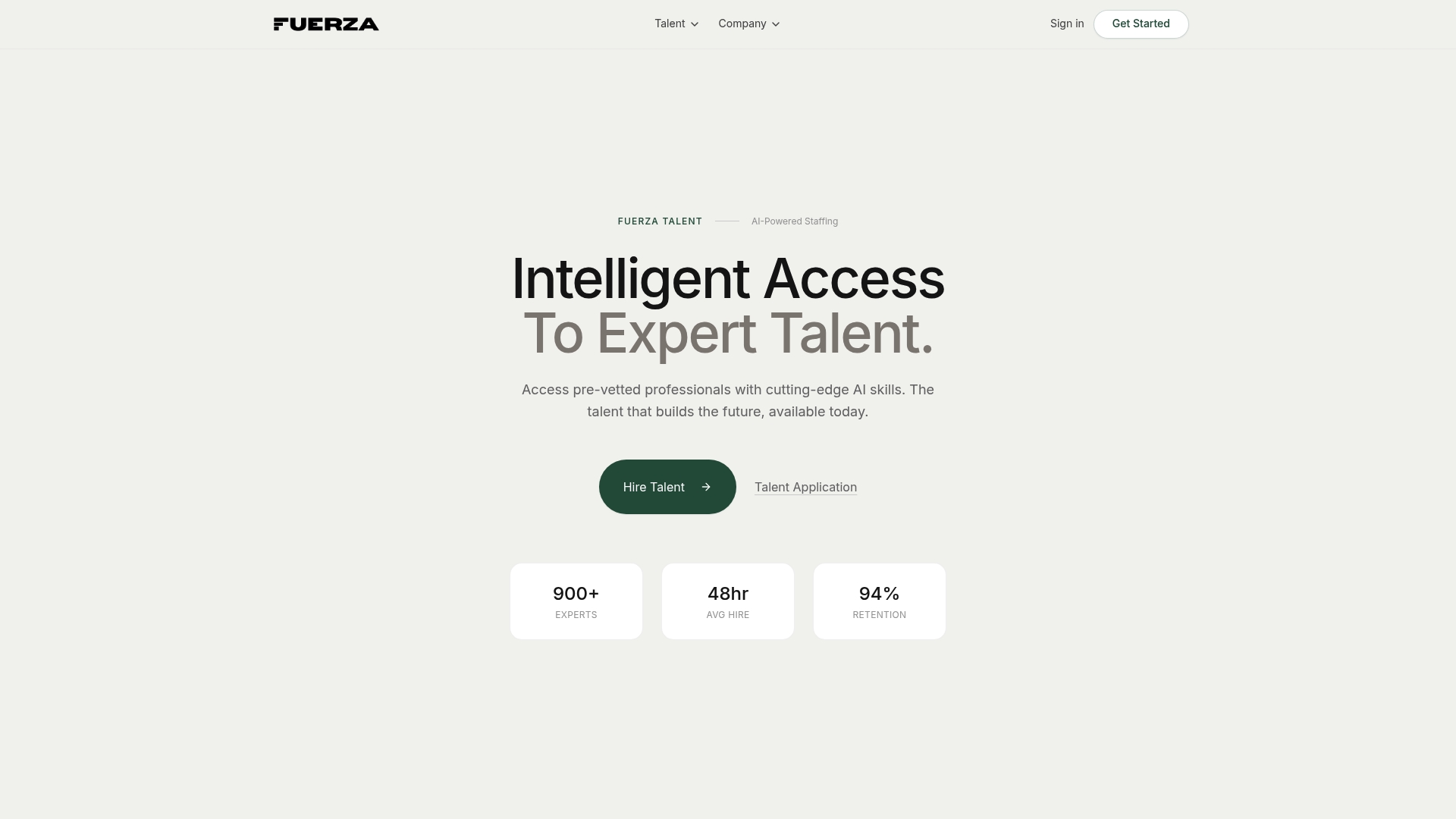
Our AI hiring solutions combine pre-vetted talent pools with intelligent matching algorithms that reduce time-to-hire while improving candidate quality. Whether you need full-time engineers or contract specialists, our platform adapts to your specific requirements.
Access pre-vetted AI and tech talent ready to contribute immediately. Our screening process ensures candidates possess verified skills and demonstrated expertise before reaching your pipeline. Flexible AI-powered staffing services support your mix of permanent and project-based hiring with seamless workflow integration.
Fuerza’s nearshore and onshore focus delivers the talent proximity and cultural alignment US tech teams need. Our Miami headquarters and strategic partnerships ensure responsive support throughout your hiring journey.
FAQ
What is the primary benefit of using AI in tech hiring?
AI primarily accelerates hiring workflows while simultaneously improving candidate quality and reducing unconscious bias. This combination delivers faster fills without sacrificing the skill match and cultural fit that drive long-term retention. The technology supports building more diverse, capable tech teams efficiently by automating time-consuming screening tasks and applying consistent evaluation criteria.
How does AI reduce bias in hiring?
AI reduces bias through blind screening that removes demographic identifiers and algorithmic evaluation focused purely on skills and qualifications. These systems apply consistent criteria to all candidates, minimizing the influence of affinity bias and stereotypes that affect human decisions. Regular algorithm audits ensure fairness and catch any patterns that disadvantage specific groups.
Can AI hiring tools be used for both full-time and contract hiring?
Yes, modern AI hiring platforms tailor their sourcing strategies and matching algorithms for both employment types. They maintain distinct candidate pools and apply different evaluation priorities based on whether you need long-term cultural fit or immediate skill availability. The best tools offer flexible workflows that adapt to each hiring context without requiring separate systems.
What should hiring managers consider when choosing AI hiring software?
Prioritize platforms that address your most pressing challenges, whether that’s time-to-hire, candidate quality, diversity goals, or staffing flexibility. Evaluate integration capabilities with your existing HR systems to ensure smooth data flow and workflow automation. Match tool strengths to your hiring volume, mix of full-time versus contract needs, and specific technical skill requirements.
Recommended
Fuerza — Hire Pre-Vetted AI & Tech Talent | AI-Powered Staffing
Fuerza — Hire Pre-Vetted AI & Tech Talent | AI-Powered Staffing
Fuerza — Hire Pre-Vetted AI & Tech Talent | AI-Powered Staffing
Fuerza — Hire Pre-Vetted AI & Tech Talent | AI-Powered Staffing
Tailor Resume Using AI for 50% More Interviews in 2026 | MatchJD